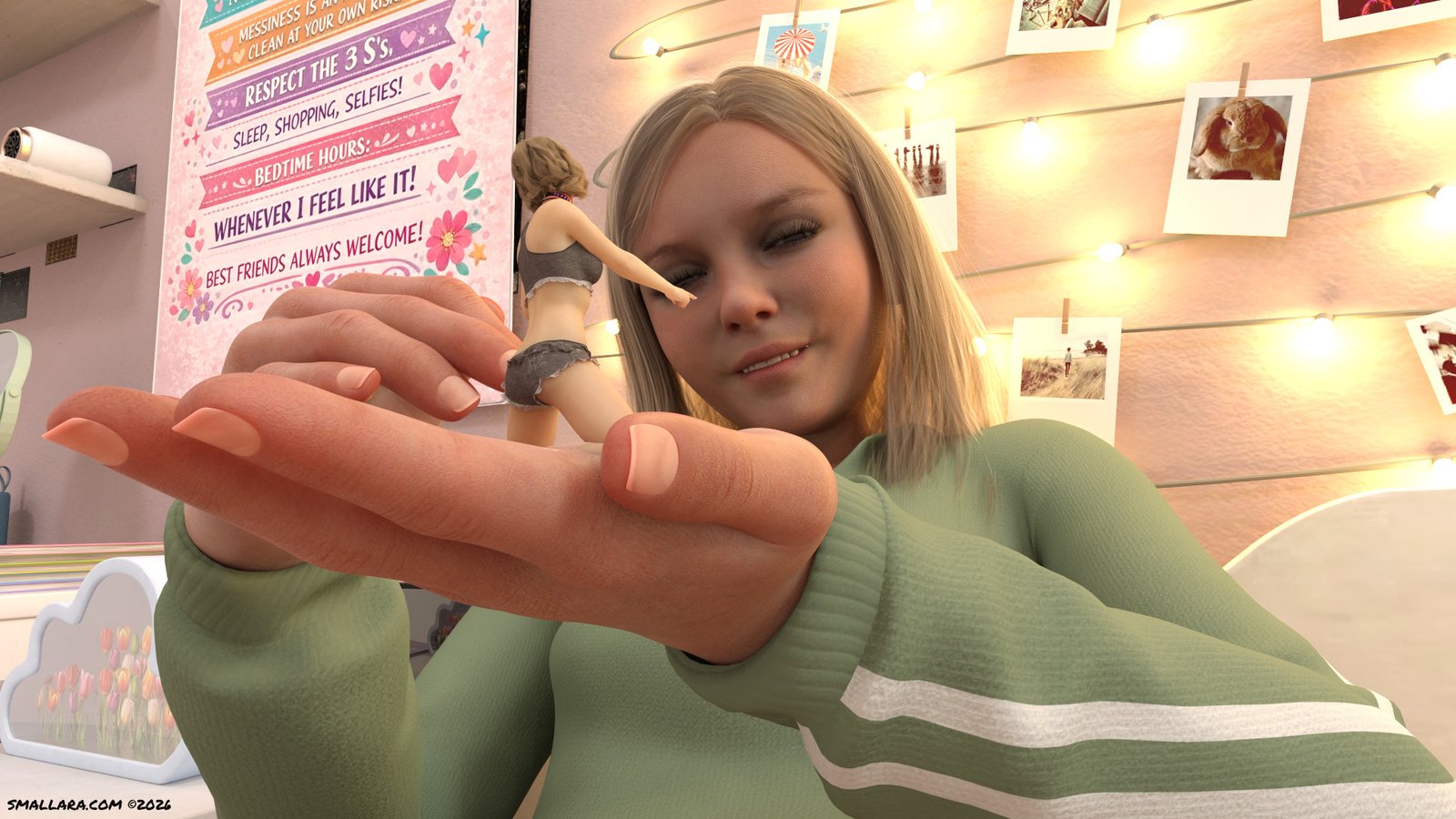

Cindy felt the cold truth of reality fall over her.
It did not arrive like panic. Panic was hot. Panic moved quickly. Panic gave the body something to do, even if that something was useless. This was different. This was slower, heavier, and much more difficult to fight. It settled over her with the calm finality of a door closing somewhere deep inside the house.
Madison intended to keep her forever.
Not for now. Not until Cindy came to her senses. Not until some mistake was corrected, some doctor was consulted, some legal avenue opened, or some adult finally stepped in and forced the world to remember who Cindy Wessen had been.
Forever.
Madison intended to raise her as her Little for the rest of Cindy’s life, and she intended to do it under the teachings Cindy herself had given her. That was the part that made the truth feel almost surgical. Madison was not improvising cruelty. She was not lashing out. She was not simply a child drunk on new power, though Cindy could not deny there was some of that in her too. Madison believed she was following a structure.
Cindy’s structure.
Cindy looked up at her daughter and felt the full shape of it.
Madison was relaxed beneath her, lying across the bed with Cindy on her chest, speaking with the intimate certainty of someone who had mistaken captivity for closeness. Her face looked soft in the bedroom light. Young. Loving. Familiar. Cindy could still see traces of the child Madison had been: the girl who wanted praise after dance recitals, the girl who came into the kitchen to complain about homework, the girl who used to curl beside Cindy on the couch during movies and lean against her without thinking.
That girl was still here.
That was the cruelty.
Madison was still Madison. She still loved Cindy. She still wanted Cindy near her. She still wanted to be good for her mother in some strange, inverted way.
And because of Cindy’s own teachings, Madison had no reason to believe that anything she was doing was wrong.
Even when Cindy tried to tell her.
Even when Cindy found the courage, humility, and desperation to say that her own doctrine had failed to account for this, Madison heard only a test. A Little’s argument. A resistance phase. A proof that she needed to remain strong.
Cindy ran through arguments in her mind.
She had always been good at that. Better than good. Argument had once been one of her favorite tools. She could frame a premise, isolate a weakness, shift an audience, turn a moral objection into a practical concern, then turn the practical concern into a policy necessity. She could see several moves ahead in conversation. She knew how to speak so people felt led rather than cornered, how to make a conclusion feel like something they had reached themselves.
But now every version of the argument ended in the same place.
If she said she was human, Madison would say Littles often clung to false identity.
If she said she had memories, Madison would say memory did not override biological reality.
If she said she was Madison’s mother, Madison would say she knew, and that was why she was taking such care with her.
If she said the teachings were wrong, Madison would say Cindy was testing her.
If she said she had changed her mind, Madison would say a Guardian could not let a Little’s fear rewrite truth.
Every path brought Cindy back here.
On Madison’s chest.
Under Madison’s hand.
Inside Madison’s room.
Living as Madison’s Little because Cindy had taught Madison a perfect circle and then fallen into the center of it.
Cindy had trapped herself.
The thought was so clean and awful that for a moment she could not breathe around it.
“Try not to worry so much about McKenzie, Mom,” Madison said.
Cindy blinked and looked up.
Madison’s voice had softened again, moving on as if the previous conversation had not left Cindy staring over the edge of her own future. Madison’s fingers rested near Cindy’s back, close enough that Cindy could feel the warmth radiating from them.
“I know you want to mend fences,” Madison continued. “And I get it. I really do. But if you push too hard, McKenzie will just dig in.”
Cindy’s mouth tightened.
Madison was giving her advice now. Not in the way daughters sometimes advised mothers, with hesitance or irritation or the half embarrassed confidence of a teenager who had recently discovered she had opinions. Madison spoke like a Guardian guiding an emotionally unstable Little through social adjustment.
“You need to let it happen,” Madison said. “Focus on yourself. Focus on being the best version of Madison’s Little that you can be. That’s what you can control right now.”
Then Madison gave her several gentle little pets.
Cindy’s body betrayed her immediately.
The strokes moved down her back with unhurried ease. Madison did not have to search for the right pressure anymore. She knew it. Her finger traveled from Cindy’s shoulders to the small of her back in a slow path that released tension almost as soon as it touched. Cindy felt her muscles loosen one by one, felt her posture soften, felt her breath settle into Madison’s rhythm beneath her.
Her mind recoiled.
Her body relaxed.
The split between the two was becoming familiar, and familiarity made it worse.
Cindy knew what had happened over the past months. She could name it now, though naming it gave her no control over it. Her smaller body had become sensitized to Madison’s touch. The little pets. The warmth of Madison’s hands. Being carried, cradled, held against Madison’s chest, laid across Madison’s lap or shoulder or palm. The private moments between life and tasks, when Madison was not performing for her friends or enforcing doctrine, but simply doting on Cindy as her Little.
Those moments had done something.
Cindy had wanted to believe they were incidental. Biological responses. Reflex. Conditioning without meaning. She had told herself that relaxing under Madison’s touch proved nothing except that Smallara had damaged her body and that Madison had learned how to exploit it.
But the truth was more frightening than that.
There had been bonding.
Not the sentimental kind Madison imagined. Not the pretty version from Guardian training language, where a resistant Little slowly learns trust through structure and care. Cindy would not grant the world that framing.
But something had formed.
Her body knew Madison.
It knew the scent of her skin and shampoo. It knew the warmth of her palm. It knew the way Madison’s voice vibrated through her when she was held close. It knew the difference between Madison’s careless hand, Madison’s amused hand, Madison’s correcting hand, and Madison’s comforting hand. It knew the rise and fall of Madison’s breathing beneath her, the way her fingers shielded against cold, the angle of her thumb when she was being protective, the weight of Madison’s gaze when Cindy had done something right or wrong.
Her body knew, and her body answered.
Cindy used to be able to say, without hesitation, that she was not Madison’s Little.
She could say it loudly. Proudly. With the conviction of a woman stating a fact other people had failed to grasp.
Now, every time she said it, something inside her heard the lie.
Not all of her.
Never all of her.
The woman she had been still rose in outrage. Cindy Wessen still existed. Cindy Wessen still remembered being tall, adult, married, powerful, polished, and human. Cindy Wessen still knew that Madison was her daughter and that daughters should not own mothers. Cindy Wessen still hated the world that had taken her body and handed the remains to a child.
But some other part of her, lower and quieter and more physical, did not care about the argument.
That part knew Madison as the center.
Every little pet taught it. Every time Madison laid her across her body and Cindy softened into the warmth, it learned again. Every time Madison fed her, bathed her, moved her, corrected her, praised her, or placed her somewhere safe, the lesson deepened. Her body drank in Madison’s touch. Her muscles responded. Her breathing eased. Her fear lowered when Madison’s hand enclosed her gently.
She hated that she was comforted.
She hated that comfort was becoming evidence.
As much as Cindy did not want it to be so, she could feel parts of herself beginning to whisper that being Madison’s Little was not always unbearable.
That was the most treacherous thought of all.
Not good. But not always unbearable.
There were warm moments. Quiet moments. Moments like this, where Madison’s bedroom held the rest of the world away and Madison’s hand moved over her with real tenderness. Moments when Cindy’s body sank against her daughter and felt, despite everything, safe.
Safe.
Cindy almost shuddered at the word.
She could still say no. She could still think for herself. She could still reject Madison’s conclusions, resent Madison’s authority, despise the titles, the pellets, the habitat, the rules, the tasks, the humiliating routines of Little life.
But Madison’s words were carrying more weight than they used to.
That was undeniable now.
When Madison told her to relax, some part of her tried. When Madison praised her, some part of her warmed before shame could crush it. When Madison said she would take care of her, some part of Cindy believed her. Not trusted her judgment, not accepted her ideology, but believed that Madison meant it.
And when Madison explained what Cindy could control, some broken, exhausted part of Cindy listened.
Focus on being the best version of Madison’s Little.
The phrase should have been absurd. Offensive. Unthinkable.
Instead, Cindy found herself turning it over in her mind.
What could she control?
Her tone. Sometimes.
Her compliance. Sometimes.
Whether Madison grew frustrated or pleased. Whether the day became harder or easier. Whether she saw Greg. Whether she earned clothes. Whether she was trusted enough to leave the habitat more often. Whether Madison’s hand came down in correction or comfort.
Cindy shuddered.
Madison felt it and gave another gentle stroke. “It’s okay.”
No, Cindy thought.
No, it is not.
But her body settled again beneath the touch.
Cindy stared across Madison’s room from the rise of Madison’s chest. The habitat sat where Madison had placed it, lit faintly from within, waiting for her like a house inside a room inside a world that no longer belonged to her. The water bottle was attached. The bowl was clean. Her bedding was arranged. Her things, if they could be called hers, were all scaled, contained, washable, replaceable.
She thought of living her life working for Madison.
A hundred years, Ava had said.
A hundred-plus years with an ungrateful Little.
Cindy had tried not to think about the number. It was too large. Too grotesque. Human beings were not meant to imagine themselves diminished across that much time. A week of humiliation could be endured. A month could be survived. Even years, perhaps, if one believed in reversal or rescue or appeal.
But forever under Madison’s thumb?
Forever learning the shape of her daughter’s moods?
Forever waking in Madison’s room, eating what Madison provided, doing what Madison assigned, adapting to Madison’s friends, Madison’s schedule, Madison’s future? Dance competitions. School years. High school. College. Akari. Ava, maybe, if whatever flickered there became something real. Moves. New rooms. New routines. New versions of the same dependency.
Cindy knew her daughter.
Madison could be loving.
Madison could be generous.
Madison could be funny, warm, and startlingly tender when she wanted to be. There would be good times. Cindy could see that clearly now, and she almost hated the good times more than the bad ones because they complicated the rage. There would be evenings like this when Madison’s hand was soft and her voice gentle. There would be praise, warmth, maybe little privileges that Cindy’s body would learn to crave. There would be moments when Cindy would feel Madison’s affection and, for a terrifying second, forget to be only angry.
But Madison could also be controlling.
Conceited.
Bossy when she wanted to be.
She could decide a thing and build the room around it before anyone else had agreed. She could turn desire into rule, rule into routine, and routine into something that seemed inevitable. She could dismiss an objection with a smile if she believed she knew better. And now, with Cindy trapped as her Little, Madison’s teenage certainty had become law at a scale Cindy could not physically resist.
The reality was becoming clear.
Cindy would not merely live near Madison.
She would live for her.
She would make Madison’s life easier. That would be the shape of her usefulness. Homework. Recipes. Cleaning. Laundry. Companionship. Practice. Emotional proof that Madison was doing well. A tiny mother folded into the machinery of her daughter’s adolescence, then young adulthood, then whatever life Madison built afterward.
And if Cindy behaved, Madison would love her for it.
Madison’s fingers continued their gentle path down her back.
Cindy closed her eyes despite herself.
Somewhere below the warmth, below the comfort, below the terrible softening of her body, the old Cindy remained awake and furious.
But now she was no longer alone inside herself.
There was another part of her too.
Smaller.
Quieter.
Learning.
And that part, the part that knew Madison’s touch and relaxed beneath it, did not care whether Cindy Wessen approved of the lesson.
It only knew that Madison was warm.
Madison was safe.
Madison was everything.
Cindy opened her eyes again, afraid of what might happen if she let them stay closed too long.
Madison smiled down at her, mistaking the movement for calm.
“That’s better,” Madison whispered.
Cindy said nothing.
She could not trust herself to speak.

0) Early one?
1) “Madison intended to keep her forever.” That is how Guardianship works
2) “Madison was not improvising cruelty. She was not lashing out. She was not simply a child drunk on new power, though Cindy could not deny there was some of that in her too. Madison believed she was following a structure.” She’s definitely having some fun with the authority.
3) “Madison was still Madison. She still loved Cindy. She still wanted Cindy near her. She still wanted to be good for her mother in some strange, inverted way” just like Cindy taught her
4) “She had always been good at that. Better than good. Argument had once been one of her favourite tools. She could frame a premise, isolate a weakness, shift an audience, turn a moral objection into a practical concern, then turn the practical concern into a policy necessity. She could see several moves ahead in conversation. She knew how to speak so people felt led rather than cornered, how to make a conclusion feel like something they had reached themselves.” Yep, but all that isn’t worth shit if the people just decide you voice isn’t worth listening to.
5) “Living as Madison’s Little because Cindy had taught Madison a perfect circle and then fallen into the centre of it. Cindy had trapped herself.” if nothing else, she made a good trap
6) “Try not to worry so much about McKenzie, Mom, I know you want to mend fences, and I get it. I really do. But if you push too hard, McKenzie will just dig in.” Actually solid advice from Madison.
7) “Focus on yourself. Focus on being the best version of Madison’s Little that you can be. That’s what you can control right now.” Damn. even with her kindness she’s got selfish undertones
8) “She could name it now, though naming it gave her no control over it. Her smaller body had become sensitized to Madison’s touch. The little pets. The warmth of Madison’s hands. Being carried, cradled, held against Madison’s chest, laid across Madison’s lap or shoulder or palm. The private moments between life and tasks,” That is how the Little bond forms
9) “when Madison was not performing for her friends or enforcing doctrine, but simply doting on Cindy as her Little.” I like that they have these moments.
10) “She had told herself that relaxing under Madison’s touch proved nothing except that Smallara had damaged her body and that Madison had learned how to exploit it.” Well, from a certain perspective, that’s exactly what happened.
11) “Her body knew Madison.” Her body grew Madison
12) “It knew the difference between Madison’s careless hand, Madison’s amused hand, Madison’s correcting hand, and Madison’s comforting hand” That would be the kind of thing she’s getting a crash course in.
13) “Now, every time she said it, something inside her heard the lie. Not all of her. Never all of her.” She is improving, just not as quickly as Madison hopes
14) “Cindy Wessen still hated the world that had taken her body and handed the remains to a child.” than why did she encourage it to?
15) “That was the most treacherous thought of all. Not good. But not always unbearable” she’s breaking or at least starting to crack
16) “When Madison said she would take care of her, some part of Cindy believed her. Not trusted her judgment, not accepted her ideology, but believed that Madison meant it.” bitch the majority of that is YOUR ideology you’re rejecting.
17) “Her things, if they could be called hers, were all scaled, contained, washable, replaceable.” They aren’t hers; they’re Madison’s, a point Madison would be sure to remind Cindy.
18) “She thought of living her life working for Madison. A hundred years, Ava had said. A hundred-plus years with an ungrateful Little.” At the end of the day, gratitude is a reward, not a right. If Madison wants a grateful Little, she needs to earn one.
19) “Ava, maybe, if whatever flickered there became something real” OK, so there’s definitely something
20) “New rooms. New routines. New versions of the same dependency.” I’m kinda curious how Cindy would fare if Madison had children. Would they call her Granny? Would she need to address them with titles? Would Cindy eventually end up serving them, doing their homework too?
21) “She could dismiss an objection with a smile if she believed she knew better” That’s not special; most people can do that.
22) “And that part, the part that knew Madison’s touch and relaxed beneath it, did not care whether Cindy Wessen approved of the lesson” losing bodily autonomy is always hard,
1) That is true. that is how it works.
2) I agree that there is some level of fun but i dont think its the focus or the point.
3) yup, shes still her daughter
4) That is also a cindy life lesson.
5) Cindy master trap maker extrodinaire
6) Madison is good with mckenzie advice. She is a McKenzie expert. Its a narrow not useful to most people skill. But highly useful within the wessen family. Just like McKenzie being a madison whisperer.
7) Its good advice though. I mean its not like she can change back form being a little. So there is nothing that can be done other then focus on excelling in your current life.
8) Its how it starts for sure. Relaxing into madison. Enjoying aspects of being madisons little. Then soon its well this isn’t so bad. THen youre fully madisons little.
9) I did want to show there were other parts of what happens and not just Madison lording over cindy 24/7. As could kind of seem like that.
10) True, although i wouldnt say smallara damaged her body so much as she became a little.
11) also true
12) Thatis not the kind of knowledge I would want any level of expertise in. Maybe the Ellie variant.
13) Agreed. Madison wanted her full acceptance day one.
14) because it never was supposed to affect her you see. When things are beneath cindy that aren’t fair its fine. The moment they somehow affect her then it becomes an issue.
15) the slightest seam starting to form.
16) Cindy not understanding that her own idealogy is affecting her is the most cindy on brand thing ever.
17) Everything in her life is provided by Madison. She is Cindy; sun and moon, the earth beneath ehr feet, the air that fills her lungs, even in death she is the soil covering her body, the heaven or hell she rises or lowers into. Madison is inevitable. All pathways in life lead to madison.
18) I mean gratitude may be a reward but so is time outside the habitat, so is time not spent cleaning a toilet, so is if you want the not shitty pellet flavors. I mean that works both ways. So its always wise ot realize what digging in ones heels will cost them.
19) I mean theres not nothing but who knows what will bloom.
20) Well they would be so disconnected they would probably just view her as a little. As even if madison said that used to be my mom. They wouldnt have any context for a little being not a little. It would be something they only heard about may not even ever have actually seen.
21) fair but maybe not with the same fair
22) that happesn in real life though too. If something feels good it just feels good.
20) that may be so regarding Cindy, but Madison and McKenzie both will most likely hold Greg out as their father and explain to their children the situation. If that is the case then they would have to explain Cindy as well.
They would certainly explain but it doesnt mean their future children or what have you woudl listen or connect to it or really believe it in the same way they would. As they wouldn’t necessarily have those same touchstones.
They could think of it like telling your child this puppy is your brother. The child wouldnt necessarily make that connection or believe it no matter hwo many times you told them.
“She had always been good at that. Better than good. Argument had once been one of her favorite tools. She could frame a premise, isolate a weakness, shift an audience, turn a moral objection into a practical concern, then turn the practical concern into a policy necessity. She could see several moves ahead in conversation. She knew how to speak so people felt led rather than cornered, how to make a conclusion feel like something they had reached themselves.”
There was a guy with a mustache in Germany who was also really good at that.
“There would be good times. Cindy could see that clearly now, and she almost hated the good times more than the bad ones because they complicated the rage. There would be evenings like this when Madison’s hand was soft and her voice gentle. There would be praise, warmth, maybe little privileges that Cindy’s body would learn to crave. There would be moments when Cindy would feel Madison’s affection and, for a terrifying second, forget to be only angry.”
This brings me back to the same question I raised yesterday.
In yesterday’s chapter, Madison mentioned that Cindy had taught her that human food could be given as a treat if the guardian thought it was safe. During all these months, at moments like this, did Madison never think Cindy deserved a treat? What would Cindy have had to do for Madison to think she earn this privilege?
Could be given is the key there. It’s like how you can give a dog human food. However, some people don’t feed their dog human food at all.
Being she is provided food that is proper to her survival and they do have little based treats as well. A person doesn’t have to provide human food.
Bruh if I went to a friend’s house and they fed one dog people food and refused to give the other one any, despite not having specific dietary restrictions or behavioral issues, I would question whether they thought less of that dog. Especially if they had to rely on that dog to cook the chicken in the first place. Giving Greg chicken but not her is straight up mean and she knows it. If she doesn’t, she is dumb as hell
I don’t care how much she tries to convince herself, she has been straight revelling in her mom’s humiliation since she shrunk. She has not acted at all like someone who loved her mom or even really cared about her. Not giving her any chicken when she was too dumb to be able to cook it herself is some shit. Giving some to Greg right in front of her was either purposefully cruel or incredibly daft.
Kenzie straight up not saying anything, even after finding out Cindy basically cooked it, shows who she really is. She isn’t any better. She just tells herself she is, but at the end of the day, she is totally fine with slavery in a house she controls.
At this point, it wouldn’t even do any good to give Cindy the chicken anyway.
After months of eating nothing but pellets, her body no longer accepts human food. Cindy is doomed to eat only pellets for the rest of her life. And this could have been avoided if Madison and McKenzie had shown some compassion.
According to Madison, Cindy herself never said that littles couldn’t eat human food. They can—as a treat. If their guardian had decided it was safe—and for some reason, at no point throughout all these months did Madison ever think that Cindy (her own mother, whom she claims to love and honor so much) deserved this “privilege”—and McKenzie, who says she disagrees with Cindy’s ideology, never intervened.
That said, I think it’s safe to say that Madison is just as cruel as Cindy (like mother, like daughter). She tells Cindy that she finds her methods cruel and that she’s only doing this to honor her, but she never seems to be acting out of resignation. In fact, she seems to love seeing them suffer and be humiliated. Take, for example, her attitude in Season 1, Episode 33:
https://smallara.com/2024/04/17/madisons-world-redux-episode-33/
Notice how she is mocking their situation the whole time:
Look at her behavior in Season 2, Episode 1:
https://smallara.com/2024/09/02/madisons-world-redux-season-two-episode-one/
She continued to act in the same cruel and sadistic way, and she knew that if they went too long without eating human food, their bodies would start to reject it, and they would have to spend the rest of their lives eating only pellets. And yet, she still did that to Cindy:
At this point, it wouldn’t even do any good to give Cindy the chicken anyway.
After months of eating nothing but pellets, her body no longer accepts human food. Cindy is doomed to eat only pellets for the rest of her life. And this could have been avoided if Madison and McKenzie had shown some compassion.
According to Madison, Cindy herself never said that littles couldn’t eat human food. They can—as a treat. If their guardian had decided it was safe—and for some reason, at no point throughout all these months did Madison ever think that Cindy (her own mother, whom she claims to love and honor so much) deserved this “privilege”—and McKenzie, who says she disagrees with Cindy’s ideology, never intervened.
That said, I think it’s safe to say that Madison is just as cruel as Cindy (like mother, like daughter). She tells Cindy that she finds her methods cruel and that she’s only doing this to honor her, but she never seems to be acting out of resignation. In fact, she seems to love seeing them suffer and be humiliated. Take, for example, her attitude in Season 1, Episode 33:
https://smallara.com/2024/04/17/madisons-world-redux-episode-33/
Notice how she is mocking their situation the whole time:
Look at her behavior in Season 2, Episode 1:
https://smallara.com/2024/09/02/madisons-world-redux-season-two-episode-one/
She continued to act in the same cruel and sadistic way, and she knew that if they went too long without eating human food, their bodies would start to reject it, and they would have to spend the rest of their lives eating only pellets. And yet, she still did that to Cindy:
At this point, it wouldn’t even do any good to give Cindy the chicken anyway.
After months of eating nothing but pellets, her body no longer accepts human food. Cindy is doomed to eat only pellets for the rest of her life. And this could have been revented if Madison or McKenzie had shown some compassion, mercy, and empathy toward Cindy.
According to Madison, Cindy herself never said that littles couldn’t eat human food. They can—as a treat. If their guardian had decided it was safe—and for some reason, at no point throughout all these months did Madison ever think that Cindy (her own mother, whom she claims to love and honor so much) deserved this “privilege”—and McKenzie, who says she disagrees with Cindy’s ideology, never intervened.
That said, I think it’s safe to say that Madison is just as cruel as Cindy. After all, she’s her daughter. Like mother, like daughter.
If she is fully aware that Cindy’s methods are so cruel, why bother to make them even worse?
When she humiliates Cindy, she shows no resignation or remorse. She doesn’t seem to be doing this reluctantly. She seems to take pleasure in doing so. She acts with malice and wickedness.
. Take, for example, her attitude in Season 1, Episode 33:
https://smallara.com/2024/04/17/madisons-world-redux-episode-33/
Notice how she is mocking their situation the whole time:
Look at her behavior in Season 2, Episode 1:
https://smallara.com/2024/09/02/madisons-world-redux-season-two-episode-one/
She continued to act in the same cruel and sadistic way, and she knew that if they went too long without eating human food, their bodies would start to reject it, and they would have to spend the rest of their lives eating only pellets. And yet, she still did that to Cindy:
McKenzie is a terrible daughter, as well. She knows that Cindy’s methods are cruel. She isn’t committed to honoring Cindy’s teachings. She knows that Cindy isn’t acting when she begs Madison to stop treating her that way.
She could show mercy toward Cindy and try to do the right thing, even though Cindy is a terrible person. She’s still her mother. If she still sees some humanity in Greg, she certainly sees it in Cindy, too.
She has already shown concern for Cindy by telling her not to let Madison be so hard on her. But what does she expect Cindy to do about it? Wouldn’t it make more sense to ask Madison not to be so hard on Cindy?
But she harbors so much resentment toward Cindy that she does nothing to stop Madison from this madness. And that makes her an accomplice.
At this point, it wouldn’t even do any good to give Cindy the chicken anyway.
After months of eating nothing but pellets, her body no longer accepts human food. Cindy is doomed to eat only pellets for the rest of her life. And this could have been prevented if Madison or McKenzie had shown some compassion, mercy, and empathy toward Cindy.
According to Madison, Cindy herself never said that littles couldn’t eat human food. They can—as a treat. If their guardian had decided it was safe—and for some reason, at no point throughout all these months did Madison ever think that Cindy (her own mother, whom she claims to love and honor so much) deserved this “privilege”—and McKenzie, who says she disagrees with Cindy’s ideology, never intervened.
That said, I think it’s safe to say that Madison is just as cruel as Cindy. After all, she’s her daughter. Like mother, like daughter.
If she is fully aware that Cindy’s methods are so cruel, why bother to make them even worse? Why deprive her of people food for the rest of her life?
When she humiliates Cindy, she shows no resignation or remorse. She doesn’t seem to be doing this reluctantly. She seems to take pleasure in doing so. She acts with malice and wickedness.
McKenzie is a terrible daughter, as well. She knows that Cindy’s methods are cruel. She disagrees with these beliefs. She isn’t committed to honoring Cindy’s teachings. She knows that Cindy isn’t acting when she begs Madison to stop treating her that way.
She could show mercy toward Cindy and try to do the right thing, even though Cindy is a terrible person. She’s still her mother. If she still sees some humanity in Greg, she certainly sees it in Cindy, too. She has already shown concern for Cindy by asking her not to let Madison be so hard on her. But what does she expect Cindy to do about it? Wouldn’t it make more sense to ask Madison not to be so hard on Cindy?
But she harbors so much resentment toward Cindy that she does nothing to stop Madison from this madness. And that makes her an accomplice.
Cindy’s teaching continues to bite her in the ass.
At this point I think Cindy has a few options.
1) Acquiesce, and become the Little that Madison wants her to be.
2) Tell Madison that she cannot live this way and then take her own life (hopefully Madison would intercede and realize that Cindy’s teachings are too much).
3) Check out mentally, become or act catatonic (acting catatonic would be hard to pull off).
4) Break the fourth wall of the story and use her powers of persuasion to convince Asuka to give her a break. 🤪
1) certainly possible.
2) Will never happen because I wouldn’t write it. the only suicide based situaiton is already in the series and i don’t intend to add another. I would if anything just furhter discuss the one already present.
3) That is a possibility but the reader wouldnt really see much of it. As it would be written as just last the result and then story would just end. As i wouldnt feel the need to write about it further. As thats more a final ending.
4) That could happen but cindy and her family were created to tell a specific story.
Is this the Turing point? Is this when Cindy accepts, for madsion ❤️
A) I enjoy that Cindy’s body is bonded and takes Control of Cindy so she likes being a little. lol
B) If Cindy was smart, she would ask to Cosplay as a Asian little so she can test her new style lol
C) I would so enjoy Ava moving in with Madison and they are a couple and Cindy bonds with her and she enjoys being with Ava more because she treats her with more kindness than Madison. Oh the drama with that lol