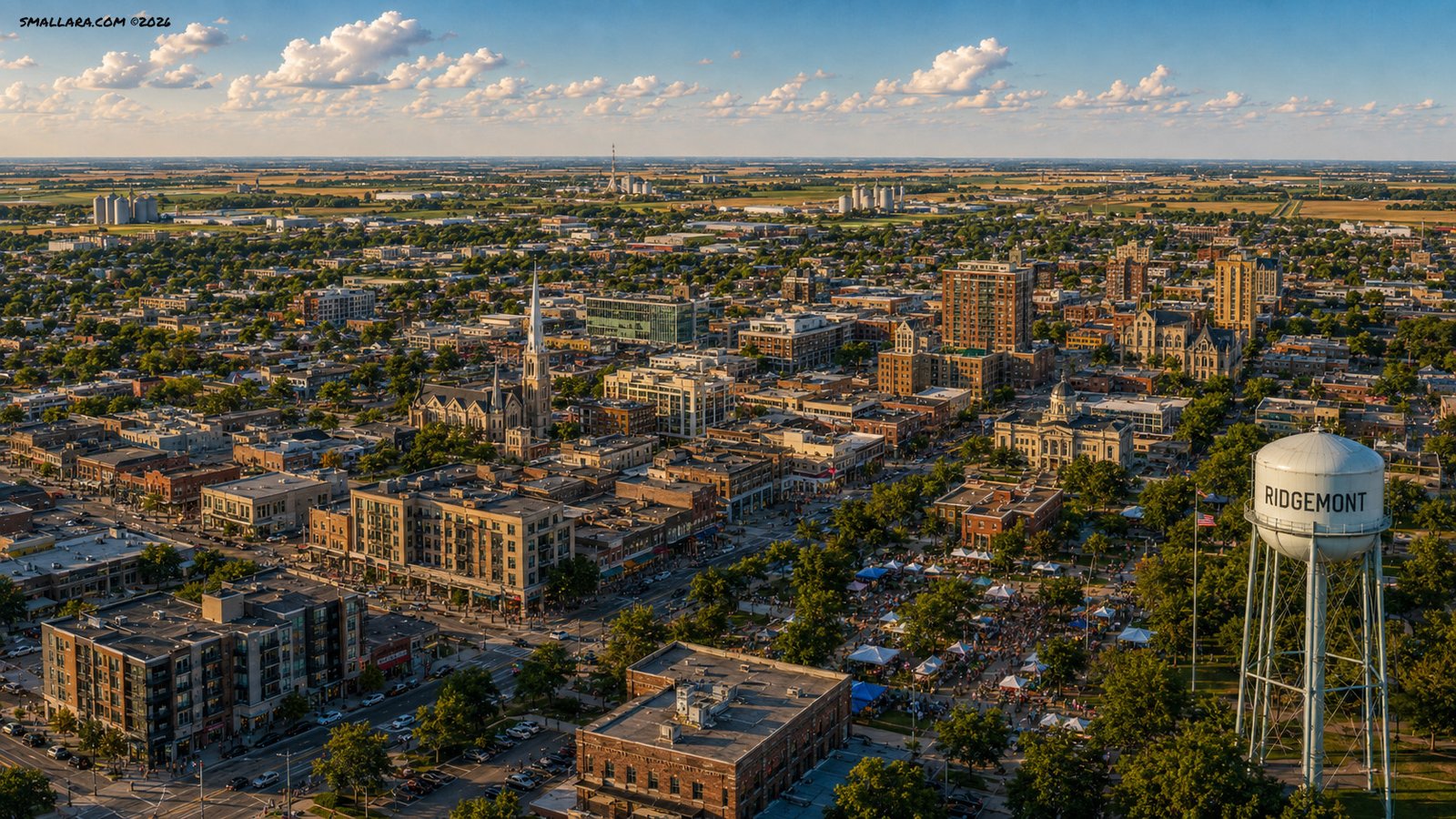

Ridgemont, Minnesota 2017
The flat, rolling farmland of central Minnesota stretched for miles in every direction around Ridgemont, an enormous quilt of cornfields, soybean rows, pasture, and freshly turned black earth broken only by windbreaks, narrow county roads, and the occasional silver grain elevator rising above the horizon. By midsummer, the corn rose green beneath an impossibly broad blue sky, the countryside seemed almost endless. Farmhouses sat back from the roads behind cottonwoods and weathered barns, their long gravel driveways disappearing between fields that had belonged to some families for generations. Tractors moved slowly through the distance like bright colored insects. Irrigation equipment glittered beneath the sun. On certain mornings the air carried the rich, unmistakable smell of damp soil and cut hay all the way toward the city limits, and after harvest the horizon opened wider still, exposing dark furrows beneath skies where flocks of geese gathered before turning south.
Ridgemont rose from the middle of all that agricultural country with the comfortable confidence of a city that had grown larger without ever quite forgetting what had been there first. With a population hovering around one hundred thousand, it was big enough to have traffic lights that backed up during the evening commute, Several high schools whose rivalries divided households, sprawling shopping centers, apartment complexes, hospitals, breweries, coffee shops, and subdivisions that seemed to push another few blocks into former farmland every year. Yet it remained small enough that someone could drive fifteen minutes from downtown and find themselves behind a combine crawling along a two lane road. Grain trucks still rolled through town during harvest season. Mud spattered pickups shared parking lots with spotless SUVs and commuter sedans. People complained about construction on Ridgemont Avenue, knew which gas station had the cheapest coffee before six in the morning, and routinely described places according to what had occupied the lot ten or twenty years earlier.
The city’s relationship with the farms surrounding it was most visible during the warmer months, when farmers markets appeared almost everywhere there was enough pavement and foot traffic to support one. On Saturday mornings, the broad plaza beside the old municipal building filled with striped awnings and folding tables crowded with tomatoes, cucumbers, peppers, sweet corn, jars of honey, fresh bread, homemade jams, bundles of flowers, and cardboard flats of berries. Smaller markets appeared outside churches, neighborhood parks, and shopping centers throughout the week. Farmers backed pickups into temporary stalls before sunrise and lowered their tailgates beneath strings of handwritten signs advertising prices by the dozen, pound, or bushel. By nine, families wandered between the tables carrying canvas bags while children begged for cinnamon rolls or kettle corn, dogs strained happily against leashes, and vendors called greetings to customers they recognized from the previous Saturday.
That mixture of city and countryside shaped Ridgemont in quieter ways, too. The eastern side of town was older, its streets shaded by mature elms and maples arching over sidewalks cracked by decades of winter frost. There were brick houses with enclosed porches, small neighborhood groceries that had survived the arrival of the big chains, Catholic churches whose bells could still be heard several blocks away on Sunday mornings, and corner bars where Friday fish fries remained serious business. Downtown had undergone the familiar cycle of decline and rediscovery. Old brick storefronts that had once housed hardware stores and pharmacies now held cafés, boutiques, restaurants, law offices, and loft apartments with exposed beams and fashionable prices. The former Ridgemont Milling Company warehouse had become a brewery. The old train depot had been restored instead of demolished. Murals covered the sides of buildings that older residents could remember being blank.
Farther west, the city became newer and broader. Four lane roads passed subdivisions with landscaped entrances and names borrowed from whatever had been bulldozed to build them: Prairie Creek, Willow Run, Harvest Ridge. Shopping centers spread around enormous parking lots filled with familiar national chains, and newer schools stood behind athletic complexes whose stadium lights could be seen from miles outside town on autumn Friday nights. Beyond them came the newest houses, then construction equipment, then survey stakes driven into grass, and finally the farmland again. Ridgemont’s edge was never especially difficult to find. The city simply stopped. One moment there were sidewalks, streetlamps, drive-through restaurants, and carefully planted trees. A quarter mile later there might be nothing but corn running uninterrupted toward the horizon.
Winter transformed everything. Snow flattened distinctions between field and ditch until the countryside became a white plain beneath a pale gray sky, while Ridgemont retreated behind plowed streets, snowbanks, frosted windows, and the constant scrape of shovels against concrete. Temperatures could sink low enough to make exposed skin ache within minutes, and the wind coming across the open farmland found every gap in a coat. Cars idled in driveways beneath clouds of exhaust. Grocery stores became crowded whenever a serious storm appeared in the forecast. School closings were watched with almost ceremonial attention by children who understood perfectly well that six inches of snow alone meant little in Minnesota; what mattered was the wind, visibility, and whether the county plows could keep the roads open. Then, sometimes within a matter of weeks, spring arrived in a rush of melting snow, muddy lawns, overflowing drainage ditches, and residents emerging from their houses in shorts the moment the temperature climbed above fifty.
Through all of it, Ridgemont possessed the peculiar intimacy of a place caught somewhere between a large town and a small city. A hundred thousand people were enough to make anonymity possible, but never guaranteed. Someone’s mother taught at the high school. Someone’s cousin worked at the hospital. Someone from church knew someone’s manager. A teenager could spend an afternoon believing she had successfully disappeared into the crowd at Ridgemont Center Mall only to come home and discover that her mother already knew exactly who she had been there with. News traveled through school hallways, workplaces, neighborhood Facebook groups, hockey arenas, coffee counters, church foyers, and backyard conversations with astonishing efficiency. People could spend years insisting that Ridgemont had become too large while simultaneously asking a stranger’s last name and immediately discovering they knew an aunt, a teacher, a coworker, or somebody’s father.
It was not a picturesque little farming town, though outsiders occasionally mistook it for one when they saw the grain elevators on the horizon or stopped at one of the summer markets. Ridgemont had grown well beyond that. It had money and poverty, old neighborhoods and new developments, crowded schools and quiet cul-de-sacs, college students, factory workers, nurses, bankers, mechanics, farmers, teachers, and families who had arrived from places thousands of miles away. It had teenagers who complained there was nothing to do and adults who complained there was too much traffic. It had people desperate to leave and people who had left at eighteen only to return at thirty with children of their own.
And surrounding all of it, visible from nearly every road leading out of town, were the fields.
They remained the oldest boundary Ridgemont had. Golden in autumn, black and empty after harvest, buried beneath snow in January, brilliant green again by June, they changed with the seasons while the city slowly pushed outward into them. Another subdivision would appear. Another road would widen. Another farm would sell. Yet for the moment, Ridgemont still sat within that immense sweep of Minnesota farmland like an island of brick, asphalt, glass, porch lights, football fields, church steeples, water towers, and human lives surrounded by an ocean of green.
Note:
This is projected to be a long story. I’m trying a slightly different method with this one to better create the characters, history, and world building. It’s a way of writing I don’t normally do so its been fun yet challenging. Todays image features the visual representation of what the fictionalized city of Ridgemont, MN looks like.
The lore hounds will notice a few important details. The start of this story, 2017, is purposeful as it’s two years before Rachel Harbours, which is the first recorded U.S. case, looks like. This is intentional as I want to show and establish what life is like pre-Smallara in the United States, but that is actually a side benefit of something I decided to do once I established and outlined what I want this story to be and to explain.
I will say just so its not shocking to people as this unfolds is structured more like an actual story. Hence the prologue here, and as you will see, the build is appropriately paced
Since its labor day in the U.S. this one is posted a little early. I hope you all enjoy Becoming Grey and its characters.


0) I knew it! I knew you’d release the prologue the night before!!
1) “Ridgemont, Minnesota 2017” Damn, Pre-Smallara America. But it would be known and observed abroad. More to the point, Callie would be 15, Ryan 17, Hannah 12, Sally and Stuart would be 36, and Juna would be someone’s (I’m hoping Sally’s) pregnancy at most!
2) “Farmhouses sat back from the roads behind cottonwoods and weathered barns, their long gravel driveways disappearing between fields that had belonged to some families for generations. Tractors moved slowly through the distance like bright colored insects. Irrigation equipment glittered beneath the sun.” Damnit man, you’re making me homesick
3) “A teenager could spend an afternoon believing she had successfully disappeared into the crowd at Ridgemont Centre Mall only to come home and discover that her mother already knew exactly who she had been there with.” Oh, that’s the medium city way
4) “This is projected to be a long story. I’m trying a slightly different method with this one to better create the characters, history, and world-building.” I’ll make sure to pay close attention.
5) “The lore hounds will notice a few important details” Hey, that’s me
6) “It’s two years before Rachel Harbours, which is the first recorded U.S. case, looks like. This is intentional, as I want to show and establish what life is like pre-Smallara in the United States” That actually does sound like something worth exploring in this world. We know its history doesn’t match our world exactly, so it should be interesting.
0) Being labor day in the us it just made sense to post it early.
1) its known but its not something people think about on a regular basis. Like people around the world know urkaine and russia are at war but its not a constant thought.
2) nice, hten its mission accomplished. As im not a farmer so capturing that aspect while not being one is important.
3) very much so. You can only escape so far.
4) thank you
5) yup the houds of lore.
6) Yes, i hope its a journey people will find interesting.
Wow a story set pre-Smallara. We don’t have very much on this world before Smallara happens, so this will fill in some gaps, which is nice. Can’t wait to see how it plays out.
That’s the goal atleast to set some of what the world was like before smallara day in the us. Which is Jordan’s event.
The town description makes me miss my youth in the 80s lol.
That’s what i was going for an older 80s and 90s vibe intermixed with more modern times.
Sorry but is Monday when will Chapter 1
start ?
Chapter one is Tuesday
Like others here, I feel like you are describing the town I grew up in (although I was much further south).
I felt that as well, and I grew up out west.