
Chapter Eighteen
July 12, 2018
The first contraction woke Callie at four seventeen in the morning, although she did not know it was a contraction until considerably later. At the time, it was just another reason she was awake. She opened her eyes to the dim blue light collecting around the edges of her bedroom curtains and lay still beneath the sheet, annoyed at the existence of consciousness. Sleeping had become less of an activity over the last few weeks and more of a series of negotiations. Her back hurt if she stayed on one side too long. Her hip hurt if she stayed on the other. Juna had apparently decided that three in the morning was an excellent time to explore the structural integrity of Callie’s ribs, and getting up to pee had become so routine that she could make the trip to the bathroom without fully opening her eyes. This particular discomfort began low in her back and moved around her middle in a slow tightening that made her stomach feel strangely solid beneath the oversized T-shirt she had slept in. Callie frowned at the ceiling, waited for it to stop, and decided it was probably nothing. It stopped. See? Nothing. She closed her eyes again.
The digital clock on her nightstand read 4:29 when she opened them the second time. Callie stared at the numbers while the same pressure gathered through her lower back, not exactly painful yet but impossible to ignore. Pain suggested something sharper and more immediate. This was more like her body had developed a large invisible hand and was slowly squeezing everything below her ribs just to see what happened. She shifted beneath the sheet, irritated when that accomplished absolutely nothing, and rested one hand against the enormous curve of her stomach.
“You better not be doing anything in there,” she whispered.
Juna did not answer, which Callie considered suspicious. She breathed until the pressure faded again and reached for her phone. There were no messages because normal people were asleep at four thirty in the morning. Maggie had sent her a meme shortly after midnight, and Luke had apparently posted something in their group chat at one fourteen that consisted entirely of a photograph of a raccoon standing beside a garbage can with the caption ME MAKING GOOD DECISIONS. Callie had not opened it yet. She was supposed to see Maggie later that morning, assuming Maggie remembered that a pregnant person in July did not consider wandering around town in ninety-degree heat to be recreation. Their current plan involved air-conditioning, frozen drinks, and as little walking as humanly possible. Callie intended to keep that plan. She put the phone down, rearranged her pillow, and closed her eyes.
At 4:42, the tightening came back. That was when Callie started looking at the clock, although she refused to call what she was doing timing. Timing would imply concern, and concern would imply that something was happening. Instead, she simply happened to notice that the next one came at 4:55 and that another arrived a little after five. There was an important difference between deliberately timing contractions and repeatedly checking the exact time whenever her abdomen tightened. The second one was casual observation. Scientific curiosity, practically. By five twenty, though, she was no longer asleep. She rolled carefully out of bed, waited for the floor to stop feeling impossibly far away, and stood with one hand pressed into the small of her back. The house was quiet. A pale stripe of July sunlight had begun to show through the curtains, and somewhere outside her window, a bird was making an obnoxiously cheerful amount of noise for this hour of the morning. Another tightening began before she reached the bedroom door, stronger this time, and Callie stopped with one hand against the frame.
“Oh, come on.”
She waited. This one hurt. Not terribly, but enough that her irritation faded beneath the uncomfortable realization that the last several had probably hurt too and she had simply been adjusting her definition each time. When it passed, she continued toward the kitchen. She was hungry, which seemed encouraging. Surely people in actual labor were not standing in their kitchens five minutes later examining cereal boxes and wondering whether Cinnamon Toast Crunch counted as a responsible breakfast.
Callie settled on toast because it required the least commitment. She had just pushed the lever down when another contraction began, and this time she instinctively gripped the edge of the counter. The muscles across her stomach tightened until the skin looked stretched even more firmly over the curve. She breathed through her nose and concentrated on the green light glowing on the coffee maker because it was there and because concentrating on something felt better than concentrating on herself.
“Callie?”
She looked toward the doorway. Her mother stood there in a pale robe, one hand holding the front closed. Sally’s hair was still flattened on one side from sleep, and for perhaps half a second she looked merely confused about why her daughter was standing in the kitchen before sunrise. Then her eyes dropped to Callie’s hand gripping the counter.
Callie released it immediately. “Morning.”
Sally did not move. “How long has that been happening?”
“How long has what been happening?”
“Callie.”
The toaster popped. Callie looked at it. “My toast is done.”
“How long?”
“I don’t know.”
Sally’s expression changed just slightly, enough for Callie to know she had already lost this argument.
She sighed. “Since four seventeen.”
“You don’t know.”
“I don’t know officially. I just happened to look at the clock.”
“Every time?”
“Not every time.”
“Most times?”
Callie pulled the toast out and immediately dropped one slice because it was hot. “That feels like a hostile interpretation of the available data.”
Sally crossed the kitchen and glanced at the clock on the microwave. “How far apart?”
“I don’t know.”
“Callie.”
“Like twelve minutes. Maybe thirteen. Sometimes less.” She reached for the butter, then stopped when she saw her mother’s face. “They’re probably fake ones.”
“Braxton Hicks.”
“Yes. Those.”
“Those usually aren’t regular.”
“Maybe mine are organized.”
Sally’s mouth twitched.
Callie pointed the butter knife at her. “I’m not having the baby today.”
“I’m not sure she got the memo.”
“I’m serious.”
“So am I.”
“No.” Callie shook her head with considerably more confidence than she felt. “Today’s Thursday.”
Sally stared at her.
“I have plans.”
“Well, in that case.”
“Maggie’s coming over.”
“Callie.”
“What? Juna has had nine months to figure this out. She can wait until tomorrow.”
Sally smiled despite herself, then looked toward the microwave clock again. “Eat your toast.”
That sounded suspiciously like an instruction given by someone who believed events were now underway, and Callie disliked it immediately. She buttered the toast anyway and sat at the kitchen table while Sally made coffee. For several minutes neither of them said much. The refrigerator hummed beside the pantry, the early sunlight slowly brightened the backyard beyond the windows, and the ordinary familiarity of the room made it easier for Callie to believe she was overreacting. She had spent dozens of mornings at that table half awake, scrolling through her phone while Hannah complained about cereal or Stuart searched for something he had put down thirty seconds earlier. Maybe the contractions would stop. Maybe Sally would finish her coffee, Callie would go back to bed, and the whole morning would become another pregnancy story that sounded more interesting afterward than it had been while it was happening. Then the next contraction came, and Callie quietly set down her toast.
Sally looked at the clock.
“Don’t.”
“I’m not doing anything.”
“You’re timing me.”
“I’m looking at my microwave.”
“You’ve never cared about the microwave this much in your life.”
Sally took a sip of coffee. “Eleven minutes.”
Callie glared at her.
Sally smiled into the mug.
By six fifteen, the contractions were eight minutes apart, and any remaining possibility of keeping the morning private disappeared when Stuart came downstairs. Sally told him Callie was having contractions before he had both feet off the staircase. He stopped, looked at Callie, looked at Sally, and spent several seconds appearing to process the fact that the event they had discussed for months might actually be happening.
“Okay.”
That was all he said at first. Then Stuart became aggressively useful.
Within ten minutes he had checked the hospital bag that had been packed for almost a month, confirmed the car seat was still installed correctly despite no one having touched it since the previous time he checked, moved the car closer to the house, filled two water bottles, found Callie’s insurance information, asked Sally whether she wanted coffee in a travel mug, checked the hospital bag again, and announced that the car had three quarters of a tank of gas.
“We’re going six miles,” Sally said.
“I know.”
“We’re not driving to Duluth.”
“I know.”
“Why are you checking the gas?”
“I wasn’t checking the gas. I happened to notice it.”
Callie looked at her mother. Sally looked back at her. Neither said anything.
Stuart frowned at both of them. “What?”
“Nothing,” Callie said.
Hannah appeared in the doorway wearing pajama shorts and a Ridgemont T-shirt, her hair sticking out in several directions. She looked from Stuart to Sally and then to Callie, who had stopped beside the table because another contraction was building.
Hannah’s eyes widened. “Is it happening?”
“No,” Callie said.
“Yes,” Sally said at the same time.
Hannah looked delighted. “Oh my God.”
“It is not exciting.”
“You’re having a baby.”
“I’ve been having a baby for nine months. That’s sort of been the whole problem.”
“No, I mean you’re having it.”
“I understand the distinction.”
Hannah came farther into the kitchen. “Does it hurt?”
Callie waited until the contraction loosened before answering. “What do you think?”
“Can you tell when she’s coming out?”
“Hannah.”
“What?”
“Stop asking your sister whether she can tell when the baby is coming out,” Sally said.
“I was just wondering.”
“Wonder quietly.”
Hannah leaned against the counter and watched Callie with the open fascination of someone observing a natural phenomenon from a safe distance. “Did your water break?”
“No.”
“Is it supposed to?”
“I don’t know.”
“I thought there was supposed to be, like, a gush.”
“Where are you getting this information?”
“The internet.”
“Great.”
Stuart reentered carrying the hospital bag. “I put a towel on the passenger seat.”
Callie stared at him.
“What?”
She looked at Sally. “Can I have a different family for today?”
“No.”
“Just until tomorrow.”
“Still no.”
At six forty-three, Callie had a contraction strong enough that she had to close her eyes through most of it. Nobody panicked. Sally did not suddenly begin shouting instructions, and Stuart did not drop the hospital bag. Even Hannah became quiet. Still, when Callie opened her eyes again, the room felt different. Her mother’s expression no longer contained much humor, and Stuart was watching her with the kind of careful stillness he had been disguising beneath all that useful activity.
“I think we should go in,” Sally said.
Callie’s answer came automatically. “It’s too early.”
“It might be.”
“They’ll send us home.”
“They might.”
“I don’t want to go all the way there for them to tell me I’m not actually in labor.”
“Then we’ll come home.”
Callie looked down at her stomach. Juna shifted beneath the stretched fabric of her shirt, a slow pressure near Callie’s side that felt absurdly normal compared with everything else happening. Suddenly Callie did not feel ready, and the thought irritated her because of how little sense it made. Of course she was ready. She had spent months getting ready. There was a crib assembled at home, diapers stacked beneath the changing table, tiny clothes washed in detergent Sally insisted was gentler for newborn skin. The clothes had been folded into drawers, unfolded by Callie because Sally had organized them wrong, and folded again. There were bottles in the kitchen and blankets in the closet and a car seat Stuart had apparently been conducting weekly safety inspections on. Callie had read things. She had asked questions. She had gone to appointments. She knew her daughter’s name and had felt her move beneath her hand at night. None of that seemed remotely connected to getting into the car and actually going to the hospital.
Another contraction began, and Callie closed her eyes until it passed. “Okay.”
Sally stepped closer. “Okay?”
“Let’s go.”
Ridgemont Medical was not far from the house, which somehow made the drive worse. There was no meaningful amount of road between Callie’s old life and whatever waited at the end of this trip. They passed streets she knew, stores she had been inside a hundred times, the turn she would have taken toward Grey’s, a gas station advertising iced coffee for ninety-nine cents. People were already beginning their Thursday mornings. Cars moved through intersections. Someone walked a dog along the sidewalk. Two men in reflective vests stood beside a utility truck drinking coffee as though this were an entirely unremarkable day. Callie sat in the passenger seat with one hand against the underside of her stomach and watched Ridgemont pass outside the window, unsettled by the fact that everybody else seemed permitted to continue having a normal July morning.
Stuart drove as though the car contained both a newborn and unstable explosives. He had apparently decided that several miles per hour below the speed limit represented the ideal compromise between safety and urgency.
“Dad.”
“What?”
“You can drive normally.”
“I am driving normally.”
“No, you’re driving like there’s a bomb in the back seat.”
“There is not a bomb in the back seat.”
“I know that.”
“Then I don’t see the issue.”
Sally leaned forward from beside Hannah. “Stuart.”
“I am going the speed limit.”
“You’re going thirty-one.”
“The limit is thirty-five.”
“Exactly.”
“Four miles an hour is not going to make a difference.”
“Then drive thirty-five.”
Stuart muttered something Callie did not catch and accelerated. She smiled despite herself, but the expression disappeared when another contraction began. For the next minute there was no car, no Ridgemont, no argument about speed. There was only the tightening across her back and abdomen and the strange instinctive certainty that she could not escape it. She breathed the way Sally had reminded her to breathe, slow and deliberate, while the hospital grew larger through the windshield. By the time the contraction released her, Callie no longer cared how fast Stuart was driving.
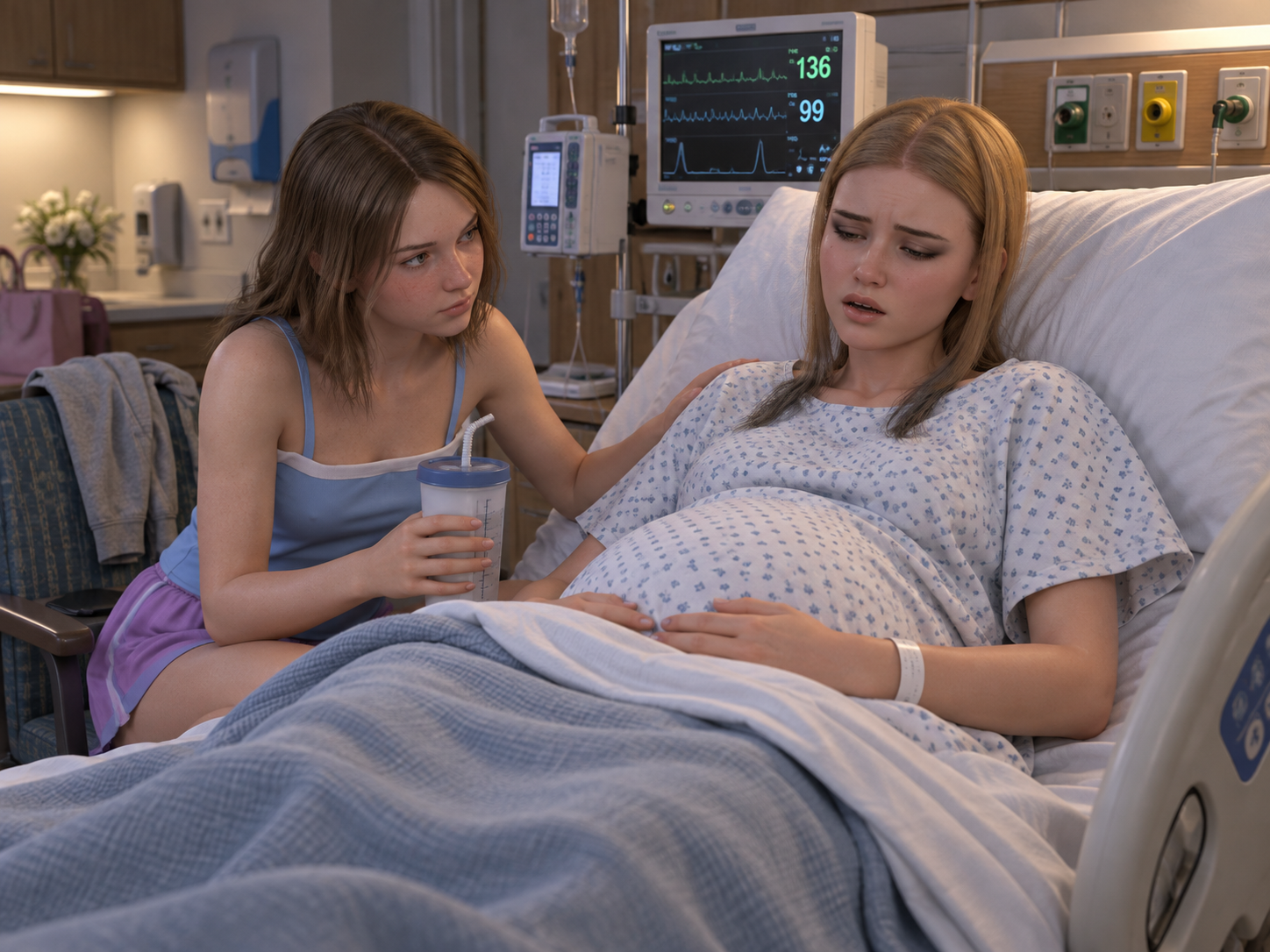
The morning became harder to divide into pieces after they reached Ridgemont Medical. There was the hospital entrance and Stuart trying to convince Callie to use a wheelchair, which she refused on principle until a nurse assured her she did not have to use one. There was registration, which involved answering questions Callie was certain she had already answered at least four different times during the pregnancy. A bracelet went around her wrist. Someone asked her birthday. Someone else asked her birthday fifteen minutes later. She changed into a hospital gown she hated immediately and was attached to monitors that produced numbers and lines she tried very hard to understand because understanding things was what Callie did when she was nervous.
At first, it worked. She watched the monitor during contractions and asked what the numbers meant. She wanted to know how far apart the contractions were, how long they lasted, whether they were getting stronger, what counted as strong, and how anyone could objectively determine whether labor was progressing at an appropriate rate. A nurse named Denise answered most of her questions with the patience of someone who had heard every possible variation before.
“That number isn’t really a pain score,” Denise explained after catching Callie staring at the monitor for the third time.
“I know.”
“You’re still watching it like you’re trying to beat it.”
“I’m not.”
Denise smiled. “Okay.”
“I just want to know what it’s doing.”
“Your body knows what it’s doing.”
Callie looked at her.
Denise considered that. “Fair. Not a comforting sentence.”
“No.”
“Then how about this? Everything looks good.”
That was better.
For a while, numbers helped. Times helped. Progress helped. Callie could understand eight minutes becoming six, six becoming five. She could understand nurses entering and leaving, Sally answering questions when Callie was distracted, Stuart appearing periodically with water or ice or some other useful object before disappearing again. Hannah had eventually been taken out to the waiting area, mostly because Sally threatened to remove her personally if she asked one more question about exactly what happened during delivery. Morning became late morning and then afternoon. At some point Callie’s phone buzzed on the tray beside the bed, and she saw Maggie’s name on the screen. Sally answered the message for her after asking permission. Callie did not ask exactly what she wrote. She was beginning to lose interest in everything that existed outside the room.
That bothered her almost as much as the pain. Callie liked knowing things. She liked understanding the shape of a problem before she dealt with it. Even when the answer was bad, knowing where the edges were made it manageable. Pregnancy had been terrifying partly because it refused to stay inside clean boundaries, but over the months she had built boundaries around it anyway. Appointments. Dates. Lists. Decisions. A crib. A name. A due date. Every unknown she could turn into a fact became one less thing capable of surprising her. Labor did not work that way. A contraction did not become easier because she knew how long the previous one had lasted. The monitor could tell her one was beginning, but her body usually told her first. Numbers stopped feeling useful when each contraction demanded everything she had until it passed and then left her knowing another one was coming.
By late afternoon, she was tired in a way she had never understood tiredness before. Her legs trembled. Sweat dampened the hair near her temples. She wanted to sleep and could not imagine how anyone expected a person to sleep when her own body kept dragging her awake from the inside. Sally stayed beside her, sometimes rubbing her back, bringing the straw to her mouth, or reminding her to loosen her grip on the bedrail, and sometimes simply sitting close enough that Callie could reach her. Stuart came and went as the room required, carrying things, asking what anyone needed, trying so obviously not to hover that the effort itself became hovering. Callie knew he was scared. She could see it in the way he checked her face before asking questions and in how quickly he stood whenever a nurse entered. He never said it, though, and Callie was grateful because she did not have room to be frightened for anybody except herself.
Another contraction climbed through her, and Callie gripped Sally’s hand. She had stopped caring whether she squeezed too hard. She had stopped caring what her hair looked like, whether the hospital gown was twisted around her legs, or how many people had seen parts of her body she would previously have preferred to keep out of public circulation. Her world had narrowed to the bed, the pressure, the sound of her own breathing, and the knowledge that she had to endure something she could not pause. When the contraction finally eased, tears were already sliding toward her ears.
“I can’t.”
Sally brushed damp hair away from her forehead. “You are.”
“No, I’m not.”
“You are.”
“I’m tired.”
“I know.”
“I don’t want another one.”
“I know.”
Callie shut her eyes. She could hear movement elsewhere in the room, quiet voices, the rustle of fabric, a monitor continuing its steady indifferent rhythm. Another contraction would come. Everybody knew that. There was no point complaining about it, no point asking to leave, because there was nowhere to go and nothing anybody could do except keep moving forward. For months, people had told her how strong she was, and Callie hated the word now. Strong sounded like someone standing upright with her jaw set, making difficult decisions and accepting the consequences. Strong sounded impressive. It did not sound like a sweaty fifteen-year-old lying in a hospital bed with tears running into her hair because she wanted one impossible thing, for the next contraction simply not to happen.
The pressure began again. Callie’s fingers tightened around Sally’s hand as she tried to breathe, but this one hurt badly enough that panic came with it, hot and irrational and immediate. Suddenly she was not thinking about Juna or due dates or everything she had learned over the last seven months. She wanted home. She wanted her own bed. She wanted to be little enough for someone else to fix whatever was happening.
“Mom.”
That was all she managed.
Sally moved closer. “I’m right here.”
Callie turned her face toward her and held on. For those few minutes, she did not have to be responsible or mature or brave about any of it. She was Sally’s daughter. She had been Sally’s daughter before she had ever become pregnant, before Juna had existed, before anybody had expected Callie to make decisions that adults twice her age struggled to make. Her mother could not stop the pain and Callie knew it, but Sally’s hand stayed in hers anyway, and somehow that mattered. When the contraction finally passed and Callie opened her eyes, she realized Sally was crying too.
“You’re crying,” Callie whispered.
“I’m allowed.”
“That’s not helpful.”
Sally laughed softly and wiped at her face with her free hand. “Sorry.”
Callie managed a tired smile. “You’re supposed to be the stable one.”
“I can multitask.”
The next stretch blurred even more. Later, Callie would remember pieces of it and have difficulty arranging them in the right order: Denise changing something beside the bed, Stuart standing near the doorway looking pale before Sally sent him out with a glance, another nurse telling her she was doing well, somebody mentioning time. Somebody else said they were close, and close became the only word Callie cared about. She no longer needed to understand every step. She just needed there to be fewer steps left.
When the birth finally came, the ending felt impossibly quick compared with everything that had led to it. There were voices encouraging her, Sally’s hand still in hers, pressure and exhaustion and pain mixed together until Callie could no longer separate one from another. She heard herself make a sound she would have been embarrassed by under any other circumstances and discovered that embarrassment no longer mattered. Someone told her once more, just once more, and a distant part of her wanted to tell them they had been saying variations of that for hours and should consider developing new material.
Then something changed.
The pressure released, and for one strange fraction of a second Callie could not understand what had happened. The room seemed to hold still around her.
A cry cut through it.
Callie’s breath caught.
The sound came again, sharp and furious and impossibly small. She turned her head toward the movement beside the bed and saw, somewhere among blue gloves, blankets, and reaching hands, a tiny wet red face with a mouth opened in absolute outrage.
“That’s her?”
Beside her, Sally laughed through tears. “That’s her.”
Juna’s face was red, scrunched, and furious, and Callie could not stop staring.
“She looks mad.”
“She had a difficult morning.”
A laugh escaped Callie and immediately turned into something closer to a sob. “So did I.”
Someone placed Juna against her. Callie’s arms moved automatically, helped by hands she barely noticed, and warm weight settled against her chest, lighter than Callie expected and somehow heavier than anything she had ever held. Juna was still crying, her tiny body tense with indignation beneath the blanket, and Callie stared at her because there did not seem to be anything else in the world worth looking at. She had hair. That was Callie’s first coherent thought. Not much, but enough to lie dark and damp against the top of her head. One tiny ear showed beneath it. Callie had never considered newborn ears before. There had been entire sections of pregnancy books about feeding and sleeping and diapers, but nobody had thought to mention how ridiculously small a baby’s ear was.
Juna moved one hand and opened her fingers against Callie’s skin. They were complete. That should not have been surprising. Obviously babies had fingers. Callie had seen the ultrasound images and watched Juna’s hands move on a screen months ago, little pale shapes in grainy black and white. Those had been images, though. This hand was real. Five tiny fingers flexed against her, each ending in a fingernail so small it seemed impossible that anyone had bothered putting it there.
“Hi,” Callie whispered.
Juna cried harder.
“Yeah. Hi.”
Sally’s hand settled gently against Callie’s hair, but Callie barely noticed. For months, Juna had existed everywhere except the world. She had existed on screens and in measurements. She had existed in the curve of Callie’s stomach, in kicks against her ribs, in appointments written on calendars and conversations held behind closed doors. She had existed as a problem people needed to discuss, a decision Callie had needed to make, and a future Sally and Stuart needed to prepare for. Teachers had adjusted plans around her. Doctors had monitored her. Friends had learned how to talk about her. Callie had bought things for her and named her and imagined her, but even then Juna had remained partly theoretical, a person Callie understood was coming without being able to understand what coming actually meant. Now she was warm against Callie’s chest, her crying weakening into angry little complaints as Callie touched one finger carefully to her cheek.
Soft.
That was real too.
Everything about her was suddenly, frighteningly real. Callie felt another rush of tears and did not bother trying to stop them. She was too tired, too relieved, too overwhelmed by the fact that the baby she had carried for months had somehow become this actual human being breathing against her skin.
“She’s so little.”
Sally smiled. “She is.”
“She was bigger in my head.”
“Probably because she’s been taking up most of your body.”
“That might be it.”
Juna’s eyes opened briefly. Callie went still. They were unfocused and dark, looking at nothing Callie could identify before slowly closing again.
“Did she see me?”
“Probably not very well.”
“Oh.” Callie considered that. “That’s probably for the best. I look terrible.”
Sally laughed, and Callie smiled without looking away from Juna.
The moment should have felt triumphant, and maybe some part of it did. There was pride beneath the exhaustion, fierce and unfamiliar. She had done it. She had carried Juna through all those months when everything had seemed too large and too complicated, and somehow they were both here. Juna was breathing. Juna was warm. Juna had ten perfect miniature fingers and an unreasonable amount of anger about being born. Happiness did not erase everything else, though. Fear slipped in almost immediately when Callie noticed the way Juna’s head rested against her and became abruptly conscious of how carefully she needed to support it. The nurses would eventually leave. Her mother would go home. The hospital would discharge them, and apparently society had decided Callie could simply take this impossibly small person back to the house because she was Juna’s mother. There was no test. No licensing process. Nobody was going to make Callie demonstrate that she knew what she was doing before handing her a diaper bag and letting her walk out the door with a human being. That seemed like a serious oversight.
“What?” Sally asked.
Callie realized her mother was watching her. “Nothing.”
“That wasn’t a nothing face.”
Callie looked back at Juna. “They’re going to let me take her home.”
Sally was quiet for a moment. “Eventually.”
“That’s insane.”
“They let me take you home.”
“Exactly. That doesn’t make it better. That just means they’ve been doing this for years.”
Sally smiled, but Callie could see that she understood what Callie actually meant.
“What if I don’t know what I’m doing?”
“You won’t.”
Callie looked at her.
Sally shrugged. “Not all of it.”
“Mom.”
“I’m serious. You won’t know everything. Neither did I.”
“You always know what you’re doing.”
Sally laughed with enough genuine amusement that Callie felt mildly betrayed. “Oh, Callie.”
“What?”
“Nothing.”
“No, what?”
“I love that you think that.”
Callie frowned.
Sally reached down and touched one finger lightly to Juna’s blanket. “You’ll learn her. That’s what you do.”
Callie looked at the tiny sleeping face against her chest. Learn her. That sounded possible. Not easy, safe, or guaranteed, but possible, and for the moment possible was enough to understand.
A while later, Stuart came back into the room. By then Juna had been cleaned up and wrapped in a blanket, and Callie had been rearranged against the hospital pillows into something resembling a person again. The room felt different than it had all afternoon. The frantic sense of forward motion was gone, replaced by the soft hum of equipment and occasional footsteps passing in the hallway. Stuart entered slowly, which was strange enough by itself. Callie had rarely seen him enter any room slowly in his life. His eyes went immediately to Juna, and he stopped beside the bed.
“Hey,” Callie said.
“Hey.”
Stuart cleared his throat and looked at his granddaughter. For several seconds he said nothing. Then he rubbed one hand over his mouth.
“Dad.”
“I’m fine.”
“You’re crying.”
“I am not.”
“You definitely are.”
“My eyes are watering.”
“Inside a hospital room.”
“Dry air.”
Sally made a sound suspiciously like a laugh.
Stuart looked at her. “It is dry.”
“Of course.”
He turned back to Juna, and whatever argument he might have made disappeared. His face softened in a way Callie had rarely seen, as though he were afraid even his expression might somehow be too loud for her.
“Hi, Juna.”
The baby slept through the introduction.
Stuart smiled, and the smile wobbled slightly enough that Callie’s own throat tightened.
“Do you want to hold her?”
Stuart looked at her, and for the first time all day the man who had checked the car seat, gas tank, hospital bag, route, and probably the structural integrity of the hospital itself appeared completely uncertain. “Can I?”
Callie almost laughed. “She’s your granddaughter.”
“I know.”
“You’ve held babies before.”
“I know.”
“Then yes.”
He moved toward the sink. Callie watched him wash his hands, then continue washing them long enough to become ridiculous.
“Dad.”
“What?”
“You’re removing skin.”
“I’m washing my hands.”
“You’ve been in the hospital all day. You’re probably the cleanest person in Ridgemont.”
He dried them carefully and approached the bed. Sally helped transfer Juna into his arms, and Stuart held her as though someone had given him an object made of spun glass and informed him replacement parts did not exist. His entire body went still. He stared down at the little bundle against his chest, and Callie watched a dozen emotions move across his face too quickly for him to hide any of them.
“She’s tiny,” he whispered.
“That’s what I said.”
“Look at her.”
“I have been.”
“No, I mean…” He stopped and shook his head slightly. “Look at her.”
Callie smiled. “I know.”
Juna moved beneath the blanket and made one soft complaining noise.
Stuart’s eyes widened. “What do I do?”
Callie laughed. The absurdity of the question hit her harder than the question itself. Her father was asking her what to do with a baby.
“I have no idea.”
Sally laughed from beside the bed.
Stuart looked between them. “Very reassuring.”
“Welcome to the team,” Callie said.
Hannah met Juna that evening, by which point the sunlight through the hospital window had turned warm and golden, stretching across the floor in long rectangles. Callie felt as though she had lived several days since waking before sunrise. Her body ached everywhere. She was tired enough that even lifting her water cup required consideration, yet she could not stop looking toward the bassinet beside the bed whenever Juna was not in her arms. Hannah entered carrying a gift bag she had apparently talked Stuart into stopping for sometime during the afternoon.
“You bought her something already?” Callie asked.
“It wasn’t my idea.”
“It was entirely her idea,” Stuart said from behind her.
Hannah ignored him and approached the bassinet. Callie had expected excitement. Hannah had spent months being interested in every new piece of baby equipment that entered the house and asking questions Callie desperately wished she would save for Google. Instead, when she looked into the bassinet, she became unusually quiet.
“Whoa.”
Callie smiled. “That’s Juna.”
“I know.”
“You said whoa.”
“I wasn’t expecting her to be that small.”
“Everyone keeps saying that.”
Hannah leaned closer. “She’s like a person.”
Callie stared at her. “What were you expecting?”
“I know she’s a person. I mean she looks like one.”
“Still not helping.”
“Like a tiny person.”
“Hannah.”
“You know what I mean.”
Unfortunately, Callie did.
Hannah looked toward her. “Can I hold her?”
“Sit down.”
“I know how to hold a baby.”
“Sit down anyway.”
Hannah obeyed immediately, which might have been the most convincing evidence all day that something extraordinary had happened. Sally helped place Juna into her arms, and Hannah stared down at her with an expression Callie had never seen on her before.
“Hi.”
Juna slept.
“I’m Aunt Hannah.” Hannah looked up. “That’s weird.”
“What is?”
“I’m somebody’s aunt.”
“You’re focusing on the weird part?”
“You’re somebody’s mom.”
Callie’s smile shifted, not quite disappearing. Hannah had not meant anything by it. She had already returned her attention to Juna, gently touching the edge of the blanket near her hand, but the words settled somewhere deep in Callie’s exhausted mind. You’re somebody’s mom. Not going to be. Not pregnant. Not expecting or preparing. Mom. Callie looked across the room at her family, at Sally standing beside Hannah with one hand resting on the back of the chair and Stuart near the window pretending to study something outside while periodically glancing toward the baby.
Hannah bent closer to Juna. “That’s Grandpa. He’s the one over there pretending he’s not watching you.”
“I can hear you,” Stuart said.
“And that’s Grandma.”
Sally smiled. “She knows.”
“No, she doesn’t.”
“She’ll figure it out.”
Hannah glanced at Callie. “And that’s your mom.”
Juna continued sleeping, unaware that anything important had just been said, while Callie felt something tighten in her chest that had nothing to do with labor. Her mom. That was her now. She had known it yesterday. She had known it for months, technically. She had filled out forms where she was listed as the mother. She had heard doctors say it and answered questions about what she planned to do after the baby arrived. Entire conversations had been built around the assumption that eventually Callie would become exactly what Hannah had just called her. Knowing had not been the same thing as hearing it with Juna actually in the room.
Later, after Hannah reluctantly surrendered the baby and Sally returned Juna to her, Callie settled back against the pillows with her daughter resting against her chest. The room had quieted again. Stuart and Hannah were discussing food in low voices near the door, and Sally sat beside the bed with the day’s exhaustion finally showing beneath her eyes. Outside the window, July evening had settled over Ridgemont, warm and bright and completely indifferent to the fact that Callie’s life had divided itself permanently into before today and after it. Juna shifted in her arms, and Callie moved her thumb gently over the blanket covering her back, feeling the tiny rise and fall of each breath beneath it.
The fear was still there. Callie suspected it would be there tomorrow too. There would be diapers and feeding and nights without enough sleep. There would be school eventually. There would be money and babysitters and doctors and a thousand questions Callie had not thought to ask yet. She was still fifteen. She was still Callie. She still wanted stupid things sometimes, ordinary things, afternoons with Maggie and football games and hours when nobody needed anything from her. Giving birth had not transformed her into somebody who suddenly understood adulthood. If anything, she understood less than she had that morning, and she was too tired to pretend otherwise. What had changed was simpler and much larger than that.
For months, everyone had called Juna the baby. Doctors. Teachers. The Bennetts. Sally and Stuart. Callie’s friends. Callie herself, sometimes. People had called her a pregnancy, a responsibility, a decision, a consequence, a future. Each word had carried its own weight, and Callie had spent months trying to be strong enough to carry all of them. None seemed big enough now. There was a tiny ear beneath dark hair, ten impossibly small fingers, and a furious little cry Callie already suspected she would recognize anywhere. There was warm weight against her chest and the frightening knowledge that somebody in the world now depended on her in a way nobody ever had before.
Callie looked down at the sleeping girl in her arms.
Juna.
Her daughter.

Welcome to the world, Juna, which is also an interesting name for the baby as well.
Yeah the name does come from a game.
Tomorrows episode should be a banger
Ooh I can’t wait.
Hope year 2019 come very soon
Year 2019 does come soon.
1) “getting up to pee had become so routine that she could make the trip to the bathroom without fully opening her eyes.” That’s just living in the same house long enough.
2) “Juna did not answer, which Callie considered suspicious” Is Juna normally talking back to her mother?
3) “Braxton Hicks.” – “Yes. Those.” – “Those usually aren’t regular.” – “Maybe mine are organised.” Callie would be more organised than most girls
4) “That was all he said at first. Then Stuart became aggressively useful.” Stuart’s already in Grandfather mode
5) ““Stop asking your sister whether she can tell when the baby is coming out,” those are questions for after the birth
6) “Can I have a different family for today?” – “No.” – “Just until tomorrow.” Your whole family is supportive and loving; the only problem is the baby daddy
7) “The clothes had been folded into drawers, unfolded by Callie because Sally had organized them wrong, and folded again” I’m loving how well you’ve established Callie’s personality.
8) “Two men in reflective vests stood beside a utility truck drinking coffee as though this were an entirely unremarkable day.” well, think of how many “unremarkable” days Callie’s had while other people were giving birth.
9) “You’re still watching it like you’re trying to beat it.” Getting competitive with her own pain, Very Callie of her
10) “She looks mad.” – “She had a difficult morning.” You try getting evicted, see how you like it.
11) “There had been entire sections of pregnancy books about feeding and sleeping and diapers, but nobody had thought to mention how ridiculously small a baby’s ear was.” Well, they gotta leave some surprises for the mother.
12) “Did she see me?” – “Probably not very well.” Babies’ eyes aren’t fully developed at birth; Juna’s basically seeing big red blotches.
13) “Apparently, society had decided Callie could simply take this impossibly small person back to the house because she was Juna’s mother” Callie also made that decision.
14) “There was no test. No licensing process. Nobody was going to make Callie demonstrate that she knew what she was doing before handing her a diaper bag and letting her walk out the door with a human being. That seemed like a serious oversight.” Parenting licences sound great, until you realise that governments deciding who is and isn’t allowed to reproduce is a slippery slope to eugenics.
15) ““Like a tiny person.” No Hannah, those are called Littles.
16) “That’s Grandpa. He’s the one over there pretending he’s not watching you.” – “And that’s Grandma.” – “And that’s your mom.” Hannah, making sure all the important introductions are complete, is adorable.