
Chapter 21
September 2020
By Monday morning, Myles Bennett was waiting for Callie inside Ridgemont High.
Not Myles himself. Callie knew that before she walked through the front doors, knew it in the same blunt factual way she knew the temperature outside or the combination to her locker. Myles was dead. There was no version of Monday morning in which he leaned against a wall somewhere with his backpack hanging from one shoulder, or appeared beside Luke with that cautious half-smile he used to wear when he wasn’t sure whether Callie was making fun of him. There was no version where she turned a corner and saw nearly black hair above the crowd, no possibility that he might look toward her and then immediately look away. She knew all of that. It still did not prepare her for how completely the school had filled itself with him.
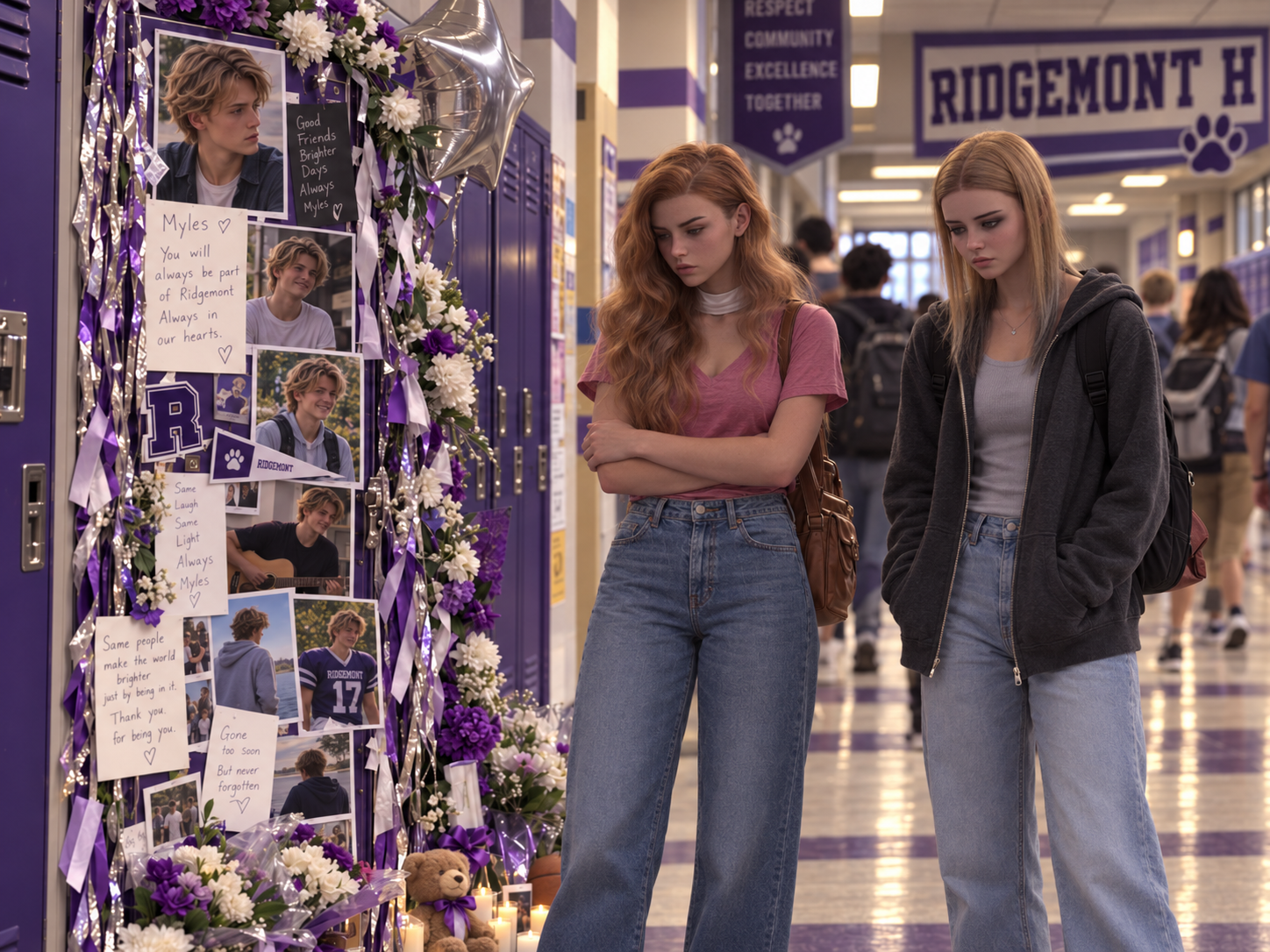
The first purple-and-white ribbon was tied around the handle of the main entrance. Another had been looped around one of the railings inside, and someone had taped a handwritten sign beside the counseling office reminding students that counselors were available throughout the day. The usual Monday noise had been turned down without actually disappearing. Locker doors still slammed. Shoes squeaked against the tile. Somebody near the staircase complained about a chemistry test, and two freshmen were arguing over whether one of them had stolen the other’s charger, but voices dipped whenever the conversation turned toward Myles. Callie heard his name three times before she had made it halfway down the main hall.
Maggie walked beside her. Luke was on Callie’s other side, close enough that the three of them occupied more hallway than necessary, though none of them seemed interested in correcting it. They had met outside without discussing the arrangement. Maggie had simply appeared near the student entrance while Callie was locking the car, and Luke had joined them less than a minute later. Neither had made a joke about it.
That by itself made the morning feel wrong.
Callie shifted her backpack higher on her shoulder and looked ahead. She saw the crowd before she saw what they were standing around, a loose gathering pressed toward one bank of lockers while everybody else curved around them. Purple showed through the gaps between bodies. White too. Someone had taped silver streamers along the top.
Her stomach tightened.
Maggie saw it at the same time. “You don’t have to go that way.”
“It’s my locker.”
“I know.”
Callie looked at her.
Maggie lifted both hands a few inches. “Not telling you what to do. Just pointing out that the building has other hallways.”
“And I have calculus in six minutes.”
Luke glanced toward the memorial. “We could be late.”
“You two can. I can’t.”
“Pretty sure this is one of the times teachers let you be late.”
That was probably true, which somehow made the idea worse. Callie had already discovered that everybody had become willing to let her out of things. She could leave class. She could skip assignments. She could go home. She could talk to a counselor. She could sit somewhere quiet for as long as she needed. It was kind, and she knew it was kind, but there was something suffocating about having half the adults in Ridgemont High looking at her as if she might shatter if somebody handed her a worksheet.
“I want to go to calculus,” she said.
Luke studied her for a second, then nodded. “Okay.”
They moved with the flow of students toward the lockers.
The memorial had swallowed Myles’s locker and spread to the ones beside it. Flowers lay across the floor in crinkled plastic sleeves. Someone had taped photographs to purple construction paper, and handwritten cards overlapped one another around them. REST EASY, MYLES had been written in silver marker across the top. Beneath it were messages from people Callie knew, people she vaguely recognized, and people she suspected had spoken to Myles three times in their lives but currently possessed very strong feelings about him.
She didn’t resent the flowers.
That surprised her enough that she stood there longer than she meant to.
There were photographs of him from football games, parties, school lunches and somebody’s basement. In one, he was laughing so hard his eyes had closed. In another, he stood with three boys Callie recognized from Games Galore, all of them holding game boxes toward the camera like trophies. Somebody had found a picture from the Thomas Game. Myles was standing beneath the stadium lights in a Ridgemont hoodie, his face turned partly away from the camera while fireworks washed the sky behind him.
Callie remembered that night.
Not the picture. The night.
She remembered the heat of thousands of people packed together on aluminum bleachers, Ridgemont beating West seventeen to seven, Maggie and Luke disappearing toward the field when the students rushed it. She remembered Myles taking her hand in the crowd. She remembered telling him he could let go and him saying he hadn’t said he wanted to. She remembered walking through Ridgemont with his hand still around hers while the fireworks faded behind the houses.
That memory remained exactly what it had always been.
It hurt more because of that.
A card near the photograph had GOOD KID written across it in thick black letters.
Callie’s eyes stopped there.
“Cal?”
She looked away. “I’m fine.”
Maggie didn’t challenge the lie.
They had almost cleared the crowd when a girl from Callie’s English class stepped toward her. Her eyes were red, and the hesitation on her face made Callie recognize what was coming a second before she heard it.
“I’m so sorry, Callie.”
Callie had practiced an answer in the car. She hadn’t realized she’d been practicing it until it came out automatically.
“Thanks.”
The girl touched Callie’s arm, just briefly. “Seriously. If you need anything…”
“Thanks.”
Callie kept moving.
Twenty feet later, a boy she vaguely knew from chemistry caught her eye.
“Hey. Callie. I’m really sorry.”
“Thanks.”
By the time she reached calculus, there had been three.
The teacher met her at the door with the careful expression adults had apparently agreed to use around her. “Callie, before class, I just want you to know that if you need to step out at any point today, you don’t need to ask.”
Callie tightened her fingers around the strap of her backpack. He meant well. Everybody meant well. That was becoming the problem.
“Okay. Thank you.”
“And if there’s anything you need…”
“I know.”
His expression shifted slightly, and Callie realized she’d said it too quickly. She forced something closer to a smile. “Sorry. I mean, thank you. Really.”
“Of course.”
She took her usual seat and opened her notebook.
Calculus turned out to be wonderful.
Numbers did not know Myles had died.
They did not lower their voices when she entered the room or look at her like they knew something intimate about her because they had heard a rumor three years ago. An equation could be wrong, difficult or irritating, but it could not feel sorry for her. For fifty-two minutes Callie worked through derivatives while her teacher filled the board, and although her concentration slipped twice, she dragged it back both times because she wanted it back. When the bell rang, she had almost managed to feel normal.
Then a girl near the door waited for her.
“I’m so sorry, Callie.”
“Thanks.”
Second period brought two more.
One was from a teacher who squeezed her shoulder and told her she could make up anything she missed. The other was from a boy Callie had not spoken to since sophomore year, who looked genuinely shaken when he told her he’d heard she had been there when the crash happened.
“That must’ve been awful.”
Callie swallowed. For a second she saw the oak again, huge and dark beyond the windshield, Myles’s taillights continuing straight when the road did not. “Yeah.”
“I’m sorry.”
“Thanks.”
By lunch, the words had begun to separate from their meaning.
I’m so sorry, Callie.
Thanks.
I’m sorry.
Thanks.
I can’t even imagine.
Yeah.
If you need anything.
I know.
I’m so sorry.
Thanks.
People weren’t trying to hurt her. Callie held onto that because it seemed important. Some of them had known Myles well. Some had only known that she had a daughter with him and assumed that made his death into something they understood. A few had probably heard she watched the crash. Others were simply doing what people did when somebody died. They found the person standing closest to the grief and handed her a sentence.
The problem was that Callie did not know whether the grief they imagined belonged to her.
Shock did. Horror did. The memory of metal folding around the oak certainly did. She had barely slept Saturday night because every time she closed her eyes, the road curved left and Myles kept going straight. She had wanted him to get into her car. She had wanted Jason to stop him. She had wanted Luke to somehow get those keys through a locked door. She had wanted a hundred different things that all ended with Myles Bennett alive on Monday morning.
None of that made her miss him.
Apparently the distinction was too ugly for public consumption.
Lunch was worse because people had time to talk.
Callie sat with Maggie and Luke near the middle of the cafeteria, although none of them seemed especially hungry. Luke had bought fries and was moving them around his tray more than eating them. Maggie kept checking her phone without appearing to read anything on it. Callie had managed half of a sandwich when two girls stopped beside the table.
One of them looked at Maggie and Luke first. “I’m so sorry you guys had to see that.”
Maggie nodded. “Thanks.”
The girl’s attention moved to Callie. “And you. God, Callie. I can’t imagine what you’re going through.”
Callie’s hand tightened around the edge of the sandwich.
“Thanks.”
The second girl gave her a small, sad smile. “He really was such a good guy.”
Something inside Callie shifted.
Not broke. Not yet.
She lowered the sandwich.
The first girl nodded. “Seriously. I had bio with him last year, and he was always making everybody laugh.”
Callie looked down at her tray.
Maggie’s shoe touched hers beneath the table.
The girls moved on.
Luke watched Callie. “You okay?”
“Yep.”
“That sounded extremely believable.”
“I’m eating lunch.”
“Technically you’re holding lunch.”
Callie looked at him.
“Stopping now.”
She took another bite because Luke had annoyed her into proving him wrong, which was enough to get her through the rest of the period.
The phrase followed her anyway.
He was such a good guy.
He was hilarious.
He helped me with algebra once.
He always let me borrow his charger.
He was a good kid.
Some of it was true.
That was what made it harder to dismiss.
Myles had been funny. Not constantly, and often accidentally, but he had made Callie laugh. He had once biked all the way to Grey’s to buy one Coke because apparently buying anything else would have made it too obvious that he’d gone there hoping to see her. He had endured losing at Madden with progressively less dignity. He had listened when she said they should slow down after that October night and had not argued with her once. Before everything collapsed, Myles had been easy to like.
Callie knew that better than most of the people leaving flowers at his locker.
She had liked him.
That did not mean what they wanted it to mean.
By the beginning of fifth period, “I’m sorry” had become background noise. Callie thanked a teacher in the hallway, thanked somebody from student council, thanked a girl she barely knew who actually started crying while talking to her. She felt terrible for resenting any of them, which only added another layer of irritation because apparently she was now responsible for feeling guilty about being annoyed by other people’s sympathy.
Maggie caught up with her outside the main hall.
“Luke got stopped by Rasmussen.”
Callie blinked. “Luke got stopped by himself?”
“Mr. Rasmussen.”
“Oh.” Callie rubbed a hand over her forehead. “Right.”
“You’re tired.”
“Excellent work, Detective Carlson.”
“There she is.”
Callie almost smiled.
They rounded the corner.
The memorial was busier than it had been that morning. People had added more flowers. A silver balloon now floated near the ceiling with its ribbon tied to the locker handle, bobbing whenever somebody passed close enough to disturb the air.
A boy standing near it was telling a story about Myles.
Callie slowed without meaning to.
“He stayed until like eleven helping us clean everything up,” the boy said. “Nobody asked him. He just did it.”
A girl beside him wiped beneath one eye. “That’s what he was like.”
“Yeah.”
“He was a good kid.”
Callie kept walking.
Almost.
“Callie?”
She stopped.
A girl Callie knew from one of Myles’s wider friend groups had stepped away from the memorial. They had spoken enough over the years to exchange greetings, not enough to qualify as friends. She looked exhausted, her eyes swollen from crying.
“I wanted to tell you I’m sorry.”
There it was again.
Callie nodded. “Thanks.”
The girl hesitated. “I know things were complicated between you and Myles.”
Maggie went very still beside her.
Callie felt it before the girl finished.
“But he really was a good kid.”
“Please don’t.”
The girl blinked. “What?”
Callie heard her own breathing. The hallway had not gone quiet, not yet, but the noise immediately around them seemed to thin as people noticed the change in her voice.
“Don’t tell me that.”
“I wasn’t trying to upset you.”
“I know.”
The girl looked genuinely confused. “Then what?”
Callie should have walked away.
She knew that. Some functional part of her brain was already presenting the better options in neat order. Go to class. Tell Maggie she needed a minute. Find a bathroom. Find a counselor. Find an empty stairwell. Wait until she wasn’t standing fifteen feet from a memorial surrounded by grieving teenagers.
Instead she looked at the words GOOD KID taped beneath a photograph of Myles laughing.
“I’m just tired of hearing it.”
A boy beside the locker frowned. “Hearing what?”
“That he was a good kid.”
The girl drew back slightly. “Callie…”
“No. You can say you’re sorry. You can tell me you miss him. You can tell me he made you laugh. I’m not mad about any of that.” Callie gestured toward the memorial, and several people followed the movement with their eyes. “I’m not mad about this either.”
“Then why are you doing this here?”
It came from another boy, one Callie recognized as somebody Myles had played games with at lunch. His face was red and openly angry.
Callie looked at him. “I didn’t start anything.”
“You know what I mean.”
“Actually, no.”
“He died two days ago.”
Callie’s jaw tightened. “I know.”
The boy’s expression changed, regret flashing through it.
Callie heard somebody whisper behind her that she had been there.
The girl who had first approached her stepped back into the conversation. “Nobody’s saying you have to forgive him. I know you guys had a bad breakup.”
Callie stared at her.
A bad breakup.
Three years reduced to two words.
“We didn’t have a bad breakup.”
The girl’s forehead creased.
“We had a child.”
No one answered.
Callie’s heartbeat had begun to pound against the base of her throat. She knew more people were listening now. The hallway was not silent, but the loose semicircle around the memorial had widened, students lingering instead of moving to class. Maggie remained just behind Callie’s shoulder. She had not touched her, which Callie appreciated. Maggie knew better than to grab her when she was angry.
The girl swallowed. “I know.”
“No, you know Juna exists.”
“Callie,” the boy said, quieter this time, “he made mistakes.”
“Mistakes.”
“Yeah. He screwed up. I’m not saying he didn’t.”
Another voice came from somewhere near the lockers. “He was scared.”
Callie turned toward it.
A boy she didn’t know well lifted one shoulder uncertainly. “He was fourteen.”
For one second, everything inside Callie went completely still.
“So was I.”
Nobody said anything.
Callie heard the distant slam of a locker farther down the corridor. A teacher’s voice came from around the corner, followed by a burst of laughter from students who had no idea anything unusual was happening twenty yards away.
Callie looked back at the boy.
“So was I,” she repeated, quieter. “Everybody always says that about him. He was fourteen. He was scared. He didn’t know what to do.” Her voice shook, and that made her angrier because she did not want them mistaking anger for uncertainty. “I was fourteen when I found out I was pregnant. I was fourteen when I had to decide whether I wanted to stay pregnant. I was fourteen when I told him. I was fourteen when I had to start figuring out doctors and school and money and childcare and whether I could still go to college. I was fourteen when people started staring at me in the hallway.”
The boy’s gaze dropped.
“Being fourteen didn’t make any of that disappear for me. Nobody showed up and said, well, Callie’s fourteen, so I guess she doesn’t have to deal with this. I didn’t suddenly turn forty because I was the pregnant one.”
Maggie inhaled softly behind her.
Callie could stop.
She knew that too.
Instead she looked at the memorial again and saw another card beneath the photographs.
YOU WERE ONE OF THE GOOD ONES.
Something hot climbed through her chest.
“You want to know what happened when I told him?”
The girl who had approached her looked uncomfortable now. “Callie, you don’t have to…”
“No. Apparently I do.”
Maggie said her name, not as a warning exactly, more like a reminder that she was there.
Callie looked at her best friend.
Maggie’s face had changed. There was concern in it, but no command to stop.
Callie turned back.
“His parents said I seduced their son. His dad called me a whore.”
The hallway went silent.
Not metaphorically this time.
The conversations nearest them simply stopped.
The girl in front of Callie stared at her.
“And Myles sat there.”
Luke appeared at the edge of the crowd.
Callie saw him over someone’s shoulder, saw confusion arrive first and then disappear beneath something harder.
The boy who had been defending Myles frowned. “What do you mean, he sat there?”
“I mean exactly that.” Callie’s hands had started shaking, so she folded her arms tightly across her chest. “He knew it wasn’t true. He knew I didn’t make him do anything. He knew I didn’t pressure him. He knew exactly what happened because he was there. His parents sat across from me and my parents and told everybody that I chased him, that I pushed him into a relationship, that I used him, that I seduced him and got myself pregnant.”
“Jesus,” somebody whispered.
“Myles said I didn’t make him. Once. And then he sat there while they kept going because actually defending me would’ve meant telling his parents they were wrong. It would’ve meant admitting he made the same choices I did.”
The girl looked toward the memorial as if checking whether it was still there.
It was.
Flowers. Pictures. Purple ribbon. Silver balloon.
Nothing had moved.
Callie’s voice came out steadier now, which somehow felt worse. “And they brought paperwork.”
Maggie looked at her. “What paperwork?”
Callie heard the question but kept her eyes forward. “They had an attorney draw up papers so Myles wouldn’t have to be Juna’s father.”
Several expressions changed at once.
The angry boy shook his head. “That’s not…”
“Not what?”
“I don’t know. I didn’t know that.”
“Nobody did.” Callie swallowed. “They put it right there on the coffee table. No custody. No visits. No doctors. No diapers. No daycare. No food. No clothes. No money. No responsibility. Nothing. They wanted me to take our daughter and make sure Myles never had to deal with any part of her.”
“Did he sign it?” someone asked.
“It wasn’t that simple. They wanted me to agree to it. The point was that they came prepared to erase him from the whole thing, and he was willing to let them.”
She looked at the GOOD KID card again.
A laugh escaped her.
There was no humor in it.
“Because Myles was such a good kid.”
The girl flinched.
Callie pointed toward the memorial. “Such a good kid that his two year old daughter deserved absolutely nothing from him.”
Somebody started crying.
Callie did not know who.
The boy near the locker looked away, jaw clenched. “He was my friend.”
Callie’s anger stumbled against that.
Not disappeared. Just changed shape.
“I know.”
“You don’t get to tell me he wasn’t.”
“I didn’t say you couldn’t be his friend.”
“You’re calling him a bad person.”
“Yes.”
The word came out before Callie had to think about it.
His face tightened.
Callie held his gaze. “I’m not telling you your memories are fake.”
“Sounds like it.”
“They’re not.” She took a breath. Her throat hurt. “I have good memories too.”
That seemed to surprise him.
Maybe it surprised everybody.
Callie looked toward the photograph from the Thomas Game. “I remember that night. We walked back to his house after the game. He held my hand the whole way. I remember playing Madden with him and listening to him make excuses every time I beat him. I remember him telling me I wasn’t like most nerds and then spending five minutes trying to explain why that wasn’t an insult.”
A tiny sound escaped Maggie that might have been a laugh if the hallway had been different.
Callie felt the memory move through her, warm and painful and still hers.
“He made me laugh,” she said. “I liked him. I wouldn’t have dated him if I didn’t.”
The boy stared at her, anger fighting with something else.
“Then how can you stand here and say this?”
“Because both things happened.”
He shook his head.
Callie stepped closer, not aggressively, just enough that she no longer had to raise her voice. “You know what happened after Juna was born? I got up with her at three in the morning. I changed diapers. I fed her. I went to school tired. I worked at Grey’s. I studied after she went to sleep. I figured out babysitters and daycare and doctor’s appointments and what happened when she got sick the same morning I had a test.”
Her voice cracked, but she continued.
“My parents helped me. A lot. Hannah helped. Maggie helped. Luke helped. I’m not standing here pretending I did everything alone, because I didn’t. My family rearranged their lives so I could stay in school. My friends babysat. People covered shifts. I had more help than a lot of girls in my situation ever get.”
Luke was staring at the floor now.
“But help isn’t the same thing as somebody else being her mom. At the end of the night, everybody else got to go home. I was still her mother. Every decision was still there the next morning. Every bottle. Every fever. Every bill. Every time I wanted to go somewhere and couldn’t. Every time I sat at the kitchen table doing homework with crayons mixed in with my notes because that’s what my life was.”
Her mind flashed to Friday night.
Three purple crayons beside her physics equations.
One tiny pink sock near the calculator.
Maggie and Luke leaving for a party while Callie stayed behind to give Juna a bath.
Then, hours later, Callie driving through Ridgemont because she had promised to get them home safely.
She could have used that.
She could have pointed toward the crash and made it evidence. She could have said this was who Myles had always been, one more selfish choice, one more refusal to listen, one more moment where everyone else offered him a responsible way out and he decided he knew better.
She wouldn’t.
Friday night did not belong in the prosecution.
Myles was dead because he drove drunk and hit an oak tree. He had not deserved to die for abandoning Juna. The universe had not balanced anything. Juna had not somehow been avenged by growing up without even the possibility that her biological father might one day change his mind.
Callie looked back at the boy.
“Myles got to walk away.”
The words landed more quietly than everything before them.
“He got to keep going to parties. He got to go home after school and decide what he wanted to do that night. He got to spend money on himself and sleep through the night and make plans without checking whether somebody could watch Juna. He got to decide that being scared meant he didn’t have to be there. He got to walk around town without people looking at him with a scowl because their parents go around town talking about you as town whore.”
The girl who had first approached Callie wiped beneath her eyes.
“He was fourteen,” someone said again, but the defense had changed. It sounded weaker now, almost like the person saying it knew what Callie would answer.
Callie shook her head. “So was I.”
A teacher had appeared at the edge of the crowd. Callie recognized him from the history department, though she’d never had his class. He looked as if he was trying to determine whether intervening would make things better or worse.
Nobody moved.
The boy beside Myles’s locker rubbed both hands over his face. “He wasn’t like that with us.”
“I believe you.”
He looked up.
“I do.” Callie’s anger was beginning to drain, leaving something heavier behind. “Maybe he was a great friend to you. Maybe he was there every time you needed him. Maybe he helped you with stuff or made you laugh or stayed until eleven cleaning up after everybody else left. I’m not saying those things didn’t happen.”
“Then what are you saying?”
Callie looked at him, then at the people around him.
“A bad person can make you laugh. A bad person can be your friend. A bad person can have good memories with you. That doesn’t magically make him good.”
The boy’s eyes hardened again.
Callie let him be angry.
“When it mattered, this is who he was.”
“That’s your opinion.”
Callie stared at him. “Tell that to his daughter. He signed away his parental rights, never saw her, and hasn’t given her a dime since she was born.” Her mouth tightened. “But yeah. That’s just my opinion.”
The anger in the boy’s face faltered. He looked toward the photographs covering Myles’s locker, then back at Callie. “I didn’t know that.”
“Most people didn’t.”
He rubbed a hand across the back of his neck, visibly struggling with where to put the information. “He never talked about Juna.”
“Right.” Callie glanced toward the memorial, toward the cards calling Myles a good kid and the photographs of him laughing with people who had known a version of him she had once known too. “Because he was such a good person.”
The boy flinched. “That’s not what I meant.”
“I know what you meant.”
His jaw tightened again. “He was still my friend.”
Callie’s anger hit something softer there. She looked at him for a moment before answering. “I know.”
“You make it sound like none of that mattered.”
“I didn’t say that.” Callie gestured toward the memorial. “Maybe he was a great friend to you. Maybe he showed up every time you needed him. Maybe he made you laugh or helped you out or stayed until eleven cleaning up after everybody else left. I’m not saying any of that didn’t happen.”
“Then what are you saying?”
“I’m saying being good to you doesn’t erase what he did to her.” Callie’s eyes held his. “And it doesn’t erase what he did to me.”
The boy’s expression hardened. “You didn’t know him any better than I did.”
Callie stared at him for a second. “You knew him when things were easy. When nothing really mattered. When you didn’t have to count on him for something that could change your whole life.” She could feel her voice starting to shake again, but she didn’t stop. “You knew him when it wasn’t life or death, when your back wasn’t against the wall, when you weren’t standing there just wanting the one other person who should care as much as you do to actually give a damn.”
The boy said nothing.
“That’s the Myles I knew too,” Callie said. “Until I needed him.”
The boy’s eyes hardened again.
Callie let him be angry.
“When it mattered, this is who he was.”
The answer seemed to take some of the fight out of him. Maybe he had expected her to insist everybody had to agree. She didn’t care whether they did. She cared that they knew what they were agreeing with.
Another girl spoke from near the lockers. “He just died.”
Callie turned toward her.
The girl’s face crumpled almost immediately, as if she regretted speaking but couldn’t stop. “I mean, can’t this wait? His parents just lost their son. Everybody’s upset.”
Callie’s chest tightened.
For the first time since the conversation began, the anger gave way to something close to exhaustion.
“What happened Friday was horrible.”
Nobody interrupted.
“I wish he’d gotten in my car.”
Maggie closed her eyes.
Luke looked away.
“I wish Luke had gotten his keys. I wish Jason had stopped him. I wish he’d taken a cab or slept on somebody’s couch or done literally anything except drive. I’m not glad he’s dead.”
Callie looked toward Myles’s photograph.
“I watched him hit that tree.”
The girl covered her mouth.
“So don’t stand there and think I’m celebrating this. I’m not.” Callie drew a shaky breath. “I don’t think he deserved to die. I’m not saying the crash was some punishment. I’m saying dying on Friday doesn’t change what happened before Friday.”
A bell rang somewhere in the building.
No one moved.
Callie could feel the adrenaline leaving her hands now, turning the shaking into weakness. She wanted the conversation finished. She wanted calculus again. She wanted a machine with a loose wire or a physics problem with one answer. She wanted Juna asking for a snack and Hannah complaining about being asked to carry a cup.
Instead she stood beneath a silver balloon and looked at people who had loved a boy she had once liked too.
“Keep the memorial.”
The boy frowned slightly.
“I’m serious. Leave the flowers. Write cards. Tell stories. Miss him.” Callie’s eyes moved across the photographs. “Remember the funny stuff. Remember the parties. Remember whatever good nights you had with him. I’m not trying to take that away from you.”
Her gaze found the Thomas Game photograph again.
“You don’t have to take mine away from me either.”
No one seemed to know what she meant.
Callie did.
She remembered Myles nervous beside her at the game. She remembered his hand around hers. She remembered the living room before it became the room where Tim Bennett called her a whore. She remembered laughing on the couch, controllers in their hands, everything easy because neither of them yet understood how expensive easy could become.
Those memories belonged to her.
So did the others.
“You can love him,” Callie said. “You can miss him. You can think I picked the worst possible place and time to say any of this, and maybe you’re right.”
The teacher near the edge of the crowd shifted slightly.
“But don’t come up to me and tell me Myles Bennett was a good person.”
Callie’s eyes went back to the GOOD KID card tucked beneath one of the photographs. She could still remember enough of the boy in those pictures to understand why people had written it. That was the part none of them seemed to understand. She remembered him too.
“He wasn’t.”
For several seconds, nobody said anything. The silence wasn’t agreement. Callie could see that plainly enough. The boy near the locker looked furious with her, although some of the certainty had gone out of his expression. The girl who had first approached Callie was crying again. Someone farther back shook their head and whispered something to a friend, and another student simply looked away toward the memorial as if Callie had said something they wished they could put back where it came from.
Callie didn’t need them to agree with her. She hadn’t said any of it to win them over. They could still love Myles. They could still leave flowers and write notes and remember every stupid thing he’d ever done that made them laugh. Some of them would probably leave this hallway thinking Callie was cruel for saying any of this two days after he died.
Fine.
They knew now.
That was enough.
The boy near the locker stared at her for another second before shaking his head and walking away. He shoved both hands into his pockets and disappeared through the crowd without looking back. The girl who had first approached Callie remained where she was, tears slipping silently down her face. Somebody behind her whispered that this was fucked up. Somebody else whispered that they had never heard any of this before.
The teacher finally stepped forward.
“All right. Bell rang. Everyone needs to get to class.”
Nobody argued with him.
Students began peeling away in small groups. Their voices returned gradually, lower than before. Some looked at Callie as they passed. Others avoided her completely.
One girl lingered after most of the crowd had begun to break apart. She knelt beside the memorial and carefully tucked another flower among the others, adjusting the stem until it rested against the locker instead of slipping onto the floor. Callie watched her stand, wipe beneath her eyes, and disappear down the hallway without ever looking in Callie’s direction. Strangely, the sight eased something in her. The flowers were still there. The photographs were still there. Nothing Callie had said required anyone to stop grieving Myles, and nothing she had revealed had somehow destroyed the memories they wanted to keep. The memorial remained exactly what it had been before she opened her mouth, only now the people who passed it knew there was more to Myles Bennett than the version displayed across his locker. That mattered to Callie more than she had expected.
“Callie.” Luke’s voice came from behind her, quieter than usual and missing nearly all of the easy humor she associated with him. She turned and found him standing beside Maggie, both of them looking at her differently than they had before the crowd gathered.
He was staring at her in a way she had never seen before. Maggie stood beside him with both arms folded tightly against herself, her face pale.
Callie’s stomach dropped.
For several seconds none of them spoke. Students moved around them toward class, giving the three of them a wide enough berth that it was obvious everyone knew exactly who they were.
Callie rubbed both hands over her face, trying to slow herself down now that the adrenaline had nowhere left to go. “I shouldn’t have done that here.”
Maggie took a breath before answering, her eyes flicking briefly toward the memorial and then back to Callie. “Maybe not.” When Callie looked at her, she added, “I’m not saying you shouldn’t have said it.”
“I know.”
“No, I don’t think you do.” Maggie’s voice was still controlled, but there was something underneath it now, something heavier than anger. “His dad called you a whore?”
Callie looked down. “Yeah.”
Luke swore under his breath, the sound low and vicious enough that Callie glanced toward him. He was staring past her at Myles’s locker, jaw tight, as if the photographs had become offensive simply by existing.
“And there were papers?” Maggie asked. “Like actual papers?”
“Yeah.” Callie dropped her hands, suddenly feeling exposed in a way she had not while half the hallway was listening. “They had everything written out. Made sure Myles never had to be responsible.”
Maggie stared at her for a long moment. “Why didn’t you tell us?”
Callie opened her mouth, then stopped. She had spent three years avoiding that question without ever realizing it was a question. “I don’t know.”
Maggie’s expression tightened, not because she believed her, but because they both knew the answer was more complicated than that.
“That’s not true.” Callie leaned back against the lockers opposite Myles’s memorial, suddenly exhausted enough that standing felt complicated. “I didn’t want to keep talking about it. Every time I told somebody something, it turned into this whole thing. Dad punched Tim. Mom was furious. Everybody was asking what happened. I just wanted it to stop being the only thing in my life.”
“You told us they were awful,” Maggie said.
“They were.”
“You said Myles wasn’t going to be involved. You said things blew up with his parents.” Maggie’s expression tightened as she tried to fit the new information into what she had thought she understood for three years. “You didn’t say they sat there and called you…”
“Whore,” Luke supplied. The word came out hard enough that a freshman passing nearby glanced over and immediately picked up his pace.
Maggie shot him a look. “I know what he said.”
Luke barely seemed to notice. His attention had shifted completely to Callie now. “And Myles just sat there?”
Callie nodded. “Pretty much.”
Luke looked past her toward the memorial. The muscles in his jaw tightened, and something in the way he stared at those photographs made Callie straighten. She knew that expression. She had seen softer versions of it whenever Luke talked about somebody hurting one of his friends, that immediate instinct to turn anger into action whether action was useful or not.
“Luke.”
“I still hung out with him.”
“Not really.”
“At parties sometimes. Other people’s houses.” He rubbed a hand over the back of his neck, but his eyes stayed on the memorial. “I talked to him. I joked around with him. I laughed with him.”
Callie finally understood where his mind had gone. “Oh, no.”
Luke looked at her.
“No. You’re not doing this.”
His brow furrowed. “Doing what?”
“Whatever guilt spiral you’re trying to build right now.” Callie pushed away from the lockers and faced him fully. “You didn’t know.”
“I knew he bailed on you.”
“You knew what I told you.”
“I knew enough.”
“No, apparently you didn’t.”
Luke’s mouth tightened. “I should’ve.”
“How?” Callie asked. “Were you supposed to magically know about a conversation you weren’t there for?”
He had no answer to that. His gaze dropped, but the guilt did not leave his face.
Maggie looked down at the floor, arms folded tightly across herself. “We should’ve asked.”
Callie stared at her. “I didn’t want you to ask.”
“I know.”
“Then what were you supposed to do?”
Maggie lifted her eyes. “Ask anyway.” When Callie started to object, she shook her head. “Friends ask the hard questions, Cal. Even when the answer is ‘leave me alone.’ Even when you get pissed at us for asking.”
“That’s not fair.”
“No, it probably isn’t.” Maggie’s voice softened, but she didn’t back away from it. “You were fourteen and pregnant and trying to hold everything together. Maybe it shouldn’t have been your job to figure out exactly how much you needed to tell us before we realized something was really wrong.”
Callie’s chest tightened. “You guys were fourteen too.”
“So?” Maggie asked. “That explains why we didn’t understand. It doesn’t mean we understood enough.”
Luke glanced at her, some of the anger in his face giving way to the same uncomfortable realization.
Callie shook her head. “You were there for me.”
“I know we were.” Maggie swallowed. “I’m not saying we abandoned you. We didn’t. I’m saying there were things we didn’t ask because you clearly didn’t want to talk about them, and at the time that felt like respecting you.” She looked briefly toward Myles’s memorial. “Now I’m wondering if some of it was just easier then knowing the truth.”
Callie went quiet.
That landed harder than she wanted it to, mostly because she could understand what Maggie meant without agreeing that Maggie had failed her.
“You don’t get to rewrite this either,” Callie said finally. “You were my friends. You helped me. Both of you.”
Maggie’s expression tightened. “Those things can be true too.”
“You were there. Both of you. You came over. You watched Juna. You brought me stuff. You covered for me when I was exhausted. Luke basically stole my backpack every time we had stairs sophomore year.”
“Junior year too,” Luke muttered.
Callie pointed at him. “Not helping.”
“You didn’t abandon me. You didn’t choose him over me.” Callie looked between them, frustrated now by the idea that either of them could somehow turn Myles’s failures into evidence against themselves. “You didn’t know because I didn’t tell you.”
Maggie shook her head slowly. “There were times I saw him after everything happened and thought, well, Callie doesn’t care anymore. Or at least you didn’t want to talk about him, so neither did I.” Her eyes drifted toward the memorial. “I told myself I was respecting that.”
“I mostly didn’t care anymore.”
“That’s not really the point.” Maggie folded her arms tighter. “I saw him at Claire’s party last spring. He was standing in the kitchen bitching about some game, and I told him he sucked at it. He told me to ask you who actually sucked at Madden.”
Despite everything, the memory caught Callie off guard. She could picture Myles saying it with that annoyingly confident expression he used whenever history had been edited sufficiently in his favor. “He did.”
For half a second Maggie’s mouth twitched, almost a smile. Then it disappeared. “And I laughed with him. I didn’t think anything of it. In my head, whatever happened between you two had happened years ago, you had Juna, he wasn’t part of your life anymore, and you were okay.”
“You were allowed to laugh with him.”
Maggie looked at her. “Was I?”
“Yes.” Callie didn’t hesitate. “You knowing what happened wouldn’t have meant you had to spit on him every time you saw him.”
“I know that.” Maggie rubbed at one eye before any tears could escape. “That’s not what bothers me. What bothers me is that I thought I understood. I knew he left. I knew he wasn’t involved with Juna. I knew his family had treated you like crap.” She paused, and Callie could see her searching for the part that had changed. “I didn’t understand how deliberate it was. I didn’t understand that they sat down across from you with paperwork and tried to erase his responsibility while he let them. I didn’t know he sat there while his dad called you that.”
Callie had no easy answer for that. Maggie had understood enough to know Myles had hurt her, but not enough to understand the shape of it, and Callie could admit there was a difference without deciding Maggie had failed some friendship test she hadn’t known she was taking.
Maggie looked down. “That’s what I mean about asking the hard questions. Maybe you would’ve told me to screw off. Honestly, you probably would’ve.”
“Almost definitely.”
“Fine.” A faint, miserable smile crossed Maggie’s face. “Then I should’ve let you tell me to screw off. And then I should’ve come back later and asked again, because that’s what you do when it’s important.” Her smile disappeared. “Because you matter, Callie. You mattered enough for me to keep asking.”
Luke had gone quiet beside them. His shoulders had rounded slightly, and he was staring at Myles’s locker as though the photographs had changed while he wasn’t looking at them. “I should’ve punched him.”
Callie closed her eyes for a second. “Apparently violence is hereditary in people I associate with.”
Luke finally looked at her, confused enough to interrupt his brooding.
“You’re not related to Dad,” Callie explained, “but I’m counting prolonged exposure.”
The smallest laugh escaped Maggie before she could stop it, damp and uneven but real enough to break some of the pressure that had been building between them.
Luke didn’t smile. The humor that usually saved him from anything uncomfortable seemed completely unavailable now. “I’m serious. He sat there while they said that about you.”
“I know.”
“And then I spent three years being normal with him.” Luke dragged a hand over the back of his neck. “Not all the time, but at parties or when we ended up around the same people. I’d talk to him. Joke around. Whatever.”
Callie’s irritation softened as she finally understood what he was doing to himself. “You didn’t know.”
“I knew he left Juna.”
“You knew a fourteen year old panicked when his girlfriend got pregnant and bailed. You knew he wasn’t involved afterward.” Callie shook her head. “That’s not the same as knowing everything that happened in that house.”
“It doesn’t feel different.”
“Because you’re trying to make feeling guilty useful somehow.”
Luke frowned at her. “I don’t do that.”
Callie looked at Maggie. Maggie looked back at her, and the agreement between them required absolutely no discussion.
Luke caught the exchange. “Okay. Maybe sometimes.”
“Luke, what exactly were you supposed to do?” Callie asked. “Go back three years and interrogate me until I told you every horrible detail I specifically didn’t want to talk about? You didn’t know what happened because I didn’t tell you what happened. I’m not blaming you for that.”
His eyes dropped to the floor. “Doesn’t mean I like knowing I was laughing with him while you were carrying all that around.”
“I know.” Callie folded her arms, watching him retreat farther into himself. “But if you’re determined to feel guilty about something, at least pick something useful.”
Luke glanced up. “Like what?”
“You ate the last of Mom’s lemon bars and blamed Hannah.”
For the first time, the guilt in his expression gave way to something else. His eyebrows rose. “She told you?”
“She didn’t have to. Your story was terrible.”
“That was four years ago.”
“And justice has finally arrived.”
A wet, unwilling snort escaped Maggie beside them, and Luke’s mouth twitched despite his obvious attempt to stop it. The familiar sound loosened something in Callie’s chest. Not much, and certainly not enough to make any of this okay, but enough that the three of them felt briefly like themselves again instead of people standing in the wreckage of information they could no longer unknow.
Luke’s expression sobered almost immediately. “You really don’t blame us?”
Callie studied him. He needed an answer badly enough that she knew a joke would only delay the question this time. “No.”
“At all?”
“I blame you for an impressive number of things. This isn’t one of them.” She stepped closer, lowering her voice now that students were still moving past them in the hallway. “You didn’t know, Luke. Neither of you did.”
He finally met her eyes, but the guilt was still there.
Callie wished saying it could make the feeling disappear. She knew better. Maggie had already made it clear that knowing they had been teenagers did not mean she was willing to absolve herself of every question she had failed to ask, and Luke apparently intended to be just as stubborn about his own version of that regret.
Still, Callie wasn’t going to let either of them turn hindsight into evidence that they had failed her.
Luke looked away toward Myles’s locker, unconvinced but finally out of arguments. The guilt wasn’t only about what he hadn’t known. It had worked its way backward into every ordinary interaction he’d had with Myles afterward, every party where he’d laughed with him, every conversation where he’d treated him like nothing worse had happened than an ugly teenage breakup. If Luke had known, all of those moments would have been different. He knew that now, and there was no fixing any of them. Worse, Myles was gone, which meant Luke would never get the chance to tell him exactly what he thought about what he’d done to Callie and Juna.
Callie could live with that. She didn’t need him to forgive himself in the middle of the hallway. She just needed him to understand that she already had.
The history teacher was still standing nearby, pretending with remarkable dedication that he was not listening to any of this. Eventually he cleared his throat.
“You three should probably get to class.”
Callie looked at the clock.
She was twelve minutes late.
“Great.”
The teacher’s expression softened. “I think they’ll understand.”
“That’s what everybody keeps saying.”
He seemed unsure what to do with that.
Callie adjusted her backpack. “Sorry.”
“You don’t need to apologize.”
Of course she didn’t.
Apparently she had been granted temporary diplomatic immunity from every ordinary expectation in the building.
“Okay.”
Maggie touched her arm. “Want me to come with you?”
Callie looked toward the hallway leading to her next class.
“No.”
Maggie didn’t take offense.
“I want to go to class.”
“Okay.”
Luke nodded. “Text us.”
“We’re in the same building.”
“Still.”
Callie looked between them. “Fine.”
They separated at the next intersection of hallways.
The rest of the school day was strange in a different way.
Nobody else told Callie Myles was a good kid.
That could have been coincidence.
She doubted it.
News moved through Ridgemont High faster than anything governed by physics had a right to. By sixth period, students who had not been anywhere near the memorial were looking at her when she entered the room. A girl two rows over whispered something to the person beside her and stopped the second Callie glanced their way. Her teacher made absolutely no reference to what had happened and simply handed her a worksheet, which was such an unexpected kindness that Callie nearly thanked him for it.
She worked.
That helped.
By the final bell, the rage had burned itself down to embarrassment.
Not embarrassment about the truth.
That distinction became clearer the longer she sat with it.
She did not wish she had lied. She did not wish she had agreed that Myles was fundamentally wonderful because saying something harsher while he was dead made everybody uncomfortable. She did not wish she had protected a version of him that required erasing herself and Juna.
She did wish she had not said the word whore within earshot of approximately half the junior and senior classes.
That part she could have lived without.
Callie packed her notebook into her backpack and waited until most of the room emptied before leaving. Maggie had texted twice.
You alive?
Then, three minutes later:
That was not rhetorical.
Callie smiled despite herself.
yes
The typing bubble appeared immediately.
Good. Luke is still brooding. It’s very dramatic.
tell him to stop
I did. He says no.
then hit him
There was a pause.
Interesting advice from the Grey family today.
Callie stared at the message.
too soon
yes
still funny
also yes
Callie put her phone away.
The main hall had mostly emptied by the time she reached Myles’s locker again.
She could have taken another route.
She didn’t.
The memorial looked almost exactly as it had that morning. More flowers had accumulated along the floor. Someone had added another photograph. The silver balloon still drifted overhead, its ribbon tapping faintly against the metal locker whenever the ventilation system pushed air through the hall.
Callie stopped.
For the first time all day, there was nobody standing around it.
She looked at the photographs without people watching her do it.
There was Myles at a birthday party. Myles beside the football field. Myles holding a game controller. Myles making a ridiculous face beside somebody Callie didn’t know.
The Thomas Game photograph was still there.
Callie stepped closer.
He looked young.
That was an absurd thing to think. They were all young. Callie was seventeen, and adults reminded her often enough that she still had no idea how young seventeen actually was. But seeing Myles frozen at fourteen, beneath stadium lights from a night when the worst problem in either of their lives had been whether they were brave enough to admit they liked each other, created a strange hollow feeling beneath her ribs.
That boy had existed.
Callie knew he had.
She remembered him holding the door open at Games Galore. She remembered him overexplaining jokes because he thought silence meant they had failed. She remembered him sitting on that reclining sofa while Callie beat him at Madden and watching his expression shift every time she moved a little closer.
None of it had been fake.
That was the part everybody seemed to want simplified.
Either Myles had always been terrible, which would make Callie stupid for ever liking him, or he had always been good, which would turn everything later into a tragic mistake caused by fear and youth.
Neither version was true. Myles had not secretly been terrible every second Callie knew him, and the good memories did not somehow prove that everything he did afterward had been an aberration that should no longer count. People were not equations. They could contain things that contradicted one another without neatly canceling out, and apparently that was one system Callie was never going to enjoy trying to solve.
Footsteps approached behind her, pulling her attention away from the photograph. Callie shifted slightly to one side, expecting whoever it was to say something, but the boy from Myles’s lunch table walked past her without a word. He carried a folded piece of notebook paper between two fingers. His eyes flicked toward Callie once, guarded and still red from crying, before he crouched beside the memorial and carefully slid the note between two sleeves of flowers.
Callie stepped farther back to give him room. When he stood again, they faced each other for a moment in the mostly empty hallway. She couldn’t tell what he thought of her now. Maybe he hated her for what she’d said. Maybe some part of him believed her and hated that instead. Either seemed possible.
He gave her a small nod.
It wasn’t agreement, and Callie didn’t mistake it for forgiveness. It was only an acknowledgment that they had both stood in the same hallway, loved different versions of the same person, and now knew something about each other they hadn’t known that morning.
Callie returned the nod, and the boy walked away without saying anything.
Her gaze dropped to the folded note tucked among the flowers. He had still left it. After everything Callie had said, after everything he’d learned about Myles, he had still been able to come here and leave whatever goodbye he’d written.
That was how it should be.
Callie had never wanted to take that from him.
Callie adjusted the strap of her backpack and checked the time. She had a shift at Grey’s later. Before that, she needed to pick Juna up, finish the physics problems she had abandoned Friday night, and get through another section of the Guardian material she’d been working on. She had calculus homework. An engineering assignment. Laundry she had been pretending not to notice for two days. Juna would probably demand a snack the second Callie walked through the door and then reject at least three perfectly reasonable options.
There would be bath time.
There would be pajamas.
There would almost certainly be an argument about pajamas.
The thought steadied her.
Myles was dead.
The memorial remained.
So did the truth.
Callie gave the Thomas Game photograph one last look, allowing herself to remember the boy who had once walked beside her through Ridgemont with his hand wrapped around hers. She did not need to hate that memory. She did not need to turn it ugly just because she now knew what came after it.
Her hand went almost automatically to her phone, but stopped before she pulled it out. Instead, she reached into the back of her case and slipped free the small photograph she kept there, one Sally had printed months ago because apparently grandparents still believed every picture worth keeping eventually needed to exist on paper.
Juna grinned up at her from it, two years old and caught halfway through a laugh, her hair slightly crooked from whatever she had been doing five seconds before the picture was taken.
Callie looked from her daughter to the photographs covering Myles’s locker.
For a moment she wasn’t sure why she had taken it out.
Then she was.
She stepped closer to the memorial and tucked Juna’s picture carefully beneath the edge of the Thomas Game photograph, leaving enough of it visible that anyone looking would see her. She didn’t write anything on it. She didn’t need to. Juna belonged here too, not because Myles had earned a place in her life, but because she had been part of his whether he chose to acknowledge her or not.
Callie rested her fingertips briefly against the edge of the photograph.
“Goodbye, Myles.”
There was no answer, of course, and for once Callie wasn’t waiting for one.
She adjusted the strap of her backpack and turned toward the doors. Behind her, the flowers remained, the notes remained, and now Juna’s smiling face remained among them. Callie didn’t look back again.

Is there counseling available for these kids? Cause man they need it.
There is a school counselor