
Chapter 30
February 10, 2022
Callie had packed the screwdriver twice and still checked for it before knocking. The plastic box under her arm contained the test assembly, a bag of spare fasteners, and enough wire to make finding anything unnecessarily difficult. Her notebook was in her backpack, along with Juna’s spare socks. She had meant to take those out. Instead, she had spent the ten minutes before leaving trying to convince her daughter that a rabbit could survive preschool without wearing them.
Professor Frank called her in, although she only caught the last part through the door. The department had moved his office to a room beside the teaching lab while the older wing was being altered. There was more space here, but someone had put a filing cabinet in front of half the window. Brenda sat at a computer near the door, working through a spreadsheet. Oliver was on his desk platform with a tablet propped beside him. Callie shut the door before setting the box down, keeping it well away from the platform’s walkway.
“You brought the actual thing.” He put his stylus aside and came toward the front railing. “I was expecting drawings.”
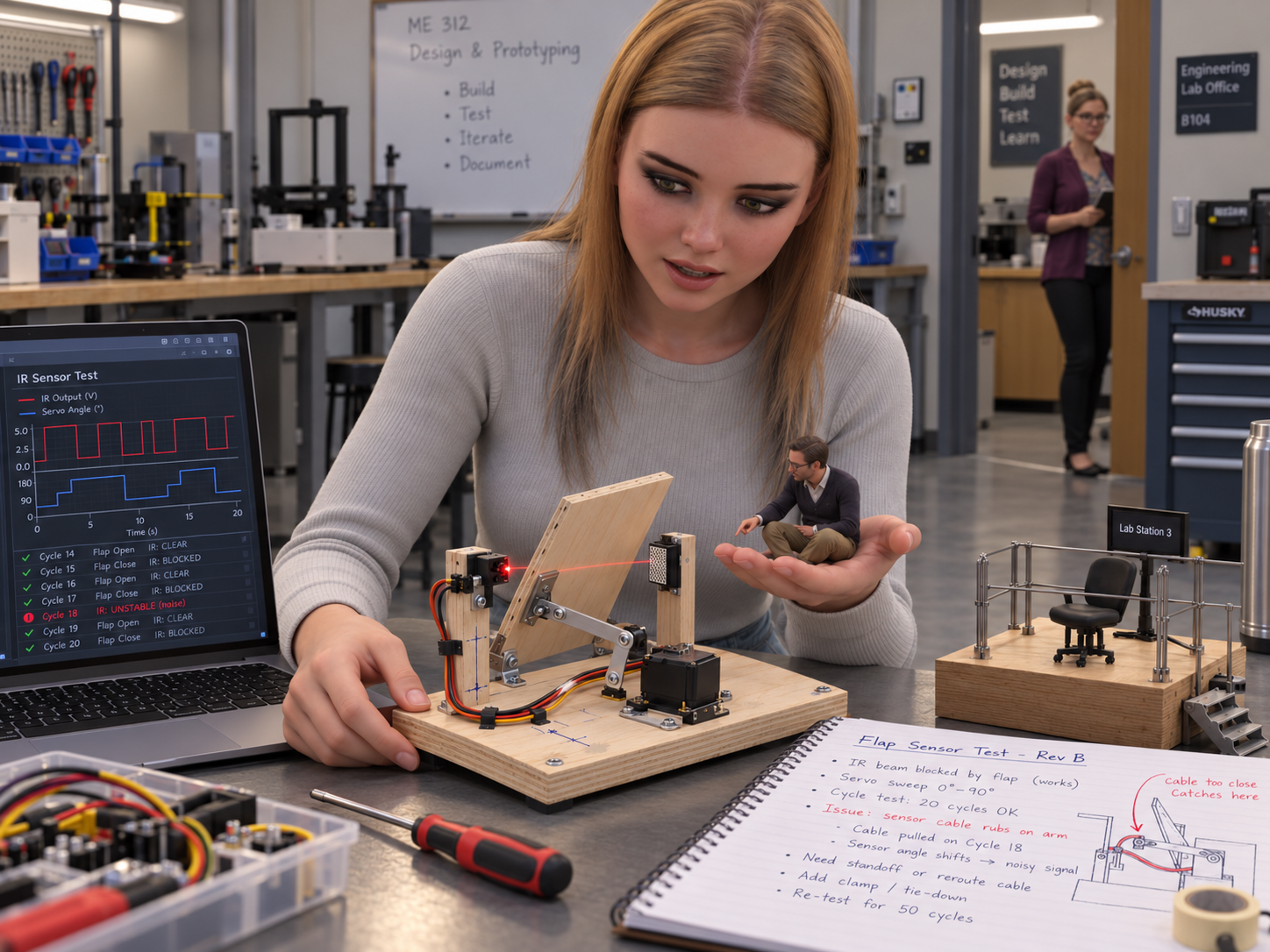
“It’s a smaller version. The enclosure’s still at home.” She took out her notebook and opened the box. Her dad had sent measurements and photographs of the original linkage, including several pictures with his thumb covering the part she needed. The model she had built here used a little hinged flap on a plywood base. It was easier to fit on their kitchen table and considerably easier to bring to campus. “Same arrangement, mostly. I changed the mounting because I couldn’t get the same bracket.”
“And did you mark that change?” Oliver asked. He waited while she found the drawing, then indicated the stand beside his platform. She positioned the notebook against it, low enough for him to see, and unfolded the page showing both versions. This time she remembered without being asked. He studied the measurements before looking back at the assembly. “Good. Tell me what’s going wrong.”
Callie explained the infrared sensor, the servo, and the flap it was supposed to move when something interrupted the beam. Most of the time it worked. After repeated cycles, it sometimes stopped registering the interruption, although the program kept running. She had assumed the motor was affecting the supply and had checked the voltage while it moved. She turned to the recorded readings, making sure the page stayed within his view. There were three evenings’ worth, with the failed cycles circled and the changes written beside each run. One row had a purple line through it where Juna had contributed.
“That one isn’t a measurement,” she said before he could ask. “It’s a road.”
Oliver leaned closer to the page. “Fortunately, it misses the results.” He followed a column with the end of his stylus, then asked why she had changed the sensor position between the second and third runs. She explained that she had wanted to eliminate a reflection from the flap. He asked whether anything else had changed, and she admitted she had moved the cable too. She had written that down, but at the time it had seemed less important. Now she found herself looking at the two notes together.
Brenda saved her spreadsheet and pushed her chair back. “The bench is free until eleven thirty. I’ve put the meter out.” She picked up a folder and glanced toward Oliver. “I’m in the next room doing the equipment returns. Callie, have you handled a Little before?”
“Only the practice equipment in training.” Callie looked from Brenda to him. She had expected Brenda to move him, the way she did after lectures. There had always been somebody else there with more experience. “I haven’t actually held anyone.”
“We can start here,” Oliver said. He walked back to set his stylus beside the tablet. “There’s no hurry. Put your things on the bench first, and then come back for me.”
Callie carried the box through the connecting doorway. The lab was empty, with stools tucked under the long benches and a faint smell of hot dust from equipment somebody had used earlier. She chose the bench Brenda had cleared, set the assembly toward the middle, and moved her backpack to the floor. A low platform with a railing stood at one end, beside a little chair and a screen stand. She checked that the space between it and the model was clear before returning to the office. Her hand had been empty the whole time she was arranging things. Now she was suddenly very conscious of it.
Oliver waited at the open end of his desk platform while Brenda stood nearby. Callie placed her left hand palm up beside the edge, supporting her forearm on the desk. She had practiced that position with a weighted model. It had never looked back at her, adjusted its shirt, or asked whether she was left-handed. She told him she was right-handed and watched him check the small step between the platform and her palm. Her fingers wanted to curl. She relaxed them, then worried she had relaxed them too much.
“That’s fine,” he said. “Keep it there.” He stepped onto her hand, one foot and then the other, and she felt two small points of pressure become a definite weight in the center of her palm. It was slight, easily supported, but she could feel where he was. When he took another step, the pressure moved. Callie watched his shoes settle against her skin and resisted the urge to shift her hand underneath him. She had known he would move. Knowing had not prepared her for feeling her professor walk across her palm.
He sat near the base of her fingers, his knees bent and one hand resting beside him. The contact spread as he settled, changing from the separate pressure of his feet to the small weight of his seated body. She could still feel his heels when he adjusted them. Her hand seemed much larger with him in it, although she had looked at that same hand every day of her life. She kept her thumb still and glanced toward Brenda, who indicated that she could bring her other hand beneath it.
“You can lift now,” Oliver told her. “I’m ready.”
Callie raised him slowly, supporting her left hand with her right. His hand touched the base of her thumb as she came away from the desk, and she stopped before she meant to. He looked up, still seated. Nothing had happened. He had simply adjusted his balance. She took a breath and continued, careful of the doorframe, her elbows close enough to her body that she was not trying to hold him out in front of her. The short walk to the lab took considerably longer than it had with the box. She felt him move once more as she turned, a small change against her palm that drew her attention immediately.
“You don’t have to look at me the entire way,” he said. “The doorway deserves some attention too.”
“I’m looking at both.” Callie glanced ahead, aware that she had mostly been looking at him. At the bench she rested her forearm before bringing her palm level with the little platform. The support helped. Her hand stopped making the tiny corrections she had barely noticed while carrying him. He stood, and she felt his weight gather onto his feet again before he stepped off. She waited until both feet were on the platform to withdraw her hand. Her palm felt oddly empty afterward, and she flexed her fingers below the bench where nobody needed to comment on it.
Brenda checked the position of the platform, then went back through the office to the equipment room. Oliver sat in the little chair and asked Callie to show him the failure before changing anything. She connected the low-voltage supply, opened the program on her laptop, and put the notebook beside the keyboard. At this distance she could hear him when she faced him. When she turned toward the box to find the screwdriver, his next question became too faint to follow. She set it down and leaned closer rather than pretending she had understood.
“How many cycles before it misses?” he repeated.
“Sometimes eight. Sometimes twenty. Once it did thirty and behaved perfectly.” She started the test and interrupted the beam with a piece of card. The flap lifted, paused, and lowered. On the screen, the sensor reading changed as expected. She repeated it while Oliver watched from the platform, making a mark beside each cycle. By the tenth, she was hoping it would fail, which was an irritating reversal of every evening she had spent with it. On the fourteenth, the card passed between the sensor and its reflector and nothing happened.
Oliver asked her to stop there. Callie switched off the supply and disconnected it before reaching across the model. She had already checked the program enough times that she knew where she wanted to look next, but he asked what the screen had actually reported. The sensor had continued to show a blocked path, even after she removed the card. Her program waited for the path to clear before responding to another interruption. She explained that, then pointed toward the mounting block. If the alignment had moved far enough to lose the reflection, passing the card through would no longer produce a change. He asked her to show him the angle from beside the flap.
She bent over the assembly and realized the upright support blocked his view from the platform. Turning the whole base would help with one side and hide the other. She considered lifting it, but the loose leads would fall across the linkage. “I could bring you closer,” she said, then looked at him properly. “If that’s easier.”
“It would be. I want to see underneath that mounting block.” He came to the platform opening while she cleared a space beside the disconnected assembly. This time she placed her palm without looking toward the office for Brenda. He stepped aboard and sat, and the shift in pressure was familiar enough that she recognized when he had settled. She still waited for him to say he was ready before lifting.
Callie rested her left forearm along the bench and brought him beside the model, keeping her hand clear of the flap. From there he could look beneath the sensor mount. He leaned forward, bracing a hand against her thumb, and she felt his weight shift toward the edge of her palm. Her fingers tightened a little before she stopped herself. Closing them would obscure his view and do nothing useful. He asked for a lower position, and she lowered her hand from the elbow, keeping her palm level. The side of her wrist pressed against the bench. She could hold him there comfortably, but now her right hand was the only one available for everything else.
“Turn the base a little toward me,” he said. “The whole base. Leave the mount alone.”
She moved it with her right hand and felt him shift again, his shoes nudging her skin as he changed where he sat. It was distracting in a way the equipment was not. She knew where a screwdriver would remain after she picked it up. Oliver might lean, turn, stand, or decide he needed a different view. She watched his position while adjusting the plywood, then stopped when he raised a hand. His voice was clearer here, close to her and with no one else moving around the room.
“Is the cable meant to pass through that gap?” he asked.
Callie looked beneath the bracket. The sensor lead ran beside the moving arm, with a loop she had left so it would not pull at the connector. She had tucked it back each time she adjusted the assembly. It was no longer tucked back. “No. It should stay outside.” She reached for the pencil to indicate the route, then remembered she was also supposed to be taking notes. “I need another hand.”
“There’s one in the office, but Brenda’s using it.” Oliver straightened and looked toward the clear space she had made. “Put me down there. We can look from this side.”
She lowered her palm to the bench, leaving her fingers flat enough for him to step across. He rose with a hand against her thumb, and she felt the brief, firmer pressure of his feet before he walked onto the work surface. A loose washer lay beyond him. Callie moved it and pulled the disconnected power lead farther back, then set the drawing where he could approach it without stepping over anything. He walked to the edge of the page while she crouched beside the bench to examine the gap. From down here she could see a pale mark on the cable sleeve where the arm had rubbed it.
“It’s catching,” she said. She moved the flap by hand, slowly, watching the loop draw inward. Near the bottom of the movement it pulled against the sensor mount, which shifted just enough for her to see once she was looking for it. She stopped and checked the fastener. It was snug, but the thin support beneath it flexed. “I thought that was staying in place.”
Oliver stood beside her drawing with his arms folded. “How could you check that without relying on what you think you saw?”
Callie wanted to answer quickly. Then she looked at her notebook, where she had already written down several things she had thought were happening. She could mark the position, photograph it before and after, and repeat the movement with the cable held clear. If the mount stayed put then, she would have a better reason to blame the cable. She explained the test while finding a strip of tape. Oliver asked how she would keep the starting position consistent, and she added a reference mark on the base. He let her finish arranging it before suggesting she photograph the original cable route too.
She reached for her phone and stopped when its corner passed above him. He was closer to her notebook than he had been a moment earlier. She moved the phone around him, set it on the far side of the model, and took the photograph. There was enough room on the bench for all of this. She simply had to remember that some of the room was occupied by a person who could walk underneath objects she would normally carry without thinking. When she needed to move the drawing, she asked him to step clear first. He did, taking his place beside the reference mark while she traced the cable route.
Before running the mechanism again, Callie offered her hand to take him back to the platform. He sat farther toward the center this time. She noticed the difference through the position of his weight, then carried him the short distance with her forearm still supported. Once he was clear, she reconnected the supply. They repeated the test with the original route, photographing the mount after each group of cycles. The reference marks separated. With the cable secured away from the arm and the starting alignment restored, they remained together. She kept testing until she had gone beyond the longest successful run in her earlier notes.
“So it’s the cable,” she said, sitting back on the stool. The relief was immediate. She had spent three evenings arguing with a problem she could now point to.
“It’s evidence for the cable moving the mount,” Oliver said. “You still need a proper way to secure it. And you changed the alignment when you put it back, so repeat the original condition once more.” He glanced toward the clock above the lab door. “Have we got time?”
Callie checked her phone. Eleven twelve. She had enough time before preschool pickup, although less than she wanted. She disconnected the supply and returned the lead to its earlier route. Recreating the fault felt wasteful until it happened again and she saw the same movement against the reference mark. She recorded it, then began sketching a small clamp that would keep the cable clear without putting strain on the sensor connector. Oliver asked where it would attach. She showed him, turned the assembly over to check the clearance, and found that her first choice would interfere with one of the base screws. She crossed it out and chose another.
“You’ve become very thorough about recording changes,” he said while she added the new position to her sketch. “Your lab work’s been consistently strong. This is the part I particularly like. You can explain what you tried, including what didn’t help.”
Callie kept her pen against the paper, suddenly uncertain where to look. She cared about her marks. She checked them much too often, usually on her phone while waiting outside preschool. Hearing him say that about the work she did beyond an assignment felt different. “I wasted a lot of time changing things I didn’t need to change.”
“You’re one of my strongest students, Callie. That doesn’t mean you’re never going to spend an evening blaming the wrong component.” He waited for her to look up. “Bring this back when you’ve repeated the tests with the clamp. The department has a student project afternoon in the spring. I’d like you to consider showing it, with the results.”
She asked what that involved, and he explained while she gathered the loose fasteners into their bag. A table, a demonstration, a short account of what she had built and tested. She would have to check the time and arrange something for Juna if it went beyond preschool hours, but that could wait until there was a date. For now she wrote it beneath the clamp drawing. Oliver reminded her that the original enclosure would need its own tests once the change was made there. She had been about to assume the model’s result would settle that too. She added another line to the page.
Brenda came through the office as Callie finished packing. Oliver told her they had found an unwanted cable guide disguised as part of the linkage. Brenda examined the photograph and asked whether Callie wanted a little clip from the parts drawer to try before making the clamp. Callie took one, wrote down what she intended to do with it, and checked that the bench was clear. Her notebook was open beside Oliver’s platform. When he asked for a lift back to the office, she offered her hand before reaching for the book, then realized she would have to leave it there until she returned.
He stepped into her palm and settled with one hand beside her thumb. She felt the movement without needing to watch every part of it this time. His weight was still slight, his shoes still distinct against her skin when he shifted. She brought her other hand beneath hers and carried him through the doorway, looking ahead while keeping him within view. At his desk she held steady as he stood and crossed onto the platform. Only after he was clear did she move her hand away.
“Thank you,” he said. “Email me if the clip changes anything unexpected. Before you redesign the entire bracket.”
“I only did that once.” Callie picked up her backpack, then returned to the lab for the notebook and box. She had been thinking about the clamp, but as she pushed the notebook into her bag she glanced at her empty palm again. The sensation of him moving there had been so specific. Even now she could remember where his hand had rested against her thumb. She tucked the screwdriver into the box, checked for the clip, and went back to say goodbye.
Outside, her phone showed a message from Ryan asking whether the project had cooperated. She had told him about it over coffee on Monday, probably in more detail than he had wanted. Callie typed that they had found the problem, then added that her professor wanted her to show it at a student project afternoon. Ryan’s answer arrived while she was walking toward the car: he would expect a demonstration, provided she warned him which bits he was allowed to touch. She smiled and put the phone away until she reached the parking lot. Before starting the car, she took one more look at the notebook. The clamp needed two holes, a way to secure the cable, and a test she could repeat. She photographed the drawing and sent it to her dad, with a request to leave the original bracket exactly as it was until they talked.

I wonder if having a good guardian relationship with Callie is the reason Ryan’s family didn’t hear much from him.