
CHAPTER 38
May 29, 2027
Callie had managed to pack the blouse she intended to wear to graduation without remembering that she had packed it. She discovered this approximately forty minutes before they needed to leave, after searching her closet twice, looking beneath the bed, and accusing the washing machine of possessing an unusually specific grudge against her. Half the hangers in the closet were empty, and the clothes remaining had been pushed together between a garment bag and two plastic storage containers. At the foot of her bed, three cardboard boxes stood in a neat row, each labeled with a room assignment and a number corresponding to the inventory on her laptop. The system was supposed to prevent situations like this. Apparently, it had not accounted for its creator.
“Ryan!” she called toward the bedroom door. “Have you seen my blue blouse?”
“Which blue blouse?”
“The one I was going to wear today.”
“That doesn’t narrow it down much.”
“It narrows it down to the blouse I specifically told you I was wearing today.”
From the living room came the sound of something being set on the counter, followed by footsteps. Ryan appeared in the doorway carrying two mugs of coffee, one of which he handed her before examining the state of the bedroom. He had stayed over the previous night, as he often did, and had apparently used the extra time that morning to accomplish several things while Callie was busy losing her clothes.
“Did you check the graduation box?”
Callie looked at him over the rim of her mug. “There isn’t a graduation box.”
“There is. You made one.”
“I made a box for things we’re taking with us.”
“Right. Then you decided your graduation outfit needed to stay accessible, so we put it in there.”
Callie lowered the mug. She remembered that conversation now. More importantly, she remembered explaining at considerable length why keeping the outfit separate from everything else was the sensible thing to do. Ryan had agreed, apparently recognizing that arguing would only delay the packing.
“Where is it?”
“Living room. Beside the bookshelf.”
“Which bookshelf?”
“The one we haven’t packed yet.”
She followed him down the short hallway and found the box exactly where he said it would be. GRADUATION / CARRY was written across the top in her own handwriting. Beneath it, in smaller letters, someone had added Do not ship this, Callie.
She looked at Ryan.
He took a drink of his coffee. “You’re welcome.”
“That’s incredibly disrespectful.”
“You were about to put it on the moving truck.”
“I was temporarily considering relocating it.”
“Across the country.”
“That wasn’t established.”
He smiled and went back toward the kitchen while Callie opened the box. The blouse was folded beneath her dress pants and a small bag containing the jewelry she had chosen. Everything was where it belonged. She was beginning to find Ryan’s competence personally offensive.
Juna occupied most of the living-room floor with the contents of a suitcase that was supposed to contain clothing for the trip. Instead, Callie found a collection of books, colored pencils, two stuffed animals, a handheld game system, a plastic container of building pieces, and an assortment of other objects apparently selected according to no principle except their immediate importance to Juna Grey.
“Sweetheart, where are your clothes?”
Juna looked up from the suitcase. “In my room.”
“Why aren’t they in your suitcase?”
“Because I’m packing the stuff I need.”
“Clothes generally qualify.”
“I have clothes on.”
Callie considered the argument for a moment. It was technically true, which made it considerably more irritating.
“Okay. We’re going to have a few days before all our boxes arrive at the new house. You need enough clothes and other things to get through that.”
Juna looked down at the suitcase, apparently reconsidering its capacity. “Can I have another one?”
“No.”
“But Gus needs to go in here, and I can’t squish him.”
The stuffed purple Ridgeback sat beside the suitcase, looking considerably more worn than he had when Callie first brought him home years earlier. One ear had been repaired twice. His nose was faded, and the fabric along his back had become softer from years of being carried, hugged, and occasionally subjected to medical procedures involving plastic toy instruments.
“Gus can come with us,” Callie assured her. “But some of the other things can go in a box.”
“Which things?”
Callie crouched beside the suitcase and surveyed the collection. The books could be divided. The pencils could stay. The game system certainly needed to remain accessible if she wanted to preserve her own sanity during the trip. The building pieces were another matter.
“Are you planning to build something while we’re traveling?”
“Maybe.”
“In the airport?”
“Not there. In the new house.”
“Then those can go in a box.”
“What if the box doesn’t come?”
“The box is going to come.”
“What if it comes late?”
Ryan appeared from the kitchen carrying a plate of toast. “She’s got you there.”
Callie turned toward him. “You’re supposed to be helping.”
“I am helping.” He set the plate on the coffee table and sat beside Juna. “All right, let’s make a deal. You pick three books, one game, and one project you want with you. Everything else gets packed so it’s waiting at the new house.”
Juna considered him. “Can I pick four books?”
“Depends. Are you going to read all four?”
“Yes.”
“Then four.”
“Five?”
Callie pointed at her daughter. “The negotiation has concluded.”
Juna grinned and began sorting her belongings while Ryan helped her make two piles. As she moved the books aside, a photograph slipped out from between their covers. Callie recognized it as one Juna had brought home from her last day of school the previous afternoon. She was standing beside the girl she’d become particularly close to that year, both of them smiling at the camera with their arms around each other’s shoulders.
“You’re bringing that?” Callie asked.
Juna picked it up carefully. “Yeah. She gave me a card too. It’s in my backpack.”
“That’s nice.”
“She said I have to send her pictures of my new school.”
“You should. We can do that.”
When she and Ryan had first told Juna about the move, her daughter’s questions had been almost entirely about her friends and whether Ryan would be coming with them. The excitement about Gracewood had developed gradually, helped along by photographs of the new house, information about the school, and the transportation maps Juna had taken to studying. Some days she asked questions about New York until Callie ran out of answers. On others, she wondered why they couldn’t simply stay in California. Callie had tried to give her room for both reactions without treating either as a problem that needed correcting.
Juna placed the photograph inside the front cover of one of her books, apparently satisfied it would be safe there, then resumed sorting through the suitcase.
Watching her and Ryan, Callie experienced an uncomfortable recognition that had little to do with packing. Ryan knew which arguments Juna was likely to make before she made them. He knew that offering a choice worked better than issuing an instruction, and that Juna would almost always try to expand whatever choice she received. He knew she preferred to keep her favorite possessions where she could see them, even when she had no intention of using them.
For years, his presence had become part of how their household functioned. Sometimes that meant dinner, homework, or a trip to the grocery store. Other times it meant something as simple as calling from the next room because Callie had forgotten where she put her keys. He still had his own apartment in the building, with his own furniture and responsibilities, but that distinction had become increasingly unimportant to the way they spent their days.
In a few days, she wouldn’t be able to call for him from the next room.
Ryan glanced up and caught her watching.
“You should probably get dressed,” he said. “Unless you’re planning to graduate in that.”
Callie looked down at her sleep shirt and shorts. “I thought I’d make a statement.”
“You’ve already made several this morning.”
“None of them were appreciated.”
He smiled and returned to helping Juna sort her books. Callie carried the blouse into the bedroom, leaving them to negotiate the future of a plastic container that apparently contained several irreplaceable pieces of civilization.
By the time they reached campus, the morning had warmed enough that Callie regretted bringing a jacket. She had put it on because the apartment was cool when they left, then carried it through the parking lot while Ryan walked beside Juna, who was explaining why graduation ceremonies should include food during the speeches rather than afterward. Having finished her school year, Juna appeared to have decided that this entitled her to question the usefulness of schedules in general.
Stuart spotted them first. He stood near the entrance to the graduate assembly area with Sally and Hannah, holding his phone in one hand and waving with the other. Sally was studying something on her own phone, probably the seating information Callie had sent her three times, while Hannah examined the growing crowd with an expression suggesting she had already found several things worth commenting on.
“There she is!” Stuart announced when they reached him. He opened his arms, and Callie stepped into the familiar embrace before he could make a production of it. “My little girl. Master’s degree and everything.”
“Almost,” Callie corrected against his shoulder. “Technically, they haven’t handed it to me yet.”
“Wouldn’t want to get ahead of ourselves.”
Sally hugged her next, then held her at arm’s length long enough to inspect the outfit. “You look lovely, sweetheart. Everything going all right with the move?”
“Mostly. The movers have the inventory, the shipping arrangements are confirmed, and we’re down to what we’re keeping with us.”
“Anything you want us to handle while we’re here?”
Callie smiled at the difference between that question and the conversations they had once had about whether she was ready to leave Minnesota. Her mother had spent years helping her work out what she needed. Now she was asking what Callie wanted.
“Actually, could you take Juna for a couple of hours tomorrow? Ryan and I need to finish sorting the kitchen.”
“Of course.”
“Mom,” Hannah interrupted, “you haven’t even asked what the payment is. She’s making us work on our vacation.”
“You’re getting an afternoon with your niece,” Sally replied. “I would think that counts as a pretty good deal.”
“It does,” Hannah admitted. “But I was hoping to negotiate lunch.”
“I can provide lunch,” Callie said.
“See? This is why you ask.”
Maggie arrived while they were arguing, carrying a small gift bag and wearing an outfit Callie recognized as one of her work-meeting choices. Her best friend had settled into UI/UX design with the same mixture of sharp observation and stubborn insistence that had made her college projects both successful and occasionally infuriating to her instructors. These days, she talked about design reviews, user-testing sessions, and clients who insisted that their software needed to be intuitive while refusing to explain what they wanted it to do.
“Okay,” Maggie said, looking Callie over. “Official assessment. You look like someone who’s about to become insufferable.”
“About to?”
“Fair correction.” Maggie hugged her, then stepped back. “I got you something, but you’re not opening it until dinner.”
“Why bring it now?”
“Because I wanted you to know I was thoughtful.”
Juna immediately demanded to know whether Maggie had brought anything for her. Maggie informed her that today was her mother’s graduation and that, for once, somebody else was allowed to receive presents. Juna accepted this with the generous tolerance of a child who had already received considerable attention from her grandparents.
Ryan checked his phone and looked toward the building. “You’ve got about ten minutes before you’re supposed to report.”
Callie followed his gaze. Students in academic gowns were already moving toward the assembly entrance, some carrying their hoods over their arms, others struggling to keep their caps in place while relatives photographed them.
“Okay.” She adjusted the folder beneath her arm and looked at Juna. “You going to behave for Ryan?”
Juna gave her a deeply offended look. “I always behave.”
Hannah made a noise that required no translation.
Ryan took Juna’s hand before the argument could develop. “We’ve got the seats. Third section from the front, toward the aisle. I’ll text you a picture when we get there.”
“Thanks.” Callie leaned forward and kissed him, then crouched to hug Juna. Her daughter squeezed her firmly before stepping away to straighten the front of Callie’s gown.
“Don’t trip,” Juna advised.
“I didn’t trip last time.”
“I know. I’m making sure you don’t this time.”
“Excellent. Hadn’t considered that.”
Callie left them debating whether walking carefully was something she should already know how to do and joined the other graduates heading inside.
The ceremony passed more quickly than she expected. She remembered her undergraduate graduation as a confusing mixture of excitement, exhaustion, and the peculiar sensation of finishing something she had spent years trying to reach. Today felt different. She knew how the procession worked, knew when to stand and when to sit, and had already accepted that academic regalia seemed designed by people who had never considered the temperature inside a crowded auditorium.
Her hood rested against her shoulders, its unfamiliar weight reminding her that this degree was not the same as the one she had received two years earlier. Around her, classmates whispered over folded programs, searched the audience for relatives, and quietly compared where they would be working after summer. Callie recognized people from laboratories, presentations, late afternoons spent correcting calculations, and several group projects she had survived through methods that were not always compatible with friendship.
Her research was finished. The final submission had been approved. There were no corrections waiting in her inbox, no presentation she still needed to rehearse, and no professor expecting another revised draft by Monday morning.
She could hardly remember the last time that had been true.
When the graduate degrees were announced, she stood with the others in her row and waited for her turn. She found her family almost immediately. Stuart had raised his phone. Sally sat beside him, smiling, while Hannah was apparently explaining something to Maggie. Ryan stood at the end of their row with Juna in front of him, one hand resting lightly on her shoulder.
Juna was watching the stage with absolute concentration. She had been studying the procession long enough to understand that each graduate had to wait for a name before walking forward. When Callie’s section approached, she leaned toward Ryan and pointed at the stage. He said something that made her straighten, and Callie realized her daughter was preparing herself.
Then the announcer called her name.
Juna waited until Callie stepped forward before bringing her hands together in several enthusiastic claps.
“THAT’S MY MOM!”
Several people nearby laughed. Ryan bent toward her, apparently reminding her of the people sitting around them, but Juna kept clapping as Callie crossed the stage. She wasn’t shouting simply because the room was loud. She had waited for her mother’s moment and had no intention of letting it pass without proper acknowledgment.
Callie smiled for the official photograph, accepted the congratulations offered to her, and returned to her seat with the extraordinary satisfaction of knowing there was nothing left to submit.
Eight years earlier, Juna had been small enough to fit against her chest while Callie tried to finish homework with one hand. Now she was standing beside Ryan in the audience, tall enough to see over the seat in front of her and old enough to understand why everyone had gathered.
Callie found them again before sitting down.
Juna waved.
Callie waved back.
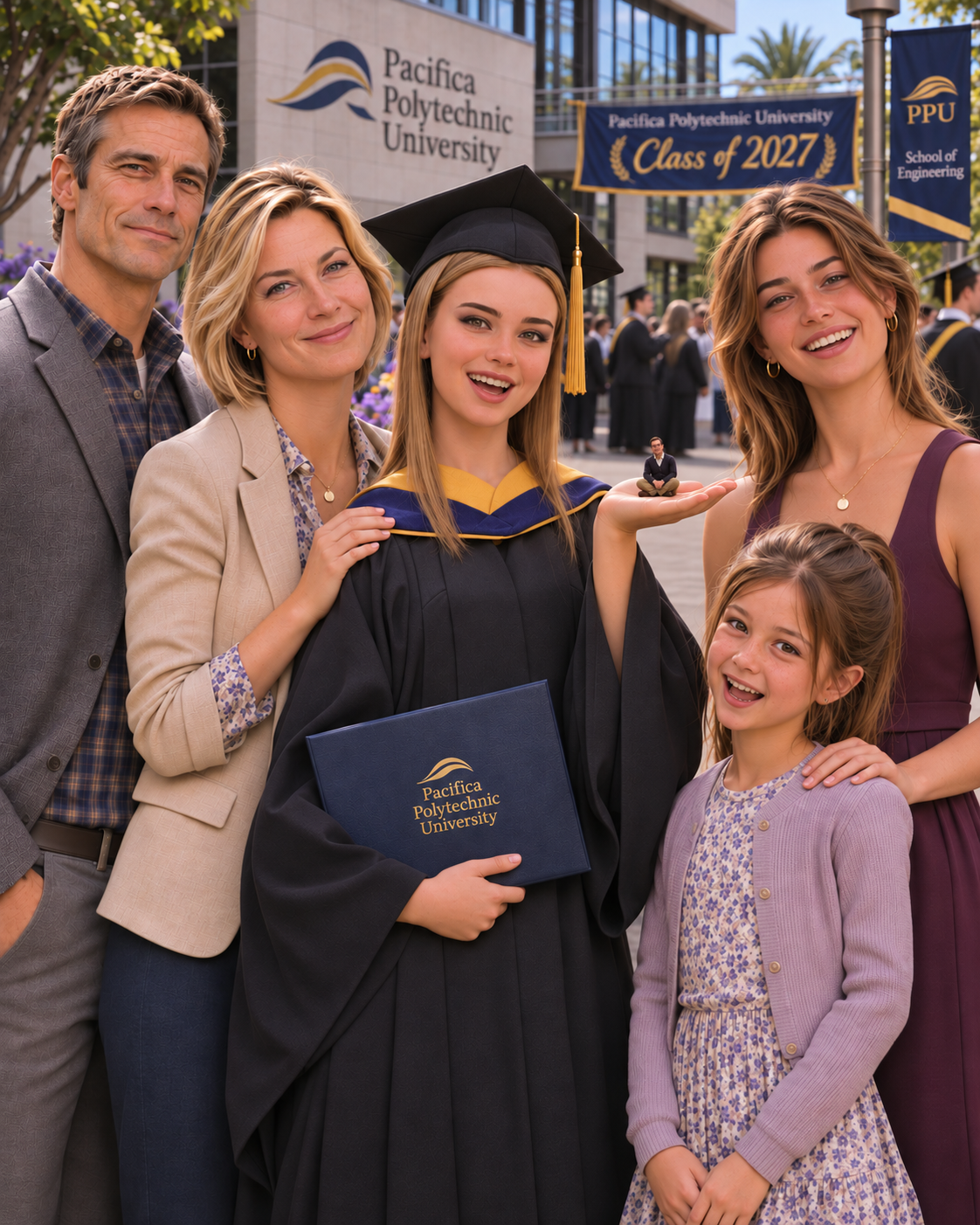
Afterward, they emerged into the bright afternoon among hundreds of graduates and families attempting to arrange photographs without blocking the walkways. Callie surrendered to the first round of pictures, endured Hannah’s instructions about standing straighter, and reminded Stuart that he did not need photographs of her from every conceivable angle. He informed her that she was welcome to stop being interesting whenever she liked.
While Sally and Maggie compared pictures, Hannah crouched beside Juna and began scrolling through the photographs on her phone.
“That one’s good,” Juna said, pointing.
“Your mom’s eyes are closed.”
“Not that one. The one where she’s walking.”
“She’s looking at the floor.”
“Because she was checking for steps.”
Hannah laughed and showed Callie the picture. “Apparently your daughter thinks this is the important part.”
“She’s not wrong. I’ve got a reputation to maintain.”
Hannah stood and slipped her phone away. “Hey, when you get settled, send me the new address. I want to get something out for Juna’s birthday.”
“You could send it to Mom. She has the address.”
“Yeah, but then Mom will decide what I should buy.” Hannah gave her a look. “I’m capable of handling my own niece’s birthday present.”
Callie smiled. Hannah had become increasingly involved in the operations at Grey’s, learning more about the ordering and supplier arrangements that Stuart and Sally had managed for years. She still complained about customers and occasionally called Callie to ask questions that could have been answered with a search, but she was no longer the little sister who depended on someone else to solve every problem.
“Fair enough,” Callie said. “I’ll send it.”
“And if you need something from home after the move, tell me before Mom starts shipping half the house.”
“I’ll keep that in mind.”
Callie was preparing to walk toward the parking area when she spotted Brenda beside one of the department’s portable platforms. Professor Frank waited on the adjoining Little-scale seating arrangement, speaking with another graduate.
She excused herself and crossed the lawn, her gown brushing against her legs.
“Professor Frank?”
Oliver Frank looked up from his conversation. His expression brightened when he recognized her.
“Callie Grey. I was beginning to think you intended to escape without saying goodbye.”
“I was looking for you.”
“A very reassuring distinction.”
Brenda greeted her with a smile. “Congratulations, Callie. We heard your name.”
“Thank you.” Callie lowered herself beside the table, bringing her face closer to Oliver’s level. She had grown accustomed to doing that during their years working together. “I’m glad you came.”
“Of course I came. I wanted to see whether you managed to graduate without submitting one final revision.”
“That seems unfair.”
“Of course it does. You haven’t had to submit anything in almost a week.”
Callie laughed. “I’m still getting used to that.”
They talked for several minutes about her research and the final approval. Oliver asked which aspects of the interface she expected to keep working on and listened while she explained how her Generitech position would build on the bioelectronic systems she had studied during her master’s. She would be joining an established research group, not directing a project of her own, and the exact assignment would depend on the team’s priorities after she completed orientation.
“And when do you start?” he asked.
“June seventh. Associate Research Engineer, Bioelectronic Interfaces.”
“An appropriately long title. How much paperwork did it take to print that?”
“Quite a lot, actually.”
“Good. Make sure you spend those first few weeks listening before you decide how everything should be improved.”
Callie gave him a look. “You’ve met me.”
“Unfortunately, yes.”
She smiled, then grew more serious. “I also wanted to thank you for the reference.”
Oliver rested his hands on the railing. “I told them what I thought of your work.”
“I know. Maren mentioned it during the interview.”
“Then I trust she told you they asked for an honest assessment.”
“She did.”
“Good. I gave them one.”
Callie shook her head, amused. “That’s reassuring.”
“It should be.” Oliver watched her for a moment before continuing. “I told them you were willing to investigate a failure instead of deciding you already understood it. I also told them you occasionally became attached to your first explanation.”
“You’re never going to let me forget that sensor mechanism.”
“Certainly not. It was an excellent lesson.”
Callie remembered the troublesome assembly she’d brought into his office years earlier. She had been convinced the problem was electrical, only to discover, after Oliver insisted they reproduce the failure, that a cable was catching against the linkage. She had been ready to change the circuit when the actual problem was mechanical. Oliver had made her establish what was happening before she started replacing components.
“I was so sure the circuit was the problem,” she said.
“You had a plausible explanation.”
“Just not enough evidence.”
“Exactly.”
Callie glanced at Brenda, remembering the first time she had carried Oliver from the office into the lab. “You didn’t just tell me what I was doing wrong. You made me figure out why.”
“That was the assignment.”
“I know. But you kept doing it. Even after I got better at arguing with you.”
Oliver smiled. “Especially then.”
She looked at him for another moment. “You took my work seriously before it was particularly impressive. And you kept giving me things I wasn’t quite ready for, then expecting me to figure out how to become ready. I really appreciate that.”
His expression softened slightly. “It was interesting work, Callie. You were willing to learn. That’s a combination worth investing time in.”
She glanced toward her family, who had gathered beneath a nearby tree. “Would you like to come over for a picture? Everybody’s here.”
“I would.”
She looked at Brenda. “Can I give him a lift?”
Brenda turned toward Oliver rather than answering for him.
“Please,” Oliver said. “My legs are not going to improve before the next photograph.”
Callie brought her hand level with the platform, her forearm supported against the table. Oliver stepped into her palm and sat near the base of her fingers, just as he had that first afternoon in the laboratory. She waited until he told her he was ready before bringing her other hand beneath and lifting him.
The movement was easy now. She no longer spent the entire time watching him instead of where she was walking, although she still kept her hand level and paid attention when he shifted his position.
“You’ve gotten considerably better at this,” Oliver observed as she stood.
“I’ve had practice.”
“I remember when you spent the entire walk to the lab watching me instead of the doorway.”
“You were moving.”
“People tend to do that.”
She carried him across the lawn to her family, with Brenda walking beside them. Juna immediately recognized the professor and greeted him, reminding him that he had once helped her mother fix a little door that kept sticking.
Oliver assured her that he remembered and that her mother had eventually accepted some very sensible advice. Callie disputed the characterization while Ryan positioned everyone for the photograph.
“Callie, bring him up a little,” Ryan said, studying the camera screen. “Otherwise he’s going to disappear against your gown.”
Callie lifted her palm carefully until Oliver was near shoulder height, comfortably supported in front of her. Ryan stepped closer to frame the photograph so Oliver would be visible beside her face while the rest of the family remained in the shot.
“Better?” Callie asked.
“Much better.”
“Am I adequately represented?” Oliver inquired.
“You’re in the picture, Professor.”
“Excellent. I was concerned I might be mistaken for an unusual brooch.”
Juna burst out laughing, nearly ruining the photograph. Ryan took another, and this time they managed to get everyone looking toward the camera.
When it was over, Callie returned Oliver to his waiting platform and stayed beside the table a moment longer.
“Keep in touch,” he told her. “I want to hear what you discover when you’ve got access to equipment we can’t afford.”
“I will.”
“And Callie?”
She looked back.
“I’m very pleased with the engineer you’ve become.”
Callie smiled, feeling unexpectedly reluctant to leave. “Thanks, Professor.”
Callie was still thinking about Professor Frank’s parting words when she returned to her family. Ryan stood beneath a tree with Juna beside him, showing her something on his phone while Hannah and Maggie argued over which graduation photograph was worth keeping. Sally had taken possession of Callie’s flowers, apparently deciding that somebody needed to make sure they survived the afternoon. Stuart stood a little farther away, talking to a man whose back was turned toward her.
She recognized the man’s posture before she saw his face.
There was something familiar about the way he stood, one hand in his pocket and the other holding a paper coffee cup while he listened to her father. Callie slowed, trying to place him. The pale blue shirt and dark slacks could have belonged to any number of people attending graduation, but the way he shifted his weight and gestured with the cup made her think of someone she hadn’t seen in years.
Then he turned.
Callie stopped.
“Mr. Steverson?”
Jed Steverson looked across the lawn and smiled.
“Hello, Callie.”
For a moment she simply stared at him. He looked older than he had at Ridgemont High. There was more gray in his hair, and the lines around his eyes had deepened. But the expression was unmistakable, particularly the slightly amused look he used to give her when she was about to explain why some perfectly reasonable classroom instruction didn’t apply to her.
“What are you doing here?”
“Attending a graduation, apparently.”
“I can see that.” She crossed the remaining distance toward him. “You came all the way from Minnesota?”
“I did.”
“For my graduation?”
“Well, I certainly didn’t come for the parking.”
Stuart laughed, looking considerably too pleased with the situation. Callie glanced at him, immediately suspicious.
“Did you know about this?”
“First I heard of it was when he walked up and said hello,” Stuart assured her. “Figured I’d let him surprise you.”
Callie turned back to Jed.
“You didn’t tell me you were coming.”
“No.”
“Why?”
He smiled, although there was something hesitant about it.
“I wasn’t entirely sure I should.”
That was not the answer she’d expected. She had kept in touch with Jed intermittently since leaving Ridgemont, usually exchanging emails about engineering projects or articles he thought she might find interesting. He’d congratulated her when she finished her undergraduate degree, and they’d spoken briefly after Generitech contacted her. She had appreciated that he still took an interest in her work, but nothing about those conversations had suggested he intended to appear at her master’s graduation.
“You could’ve asked,” she said.
“I could have.”
She waited.
Jed glanced toward the rest of her family, then back at her.
“I wanted to see you graduate, Callie. And there are a few things I’ve been meaning to talk to you about. Things I’d rather say in person.”
Callie studied him more carefully. Jed had never been especially sentimental, at least not in any way she remembered from his classroom. His version of encouragement usually involved pointing out something she’d done correctly before explaining what she could improve. When he’d congratulated her on getting into PPU, he’d spent almost as much time asking about its engineering facilities as he had discussing her acceptance.
“Okay,” she said. “You’ve definitely got my attention.”
Jed looked toward Stuart. “Would you mind if I borrowed your daughter for a few minutes?”
Stuart glanced at Callie rather than answering.
She nodded. “It’s fine.”
“Take your time,” Stuart said. “We’re not going anywhere.”
Callie was reasonably certain that wasn’t true. Her father had been discussing lunch for the better part of an hour, and Juna had already asked twice when they would eat. But she let the statement pass.
Jed gestured toward a paved walkway leading past the engineering building. Callie followed him, carrying her diploma folder beneath one arm and her jacket over the other. Families crossed the lawn around them, stopping for photographs beneath graduation banners or searching through programs for relatives who had disappeared into the crowd. The afternoon sun was warm against her shoulders, and the breeze was just strong enough to make the loose fabric of her gown move around her legs.
They had gone perhaps thirty yards when Callie glanced at him.
“You’re making this feel like I’m about to get called into your office.”
Jed looked over.
“You remember those conversations?”
“Unfortunately.”
“You generally deserved them.”
“I was an excellent student.”
“You were an excellent student who occasionally believed instructions were suggestions.”
“Only when the instructions were wrong.”
Jed smiled.
“I’ve missed that.”
They reached a bench beside a landscaped garden, far enough from the main gathering that the conversations around them had become less distinct. Jed stopped beside it and set his coffee cup on the wooden seat.
“First,” he said, turning toward her, “congratulations. You earned this.”
“Thank you.” Callie shifted the diploma folder. “I appreciate you coming.”
“I wanted to.” His gaze moved toward the engineering building. “You’ve accomplished quite a bit since you left Ridgemont.”
“Yeah. It’s been a busy few years.”
“I imagine.”
Something in his tone made her look at him.
“You know, that actually brings me to something I should probably explain.”
Callie raised an eyebrow.
“That sounds promising.”
“Do you remember when you were applying to Pacifica Polytechnic? You sent me some of your projects.”
“Sure. You told me one of my circuit diagrams was unnecessarily complicated.”
“It was.”
“It worked.”
“Those statements aren’t mutually exclusive.”
Callie smiled despite herself.
“Anyway,” Jed continued, “I’ve known someone on the engineering faculty here for years. We worked together on an educational program before she came to PPU. We still see each other occasionally at conferences and workshops, and we keep in touch.”
“Okay.”
“Not long after you started college, we were talking about the first-year engineering program. I mentioned that one of my former students from Minnesota had enrolled here.”
Callie looked at him.
“She knew who you were.”
“What?”
Jed smiled faintly.
“Apparently you’d already managed to make yourself memorable.”
“That doesn’t sound especially encouraging.”
“She said you asked a lot of questions.”
“Oh, that’s definitely bad.”
“She also said you did the work.”
Callie laughed, then stopped.
“Wait. You’ve been talking to somebody here about me?”
“Occasionally.”
“How occasionally?”
“Once or twice when we happened to speak. Sometimes less. It wasn’t anything organized, Callie.”
She stared at him.
“Mr. Steverson.”
“I didn’t ask to see your grades or student records. I wasn’t calling the university to check your attendance.” He looked mildly offended by the possibility. “We’d catch up about our work, and sometimes I’d ask if she’d heard anything about you. Occasionally she had. Other times she hadn’t.”
Callie folded her arms.
“And you’ve been doing this since I started here?”
“More or less.”
“That’s six years.”
“Yes.”
She looked toward the engineering building, trying to picture how many conversations could have taken place without her knowing. The university was large. She’d worked with dozens of instructors, research assistants, and graduate students. It was entirely possible that someone she’d encountered during her first year knew Jed without ever having mentioned him.
“Why didn’t you tell me?”
“I didn’t think there was particularly much to tell.”
“You were keeping tabs on me.”
“Not quite.” Jed considered his wording. “I was interested in how you were doing. When we spoke, I sometimes asked. That’s all.”
“You could’ve asked me.”
“I did sometimes.”
“About my projects. Not whether I was actually managing.”
He nodded.
“That’s fair.”
Callie looked at him for another moment.
“Why?”
Jed glanced down at his coffee cup.
“Because I wanted to know.”
“That’s not much of an answer.”
“No,” he admitted. “I suppose it isn’t.”
He looked toward the students crossing the lawn.
“At first, I wondered how you were settling in. You’d moved a long way from home, and you were beginning a demanding program while raising a young child. Later, I started hearing about your projects and some of the research you were involved in. Your name appeared in university announcements and presentations. I kept seeing indications that you were doing well.”
Callie studied him.
“And you were surprised?”
Jed hesitated.
“I was pleased.”
“That’s not what I asked.”
“No,” he acknowledged. “It isn’t.”
She waited, but he didn’t immediately continue. That was unusual. Jed had always been remarkably comfortable saying things Callie didn’t particularly want to hear.
“You thought I was going to quit,” she said.
He looked at her.
“I thought it was a possibility. A serious one.”
Callie felt the familiar irritation return.
“A serious one.”
“Yes.”
She turned toward the building again, remembering a conversation in his classroom that she’d carried with her for nearly a decade.
“You told me I could be an engineer.”
“I did.”
“But you didn’t think I’d actually get there.”
Jed considered that for a moment.
“I thought the obstacles you were facing might prevent you from getting there.”
“That’s a very teacher way of saying the same thing.”
He gave a small, reluctant smile.
“Probably.”
Callie looked down at the diploma folder in her hands. She’d remembered Jed’s encouragement many times during college, particularly when she became frustrated with a project or began worrying that she was taking on more than she could reasonably manage. But she’d remembered his doubts too. Sometimes those had been more difficult to put aside.
“You know what I remember most about that afternoon?” she asked.
“What?”
“You told me you thought I was responsible enough to try doing everything until I couldn’t anymore.”
Jed nodded.
“I remember.”
“You were pretty specific. Full course load, raising Juna, working, helping at Grey’s, never asking for an extension.”
“That sounds like something I’d say.”
“You did say it.”
Callie shook her head.
“And the annoying thing was that you weren’t entirely wrong. I did try to do all of those things. A lot of the time, actually.”
“I suspected you might.”
She gave him a look.
“Don’t sound pleased with yourself.”
“I’m not.”
“Good.”
She glanced toward the bench and considered sitting, but the graduation gown made the prospect more complicated than it was worth.
“There were semesters I barely got through,” she continued. “Juna would be sick, or I’d have a lab running late, or somebody would need me at work. I’d get home and still have three hours of assignments left. Sometimes I’d sit there wondering whether I was actually going to finish.”
Jed listened without interrupting.
“And sometimes I’d remember you telling me I was making a mistake.”
His expression changed.
“Callie…”
“You said it. I remember the exact words.”
“I know.”
She looked at him for several seconds before continuing.
“I knew you cared about me. That’s why I listened to you in the first place. But when you told me you thought I might be making a mistake, I heard that you didn’t believe I could do it.”
Jed looked down briefly.
“I can understand that.”
“I wasn’t asking you to tell me everything was going to be easy. I knew it wouldn’t be. I’d been hearing about everything that could go wrong since I found out I was pregnant.”
She adjusted her grip on the folder.
“I just wanted somebody who understood what I wanted to do with my life to believe I still had a chance.”
They stood quietly for a moment. Jed didn’t offer an explanation, and Callie wasn’t sure whether she wanted one yet.
“There’s something else,” he said eventually.
She looked at him.
“I’ve wanted to ask you about Myles.”
Callie’s expression changed.
“What about him?”
“His death. What happened afterward.” Jed paused. “I was still teaching at Ridgemont when the accident happened. I knew you’d been there that night. And I heard about the memorial.”
Callie looked away.
She hadn’t expected Myles to become part of this conversation, although perhaps she should have. Jed had known her before Juna was born. He had been there when everyone at school seemed to have an opinion about her pregnancy, and he’d been teaching at Ridgemont when Myles died.
“You heard about what happened at his locker?”
“I heard there was an argument. I heard you told some of the students that Myles hadn’t been involved in raising Juna.”
“That was one way of putting it.”
Jed waited.
Callie could remember that hallway with uncomfortable clarity. The purple-and-white ribbons, the flowers, the photographs of Myles laughing with his friends. The silver balloon tied above his locker. She could remember looking at a card calling him a good kid and feeling something inside her tighten.
“Everybody kept acting like he was this wonderful person,” she said. “And I knew he had been a good friend to some of those people. I’d been his girlfriend. I had good memories of him too. But people kept coming up to me and telling me how sorry they were, like we’d been together all those years and I’d lost the father of my child.”
Jed nodded slowly.
“They didn’t know what happened.”
“Most of them didn’t.” She looked at him. “His parents wanted him completely out of Juna’s life. They had an attorney involved. Documents giving up his rights and responsibilities. They even tried to include something that would’ve stopped me from identifying him publicly as her father.”
Jed stared at her.
“I didn’t know that.”
“Yeah. Most people didn’t.”
She remembered the attorney’s office, the long wooden table, and the recorder sitting in the middle with its red light glowing. She remembered how long it took to make Myles explain his own decision instead of allowing his parents and their attorney to do all the talking.
“I made him say what he was choosing,” she continued. “Not what his parents wanted. What he wanted. I made him say it on the recording.”
Jed looked at her carefully.
“What did he say?”
“That he was refusing custody. Refusing to help raise the baby. Refusing to support her. And when I asked what all that caring he claimed to have was actually going to mean for our child…” Callie stopped, remembering how quietly Myles had answered. “He said nothing.”
Jed was silent.
“Nothing,” she repeated. “That was what he was going to do for Juna.”
She looked away, toward a family gathering beneath one of the graduation banners.
“Then he died, and everybody wanted me to act like none of that had happened.”
“Callie, I didn’t realize how much was involved.”
“I know.”
She drew a breath.
“And the thing is, I wasn’t glad he died. I wasn’t celebrating. I was there when he crashed.”
Jed nodded.
“I heard that.”
“We tried to stop him from driving. I offered him a ride. Luke tried to get his keys. There were other people trying to help, and Myles just…” She shook her head. “He got away from everybody. He passed us on the road. I remember looking at his car and thinking he was going too fast.”
Her fingers tightened against the diploma folder.
“Then he didn’t make the turn.”
The memory was still extraordinarily clear: the road ahead, Myles’s taillights, the enormous oak standing beyond the edge of the pavement.
“I watched him hit that tree,” she said.
Jed didn’t speak.
“I wanted somebody to get him out. I wanted him to be okay. Whatever else he’d done, I didn’t want him dead.”
“Of course you didn’t.”
“But afterward, when everybody kept telling me what a good person he was, it felt like I was supposed to pretend Juna didn’t exist. Like dying somehow erased the decision he’d made about her.”
Callie looked down.
“I wasn’t trying to ruin his memorial. I told those kids they could keep the flowers and the pictures. They could remember all the good things about him. I had good memories too.”
She paused.
“I went back later and left a photograph of Juna.”
Jed looked at her.
“At his locker?”
“Yeah. Just a picture of her. I didn’t write anything on it.” Callie swallowed. “I wanted her to be there too. She was part of his life whether he wanted to acknowledge it or not.”
Jed watched her for several seconds.
“I wish I’d known more about what you were dealing with.”
Callie gave a small shrug.
“I wasn’t exactly telling everybody.”
“No. I understand that.”
“I didn’t want every conversation to turn into a discussion about Myles. I was trying to raise Juna and get through school. Most days I just wanted people to leave me alone.”
She thought of Maggie and Luke, of the things they’d learned at the memorial and the way they’d struggled with the realization that they hadn’t known everything about what happened.
“My friends didn’t even know all of it until that day,” she admitted. “Not because they didn’t care. I just didn’t want to keep talking about it.”
Jed nodded.
“I remember hearing about the argument and wondering whether I should find you. Then I told myself you had your family and your friends, and that if you wanted to speak to me, you knew where my classroom was.”
“I probably would’ve told you I was fine.”
“I imagine you would have.”
“I might’ve gotten mad at you.”
“That wouldn’t have been new.”
Callie smiled faintly.
“But I could’ve asked,” Jed said.
She looked at him. He wasn’t trying to turn the conversation toward his own regret, and she appreciated that. She had needed people to give her room back then, even if she’d occasionally wished they understood more than she was willing to tell them.
“I was angry for a long time,” she admitted. “Not all the time. Mostly I was busy. But sometimes something would remind me of him, and I’d get angry all over again.”
“I can understand that.”
“And sometimes I missed the person he used to be.” She looked toward the distant graduation crowd. “I don’t know if that makes sense.”
“It does.”
“I liked him, Mr. Steverson. Before everything happened. There were good things. That’s what made the way he treated me afterward so hard to understand.”
Jed nodded.
“People aren’t always one thing, Callie.”
“No,” she agreed. “They’re really not.”

Man, these moments with the Grey family altogether are awesome.
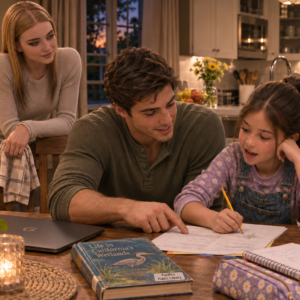
When I saw the picture before reading the episode I thought “Oh No! Ryan shrank”, but then I remembered Professor Oliver. So maybe we will see Ryan with jazz hands yet.😝
I keep hoping Ryan will tell Callie everything lol. And of course he changes and she get control of his money and has extra recourses to help him