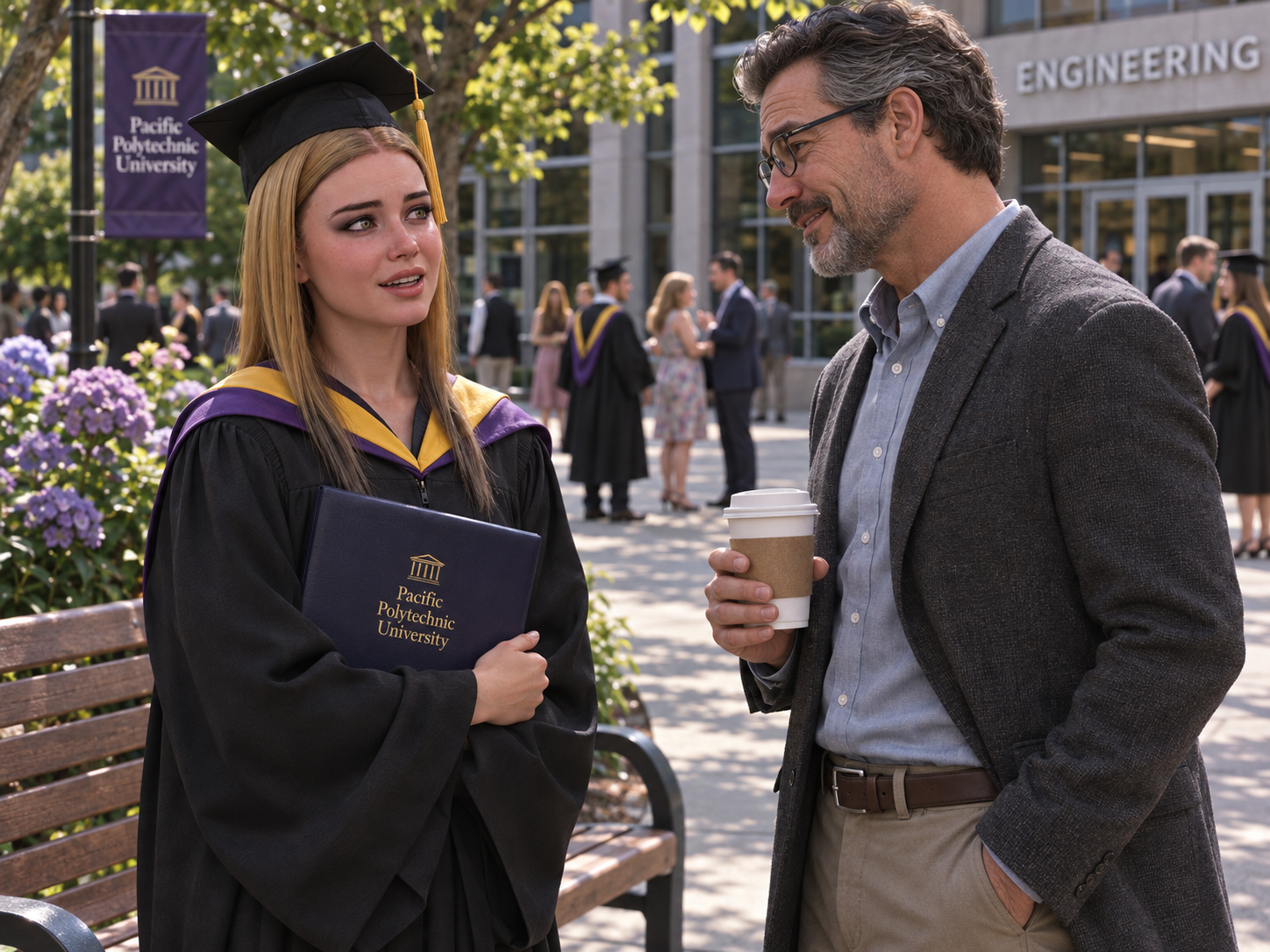

CHAPTER 38.5
May 29, 2027
They stood quietly for a few moments. Callie watched a group of graduates attempting to arrange themselves for a photograph while a small child repeatedly wandered into the middle of the shot. Somewhere beyond them, a car horn sounded from the parking area.
Then Jed picked up his coffee cup, looked at it, and set it down again.
“All of that is actually part of what I wanted to talk to you about.”
Callie turned toward him.
“What do you mean?”
“Generitech.”
She frowned.
“What about Generitech?”
“Why I recommended you.”
Callie studied him.
She had known since the recruiting process began that Jed had helped bring her work to the company’s attention. He had mentioned knowing people involved with Generitech through its educational outreach programs, and when the recruiter contacted her, he’d confirmed that he had passed along information about her research. She had thanked him, but the explanation had never felt entirely complete.
“Okay,” she said. “Actually, I’ve been wondering about that.”
“I thought you might.”
“You knew I wanted to work there. You’ve known that for years. But why did you go out of your way to recommend me?”
“Because I believed they’d be interested in you.”
“That’s not much of an answer.”
Jed smiled.
“No. It isn’t.”
“Was it my research?”
“That was certainly part of it.”
“Then what was the rest?”
He looked toward the engineering building again.
“Do you know what Generitech considers one of the most important parts of hiring someone?”
Callie raised an eyebrow.
“Technical qualifications?”
“Those matter. Obviously. They’re not going to hire someone into an engineering research position who can’t do engineering. But that’s not what I mean.”
She waited.
“Years ago, I worked with some people from Generitech through their school outreach programs. We were discussing the differences between preparing students for college and preparing them for actual careers. One of their people said something I’ve remembered ever since.”
“What was it?”
“That Generitech can teach almost anyone the skills they need, provided they have the aptitude and are willing to learn.”
Callie considered that.
“That’s a pretty broad statement.”
“It is. But think about what the company has available. Their laboratories, their equipment, the people who work there. They can train a promising engineer to use a particular system. They can teach new procedures, new research methods, new ways of approaching a problem. They can give somebody the resources to develop abilities that might otherwise take years.”
“Okay.”
“But there are things they can’t simply teach somebody.”
“Such as?”
“Character.”
Callie looked at him.
Jed continued.
“They can’t teach someone to be honest when admitting a mistake might cost them something. They can’t teach somebody to care about the people affected by their work. They can’t make somebody value family, or convince someone who’s fundamentally indifferent to other people that everyone deserves to be treated with dignity.”
He paused.
“And they certainly can’t teach someone to work hard if that person has no interest in doing so.”
Callie gave a small smile.
“I’ve met a few people like that.”
“So have I.”
“Most of them ended up in my group projects.”
Jed laughed.
“I warned you about those.”
“You really undersold it.”
“I’ll remember that.”
He looked at her again.
“Generitech believes it’s worth investing in people who already possess those qualities, even if they still have a great deal to learn. Because teaching someone a new skill is considerably easier than teaching someone to care what they do with it.”
Callie thought about the interview. She remembered Dr. Shah asking questions that had little to do with the specific components in her prototype and much more to do with how she approached problems. She remembered Navarro challenging her assumptions about Little users and waiting to see whether she would defend her design or reconsider it.
“So what did you tell them about me?”
Jed smiled faintly.
“I told them about a student I taught at Ridgemont High.”
Callie waited.
“I told them she was exceptionally bright, curious, and stubborn enough to argue with me over a servo motor that was barely misbehaving.”
“It was jittering.”
“I know. You’ve made that clear.”
She smiled.
“But I didn’t start with your grades, Callie. Or your projects.”
“Then what did you start with?”
“Juna.”
Callie’s expression changed.
“You told them about my daughter?”
“Yes.”
She stared at him.
“Mr. Steverson.”
“I know. Let me explain.”
Callie folded her arms.
“You’d better.”
Jed nodded.
“I told them you became a mother while you were still in high school. I told them about your determination to continue your education and the responsibilities you took on while doing it. I told them you had a family who supported you, friends who helped, and that you were willing to accept that help while still doing the work yourself.”
Callie listened carefully.
“I told them about Myles too.”
Her eyes narrowed slightly.
“What about him?”
“What I knew. That Juna’s father hadn’t been involved in raising her. That he died while you were still in high school, and that it had been an extraordinarily difficult time for you.” Jed paused. “I didn’t know the details you’ve told me today. I didn’t have those to share.”
She looked away for a moment.
“I’m not sure how I feel about you telling a prospective employer about all of that.”
“That’s fair.”
“Especially when you didn’t tell me you were doing it.”
Jed nodded.
“I understand. And if you believe I should have asked you before bringing up your personal history, I won’t argue with you.”
Callie studied him. She wasn’t particularly comfortable with the idea that Generitech had heard about her pregnancy before she had even submitted her résumé, although she also understood that a considerable amount of her history was known publicly in Ridgemont.
“What exactly were you trying to accomplish?”
“I wasn’t telling them that difficult things had happened to you and therefore you deserved a job. That would’ve been insulting.”
“Good.”
“Lots of people face difficult circumstances, Callie. Suffering doesn’t automatically make someone admirable, and I wasn’t presenting you as some inspirational story about a young mother who overcame the odds.”
She nodded.
“Then what were you telling them?”
“About the choices you made.”
Callie looked at him.
“When you became pregnant, you had people telling you what they thought you ought to do. Some of those people were concerned about you. Others were concerned about how your decision might inconvenience someone else. But you took the time to decide what you wanted, and once you made that decision, you accepted the responsibilities that came with it.”
He paused.
“And then you kept going.”
Callie looked down at her diploma folder.
“You didn’t pretend everything would be easy. You didn’t insist you could handle every responsibility without help. You adjusted your plans, relied on people who cared about you, and kept working toward the future you wanted.”
“I had a lot of help.”
“I know. That’s one of the things I told them.”
She looked up.
“Why?”
“Because Generitech values family and community. Because they understand that good people aren’t supposed to do everything alone.”
Callie thought of Stuart and Sally, of Hannah helping at the store, and Maggie and Luke taking turns watching Juna when she needed to study. She thought about Ryan helping with homework, making dinner, and occasionally reminding her that she couldn’t solve every problem by adding another task to a spreadsheet.
“Some people would say I only managed because everybody helped me.”
“They’d be right that you had help,” Jed said. “They’d be wrong if they thought it meant you didn’t do the work.”
She smiled faintly.
“And I told them that being a mother wasn’t something you did when you had time left over from pursuing your career. Juna was part of your life from the beginning. You wanted to be there for her, and you found ways to pursue engineering without treating your daughter as an obstacle you needed to remove.”
Callie swallowed.
“I never wanted her to feel like that.”
“I know.”
He let the words settle before continuing.
“And there was another part of it. Something I thought was particularly important for a company like Generitech.”
“What?”
“The way you treat people.”
Callie frowned.
“You’re going to have to be more specific.”
Jed smiled.
“I expected you would.”
He gestured vaguely toward the campus.
“Generitech works with Littles every day. Not merely as customers or employees, but as people whose lives are directly affected by the things its engineers build. And it has a very particular philosophy about how those people ought to be treated.”
“That they’re people?”
“Exactly.”
Callie gave him a look.
“That’s not exactly revolutionary.”
“It shouldn’t be.”
“It shouldn’t even be controversial.”
“I agree. But you’ve seen how people talk about Littles.”
Her expression hardened.
“Yeah. I have.”
“Some people treat them as though becoming smaller means becoming less important. As though losing physical independence somehow reduces the value of a person’s intelligence, experience, or opinions.”
“Which is ridiculous.”
“I know.”
“Professor Frank is one of the smartest people I’ve ever met. He’s taught me more about engineering than almost anyone. The fact that I can carry him across a room doesn’t change that.”
Jed nodded.
“And you don’t think that’s something worth mentioning?”
“What? That I treat my professor like a person?”
“Yes.”
“Mr. Steverson, you don’t get bonus points for basic decency.”
“Exactly.”
Callie stopped.
Jed smiled slightly.
“That’s one of the reasons I thought of you.”
She looked at him for a moment.
“You don’t treat respecting Littles as something extraordinary that deserves praise,” he continued. “You treat it as an ordinary obligation. You don’t assume you’re better than somebody because you’re larger, wealthier, or more physically capable. You understand that a Little has a family, a history, relationships, knowledge, and opinions that matter just as much as anybody else’s.”
He paused.
“And you understand that the people you’re designing equipment for aren’t merely test subjects.”
Callie thought about the work she’d done on her master’s research.
“They’re the people who actually have to use it.”
“Yes.”
“Which is why we need to listen when something doesn’t work for them. I can have a perfectly functioning circuit and still have a terrible device.”
Jed smiled.
“That sounds like something Professor Frank would say.”
“He has. Repeatedly.”
“Then he’s been doing his job.”
Callie shook her head, amused.
“But that’s what I told Generitech,” Jed continued. “That you were the sort of person who would listen when a Little said something wasn’t working, even if the instruments suggested the device was functioning perfectly. That you wouldn’t automatically assume the person using it was the problem.”
“Navarro actually asked me something like that in my interview.”
“Oh?”
“He wanted to know why we didn’t just teach the Littles to stop pressing a button twice. I told him training wouldn’t fix an interface that wasn’t communicating properly.”
Jed laughed.
“Of course you did.”
“He pushed back.”
“I imagine he did.”
“So I explained why I thought he was wrong.”
“That sounds familiar.”
Callie smiled.
Jed leaned slightly against the bench.
“The research matters, Callie. Your degrees matter. But Generitech could evaluate those things without my help. What I could tell them was what kind of person I’d known you to be.”
She looked at him.
“I told them you were hardworking. That you took responsibility seriously, sometimes more seriously than was good for you. That you cared about your family and understood what it meant to depend on other people. That you believed a person’s worth wasn’t determined by their size or their circumstances.”
He paused.
“And that you would care whether your work actually improved somebody’s life.”
Callie was quiet.
“You really told them all of that?”
“I did.”
“How long was this recommendation?”
Jed smiled.
“Longer than the résumé.”
She laughed softly.
“That explains a few things.”
“Don’t give me too much credit. I didn’t make the hiring decision.”
“I know.”
“I contacted somebody I knew through the outreach program and asked whether they’d pass along your information to the appropriate people. I told them why I thought you deserved a look. After that, it was up to them.”
“And they contacted me.”
“Yes.”
“And then they made me explain practically every detail of my research.”
“Good.”
“You’re enjoying that.”
“A little.”
Callie laughed despite herself.
“But that’s exactly how it should’ve happened,” Jed said. “I could tell them what kind of person I believed you were. I couldn’t answer their technical questions for you. I couldn’t complete the research, earn your degrees, or make you demonstrate that you belonged in their laboratory.”
He gestured toward the diploma folder beneath her arm.
“You did those things.”
Callie considered that for a moment.
“So you really just persuaded somebody to take a first look?”
“That’s it.”
She smiled faintly.
“That’s a pretty small contribution for someone who flew all the way from Minnesota.”
“Perhaps. But the work afterward belonged to you.”
Callie studied him for several seconds. There was still something she wanted to know, something that had been bothering her since he first explained what he’d told the company.
“And if they hadn’t offered me the job?” Callie asked.
“I still would’ve thought they should meet you.”
“Even if I hadn’t finished my master’s?”
“Yes.”
“Even if I hadn’t finished college?”
Jed considered that more carefully. “Would I have recommended you for the same engineering position without the qualifications? No. That wouldn’t have been fair to you or to them. But would I still have believed you were somebody worth knowing, somebody worth helping find an opportunity? Absolutely.”
Callie looked down at the diploma folder in her hands. She ran her thumb along the edge, feeling the raised lettering beneath it.
“Because if I hadn’t finished college, Juna still wouldn’t have been a mistake.”
Jed’s expression softened. “No, Callie. She wouldn’t have.”
She nodded, although it took her a moment to look at him again. It was the answer she’d wanted from him years earlier, when she’d stood in his classroom trying to explain why the child she was carrying wasn’t something she needed to apologize for. Hearing it now mattered, but it didn’t quite settle everything between them.
“You know,” she said, “I spent a long time thinking about what you told me that afternoon.”
“I know.”
“Do you? Because there were times I wanted to call you just to tell you how wrong you were. Usually right after something went particularly badly.”
Jed gave a quiet laugh. “I can imagine.”
“And then there were times I thought maybe you were right.” She glanced toward the engineering building, where she’d spent so many late evenings. “I didn’t like those very much.”
He watched her for a moment, then set his coffee cup on the bench. He adjusted its position so it wouldn’t tip, a small, deliberate action that gave him something to do before speaking.
“Callie, there’s something I haven’t told you.”
She looked back at him. “You’ve been full of surprises today.”
“I suppose I have.”
He smiled, but it disappeared almost immediately.
“I’ve spent most of my career telling students what I think they need to hear. Sometimes that’s encouragement. Sometimes it’s telling a promising kid that the work they’re turning in isn’t good enough. And occasionally it’s having a conversation neither of us particularly wants to have.”
Callie remembered several of those conversations.
“You’re pretty good at that last one.”
“I’ve had practice.” He folded his hands. “I don’t enjoy making students angry with me, Callie. I never did. But I have always believed that caring about someone means being willing to tell them something difficult when you genuinely believe they need to hear it.”
She nodded slowly.
“And when you came into my classroom that January, I cared about you. You were one of the most gifted students I’d taught. You had opportunities ahead of you that I’d watched other students work years to reach. And you were about to take on a responsibility that would change almost every part of your life.”
“I knew that.”
“Yes,” he said. “You did. Better than I gave you credit for.”
Callie was quiet.
“I was worried,” Jed continued. “I was worried about you trying to finish high school while raising a baby. I was worried about college, about money, about what would happen when you needed to be in two places at once. I was worried you’d keep pushing yourself until there was nothing left to give, because I knew enough about you to understand that walking away from something important wasn’t going to come easily.”
He looked directly at her.
“And I’m not going to stand here nine years later and pretend I didn’t believe what I said. I did. Every word of it.”
Callie held his gaze. That sounded like the Jed Steverson she remembered, stubborn enough to defend an unpopular opinion even when it would have been considerably easier to say something reassuring.
“You were pretty convinced,” she said.
“I was.”
“You told me you thought I might be throwing away my future.”
“Yes.”
“And that I probably wasn’t going to be able to do everything I thought I could.”
“Yes.”
She swallowed. “That one stayed with me.”
Jed looked down briefly.
“I know it did.”
A family passed along the path behind them, laughing over something on a phone. Callie waited until they’d moved farther away before continuing.
“I didn’t need you to promise me everything would work out,” she said. “I knew it might not. I was scared enough already. But I wanted you to believe I had a chance.”
“I know.”
“And I don’t think you did.”
Jed was silent long enough that she wondered whether he would try to explain the distinction again, perhaps tell her that he’d believed in her abilities even while questioning her judgment. She had heard that distinction before, and there was truth in it. It simply wasn’t the entire truth.
Finally, he nodded.
“You’re right.”
Callie looked at him.
“I believed in your intelligence. I believed in your talent. I believed you had the potential to become an extraordinary engineer.” He paused. “But I didn’t believe you could carry all of those responsibilities and still reach the future you were describing to me.”
She felt the familiar ache of hearing him say it plainly.
“And that,” Jed continued, “is where I was wrong.”
Callie didn’t speak.
“I wasn’t wrong to be concerned about the difficulties. You and I both know how many of those difficulties turned out to be real. But I was wrong about you. I was wrong about what you could endure, what you were willing to learn, and how determined you would be to build a life that included both your daughter and your ambitions.”
He drew a breath.
“I thought eventually something would have to give. I thought the cost would be too high, and you’d have to put engineering aside. Maybe for a few years. Maybe permanently.”
Callie nodded faintly. That was what she’d always believed he’d meant, even when he insisted she had the ability to succeed.
“And instead,” Jed said, “you finished high school. You went to college. You raised Juna. You dealt with things I couldn’t possibly have anticipated, including what happened with Myles. You earned your first degree, decided that wasn’t enough, and went back for another. And now you’ve accepted a position at one of the companies you’ve wanted to work for since you were a kid.”
His voice had become quieter.
“Every time I heard something new about you, I was happy. I was relieved you were doing well, certainly, but more than that, I was proud. I’d hear that you were working on another project, or that you’d completed another year, and I’d think about that girl standing in my classroom telling me she was going to find a way.”
Callie felt her throat tighten.
“Then why didn’t you ever tell me?”
Jed looked at her for several seconds.
“Because I didn’t know how to tell you without admitting how badly I’d underestimated you.”
She stared at him.
He gave a small, rueful smile.
“Not a particularly admirable answer, is it?”
“No,” she said, almost laughing. “Not really.”
“I know.”
She looked away, blinking against the unexpected moisture in her eyes. She had spent years imagining what she might say to him if she ever had the opportunity to prove that his predictions were wrong. She’d pictured showing him a degree, telling him about her work, perhaps allowing herself the satisfaction of reminding him what he’d said.
She hadn’t imagined that he already knew. Or that he’d been privately celebrating the very achievements she’d sometimes thought he expected her never to reach.
“I never stopped hoping for you, Callie,” Jed said.
She looked back at him.
“I want you to understand that. My doubts weren’t wishes. I never wanted you to fail so I could be proven right. I hoped every single year that you would prove me wrong.”
He smiled a little.
“And you did. More thoroughly than I could’ve imagined.”
Callie let out an unsteady breath.
“Well, I was always pretty stubborn.”
“Stubborn doesn’t begin to cover it.”
She laughed, wiping beneath one eye with her fingertip.
“But that’s not the only reason I’m here,” Jed said.
Callie glanced at him. “You mean you didn’t fly all the way from Minnesota just to tell me how stubborn I am?”
“No. I could’ve done that over the phone.”
“Would’ve saved you a lot of money.”
“Probably.”
His expression grew serious again.
“Callie, I’ve taught a lot of students over the years. Hundreds. Some were extraordinarily talented. Some needed more help than others. Some went on to do remarkable things, and others found paths that looked nothing like what we’d imagined when they were sitting in my classroom.”
He paused, looking toward the graduation crowd.
“I care about my students. I always have. But I don’t randomly get on an airplane and fly across the country for every former student’s graduation.”
Callie looked at him.
“I came because I wanted to see you walk across that stage. I wanted to meet your daughter properly, congratulate you, and see the woman you’ve become. But more importantly, I came because there’s something I’ve owed you for a very long time.”
She waited.
Jed turned fully toward her.
“When you came to me in 2018, I cared enough about you to tell you what I genuinely believed, even though I knew you weren’t going to like hearing it. I believed I was doing my job as your teacher. And I still believe that sometimes the most important thing a teacher can do is have an uncomfortable conversation with a student they care about.”
Callie nodded slowly.
“But if I cared enough to tell you when I thought you were wrong, then I ought to care enough to stand in front of you and admit when I was wrong.”
The words settled between them.
“I meant what I said back then,” Jed continued. “I’m not going to pretend otherwise, and I’m not going to apologize for giving you an honest answer when I thought your future was at stake. But I am sorry that I didn’t believe in you the way I should have.”
Callie’s eyes stung again.
“I’m sorry I looked at your life and saw limitations where you saw possibilities. I’m sorry I didn’t trust you when you told me you understood what you were choosing. And I’m sorry I left you feeling that somebody whose opinion mattered to you had already decided you couldn’t succeed.”
His voice caught slightly on the final words, just enough for Callie to notice.
“I was wrong about you, Callie.”
She pressed her lips together.
“And I have never been happier to be wrong about anything in my life.”
Callie looked down, blinking hard. She’d managed to make it through the graduation ceremony without crying, even when Juna had shouted from the audience. She’d endured her father’s photographs, her mother’s hugs, and Professor Frank telling her how pleased he was with the engineer she’d become.
Somehow, this was what finally threatened to undo her.
Jed waited while she gathered herself.
“You know,” she managed, “you could’ve just written a very nice recommendation letter.”
He laughed softly.
“I did that too.”
“Apparently a very long one.”
“That happens when there’s a lot worth saying.”
She shook her head, then looked at him again.
“Why now?” she asked. “You knew when I graduated two years ago. You could’ve said something then.”
“I could have. I should have.” He hesitated. “But when I heard you’d been accepted into the master’s program, I realized you weren’t finished. You were still doing exactly what you’d told me you wanted to do. And when Generitech began looking at your work, I thought perhaps I could help open a door.”
He paused.
“Then I heard you’d accepted the offer. And I knew I wanted to be here today.”
Callie watched him carefully.
“Not because you finally decided I was successful enough?”
“No.” Jed shook his head. “Because I realized that if I kept waiting for some perfect moment to tell you what I should have told you years ago, I’d probably never do it.”
She gave a small, watery laugh.
“And frankly,” he added, “I’ve spent enough years telling students not to make excuses to recognize when I’m making one myself.”
“You’re really not very good at admitting you’re wrong, are you?”
“No,” he said. “As you’ve probably noticed, I’m considerably better at explaining why everyone else is.”
Callie laughed again, and this time it came with a tear she couldn’t quite stop. She wiped it away, mildly annoyed with herself.
Jed let her have the moment without commenting.
“You were important to me,” she said eventually.
His expression softened.
“I know.”
“No, I don’t think you do.” She looked at him. “You were one of the first people who made me feel like engineering was something I could actually do for a living. Not just some hobby I was good at. You made me work harder because you expected more from me.”
“I remember.”
“And when you told me you thought I was making a mistake, it hurt because I trusted your judgment.”
Jed nodded.
“I understand.”
“I spent years wanting you to be wrong.” She took a breath. “And sometimes I really wanted you to know you were wrong.”
“I suspected as much.”
“But hearing you say it…” Callie stopped, searching for the words. “I guess I didn’t realize how much I needed that.”
Jed’s expression changed, the familiar teacher’s composure giving way to something gentler.
“Well,” he said, “you deserved to hear it.”
She looked at him for a long moment.
“I’m sorry, Callie,” he said quietly. “Truly.”
The words were simple, stripped of the explanations and qualifications he’d spent so much of their conversation providing.
“And I have never been more proud of one of my students than I am of you today.”
Callie couldn’t quite answer.
For a moment she saw the old engineering classroom again, the cluttered worktables, the faint smell of solder, the winter afternoon when she’d stood in front of him trying to explain that becoming Juna’s mother didn’t mean abandoning everything else she wanted to be. She remembered his concern, his doubt, and the awful feeling of leaving that room unsure whether the teacher she admired thought she’d already ruined her future.
Now he was standing in front of her nine years later, having traveled halfway across the country to tell her he’d been wrong.
She stepped forward and hugged him.
Jed seemed surprised for an instant, then put his arms around her. He held her firmly, one hand resting between her shoulders, and for several seconds neither of them said anything.
“Thank you,” Callie whispered.
“You’re welcome, kiddo.”
She laughed softly against his shoulder.
“I haven’t been your student in years.”
“Occupational hazard.”
When she stepped back, Jed looked at her with the faintly amused expression she’d known since Ridgemont.
“Now, for the record, none of this means I’m going to stop telling you when I think you’re wrong.”
Callie wiped beneath her eye.
“Oh, I wouldn’t dream of expecting that.”
“Good. Because I suspect Generitech will be keeping you busy enough that you’re going to make plenty of new mistakes.”
“Wow. You really know how to ruin a moment.”
“Another occupational hazard.”
She smiled, still feeling the weight of the conversation.
“And when I do make mistakes,” she said, “I suppose I should expect an email telling me exactly what I did wrong?”
“Naturally.”
“With diagrams?”
“If necessary.”
“Great. Looking forward to it.”
Jed laughed.
Then he rested a hand briefly on her shoulder.
“Whatever happens next, Callie, don’t forget what got you here. Not the degrees or the job offer. The people. Your family, your friends, the people you’re going to work with, and the people your work is going to help.”
She nodded.
“I won’t.”
“I know you won’t.” He smiled. “That’s why I recommended you.”
Callie glanced toward the lawn, where Juna had apparently finished waiting for her mother to return and was making her way toward them with considerable purpose.
“Mom!”
Callie turned, grateful for the familiar voice.
“What is it, sweetheart?”
“Grandma says everybody’s ready to eat, but you’re still talking!”
“That’s because I ran into somebody.”
Juna came to a stop beside her and looked up at Jed.
“Who’s that?”
Callie smiled.
“This is Mr. Steverson. He was my engineering teacher when I was in high school.”
Juna examined him with immediate interest.
“Did you teach my mom how to make stuff?”
Jed smiled.
“I tried.”
“Was she good at it?”
“Very.”
Callie folded her arms. “Careful, Mr. Steverson. You’re going to ruin your reputation.”
“I think it’s probably too late for that.”
Juna looked between them, then held out her hand.
“I’m Juna.”
Jed bent to shake it.
“It’s very nice to finally meet you, Juna. Your mother told me about you when you were still a baby.”
Juna considered that.
“I’m not a baby anymore.”
“No,” Jed said, smiling. “You certainly aren’t.”
“And my mom has two degrees now.”
“She does.”
“And she’s going to make inventions in New York.”
“That’s what I hear.”
Juna looked pleased with herself. “She’s really smart.”
Jed glanced at Callie.
“Yes,” he said. “She is.”
Callie smiled, feeling her eyes threaten to sting again.
“And she’s very stubborn,” Jed added.
Juna nodded enthusiastically.
“I know.”
“Fantastic,” Callie muttered. “You two have known each other for thirty seconds and you’re already ganging up on me.”
Jed laughed, and Juna took Callie’s hand, tugging her gently toward the gathering.
“Come on, Mom. I’m hungry.”
“All right. We’re coming.”
Callie looked back at her former teacher.
“Thank you for coming,” she said.
Jed smiled.
“I wouldn’t have missed it.”
She held his gaze for another moment before letting Juna lead her toward the others. The conversation hadn’t erased the hurt she’d carried from that classroom, nor did she particularly need it to. Jed had meant what he said then. He had cared enough to be honest with her, even when she hated his answer.
But he’d cared enough to come all this way and tell her he was wrong, too.
And somehow that mattered more than finally being able to prove it.
They rejoined the family, and Jed agreed to one last photograph before saying goodbye.
The restaurant was busy enough that their large table occupied most of one corner, but the food arrived quickly and the conversation settled into the familiar mixture of overlapping questions and interruptions. Stuart wanted to know how the moving company handled delivery dates. Sally asked whether Juna’s school arrangements were confirmed. Hannah wanted to know whether Gracewood’s transportation system was actually as convenient as Callie claimed or whether she had simply fallen in love with the engineering diagrams.
“The enrollment paperwork is accepted,” Callie told her mother. “We have the placement confirmation, and the school wants to do an orientation visit after we arrive. I’ve sent the records they requested. Anything else they need can go directly from her current school.”
“And we’re going to ride the train to school,” Juna announced.
“Possibly,” Callie corrected. “We still have to learn the route.”
“Mom showed me the map.”
“She’s looked at that map so many times,” Ryan said, “I’m pretty sure she could tell us where to transfer already.”
Juna nodded with complete confidence.
“And your housing is all settled?” Sally asked.
“The assignment is confirmed. We’ve got the arrival information, the instructions for the keys, and the contact number if something isn’t ready. The relocation team has been really good about answering questions.”
“That sounds promising.”
“It does.” Callie smiled. “I’m still expecting to arrive and discover I’ve forgotten something incredibly obvious.”
“That’s why they have stores,” Stuart told her.
“Your professional advice as a grocery-store owner?”
“Twenty-five years of experience.”
“And what about Ryan joining you?” Sally asked. “Did the company ever clarify how that works?”
“Yeah. Maren sent the written requirements for adding him to the household later. We know which paperwork he’ll need once his moving date is settled.” Callie glanced at Ryan. “At least that part won’t be a surprise.”
“An encouraging development,” Ryan said. “We’ve already got enough surprises scheduled.”
Maggie leaned toward Callie while the others began asking about the Gracewood house. “So when am I visiting?”
“When can you get away?”
“Depends how much notice I give.” Maggie considered the question while stirring her drink. “What about a long weekend in July? After you’re settled.”
“Juna’s birthday is July twelfth. We could work around that.”
“Even better.” Maggie picked up her phone. “I’ll check my calendar.”
Callie watched her open the app and begin looking at dates. Their friendship had survived Minnesota, California, apartments, different courses, different careers, and a thousand small changes in the amount of time they could spend together. Maggie no longer lived in the next room, and she had long since stopped being the person who could be counted on to come home and complain about a design assignment at the kitchen table. But she still knew when Callie was trying to solve too many problems at once, and Callie still knew which clients Maggie disliked before Maggie finished describing what they had done.
“We’re keeping Sunday evenings,” Maggie said without looking up.
“Our calls?”
“Yes. I refuse to lose the one appointment where I can complain without having to pretend I’m seeking constructive feedback.”
“You do that at work?”
“Apparently it’s frowned upon to tell a client their proposed interface looks like a refrigerator having a medical emergency.”
Callie laughed. “Fine. Sundays. We’ll adjust for the time difference.”
“Good. Now, your present.”
Maggie retrieved the gift bag from beside her chair and handed it over. Inside was a small hardcover photo album, its dark blue cover marked with the words California, Apparently.
Callie opened it.
The first photograph showed their original apartment shortly after moving in, when half their belongings had still been in boxes and Juna had decided that an empty cardboard container made an excellent hiding place. Another showed Maggie sitting on the floor beside a preschool-aged Juna, both of them wearing paper crowns. There were pictures from campus, a birthday dinner, an afternoon at the beach, and a particularly unflattering photograph of Callie asleep on the couch with an open textbook resting against her stomach.
“Oh, I hate you.”
“I know. But look at the next page.”
Callie turned it and found a picture of Maggie holding a small paper sign that read No more group projects. Beside it was a photograph from Callie’s undergraduate graduation, with Juna standing between them.
Several pages near the back were blank.
“Those are for when I visit,” Maggie explained. “I figured you can start filling the next part yourself.”
Callie ran her thumb along the edge of the album. It was the sort of gift Maggie would think to make, a collection of ordinary moments that Callie had been too busy experiencing to realize anyone had photographed.
“Thank you,” she said, looking up.
Maggie smiled. “You’re welcome.”
Across the table, Stuart had turned his attention to Ryan.
“So when are you joining them?”
Ryan set down his glass. Callie knew the answer, but hearing the question in the middle of the family celebration brought the approaching separation into sharper focus.
“August or September is still what we’re working toward,” Ryan said. “The bookstore has its summer staffing arranged, and Lena needs me while the replacement gets trained. My lease runs through August, too. I’m trying to get everything finished as early as I can, but I don’t have a definite moving day yet.”
“And you’ll visit before then?” Sally asked.
“That’s the plan. Once Callie has her schedule, we’ll find a weekend that works.”
Juna was watching him. “How many weeks is that?”
Ryan turned toward her. “Until I move? If things work out for August, maybe ten weeks or so. If it takes until September, it’ll be longer.”
“How much longer?”
“Maybe thirteen or fourteen weeks. But we’re going to try to visit before then.”
Juna examined him. “That’s a lot of weeks.”
“It is,” he agreed. “We’ll talk while we’re apart, though.”
“Every day.”
Ryan smiled. “I think we can manage most days.”
Callie reached for her daughter’s hand beneath the table. They had discussed the timetable at home, including the things Ryan needed to finish before he could relocate. Juna understood the reasons individually. What she was beginning to understand now was that those reasons added up to a summer without him in the house.
The conversation eventually moved to dessert, photographs, and Hannah’s account of a particularly irritating customer at Grey’s. Callie joined in, grateful that nobody tried to make Ryan’s plans into a larger public conversation. She had made a decision about her career. He had made a commitment to finish his responsibilities in California. Neither of them had mistaken the arrangement for something they particularly wanted.
They were simply going to have to make it work.


Ryan really needs to tell everyone about his vulnerability. If he changes and no ones around to help him, he could end up disappearing from Callie and Junas lives without a word and that’d be 1000 times worse
Agreed, the time is now. As for my thoughts on today’s episode, Callie and her former teacher had a great conversation.
If not, then i’m sticking with the theory that the Tucker story’s going to get redone as Ryans story lol
Hmm, that would be interesting.
This was the big payoff chapter for everything that has happened to callie bringing it full circle as this setup chapters/intro comes to an end.
Ryan not telling Callie about himself if weirding me out so I have to speed read and see if he says anything lol.
Ryan could never tell Callie and only be a character for the California arc
He probably should but he’s running out of time.