

Chapter 42
June 2027
The conference room was smaller than Callie had expected, with a rectangular table surrounded by six chairs and a wide window overlooking one of the landscaped courtyards she’d passed on her way through Generitech Headquarters. The walls were a soft off-white, broken only by a large display that appeared to be built directly into the surface. There were no visible cables, equipment racks, or conference phones. A narrow strip of light followed the perimeter of the ceiling, providing enough illumination without casting any noticeable glare across the tabletop. Callie had barely settled into her chair when the brunette woman across from her finished reviewing something on her tablet and looked up with a friendly smile.
“All right, Callie. First of all, welcome to Generitech. I’m Denise Hadridge, and I’ll be handling the administrative portion of your onboarding this morning.” Denise set her tablet beside a glass of water and folded her hands comfortably on the table. She looked to be somewhere in her forties, with dark brown hair that fell just past her shoulders and a manner suggesting she’d conducted this particular meeting enough times to know exactly which questions were coming. “I understand you and your daughter just moved into Gracewood?”
“Yeah, a couple of days ago.” Callie adjusted the strap of her purse where it rested against her chair. “We’re still getting settled. Most of our stuff is put away, but I’m pretty sure Juna has managed to lose something important in every room already.”
Denise smiled. “How old is she?”
“Eight. She’ll be nine next month.”
“Oh, that’s a fun age. Has she had a chance to explore the neighborhood yet?”
“A little. We haven’t made it very far because she keeps finding something else she wants to investigate. She likes the condo, though, and she’s very excited about her new school.” Callie glanced toward the window, where a pedestrian path curved between several carefully maintained trees. “Honestly, I think she’s handling the move better than I expected. She’s still getting used to the idea that we’re not going back to California.”
“That’s understandable. It’s a big adjustment, especially for a child.” Denise picked up her tablet. “Well, hopefully we’ll make the work portion of your transition a little easier. I have your employment file here, and it looks like everything from recruitment and relocation has been completed. Your housing agreement is active, your employee benefits are enrolled, and we have confirmation of your arrival. How did the actual move go?”
“Pretty well, actually. Your relocation team made it a lot easier than I thought it would be. Having the condo furnished before we got here was a huge help.” Callie thought about the boxes still stacked in the third bedroom and decided that wasn’t technically a failure of the moving company. “I think the worst part was getting my daughter to understand that we couldn’t unpack every single thing the minute we walked through the door.”
“That sounds about right.” Denise made a small notation on her tablet. “And I see you’re joining Research and Development under Dr. Shah’s group. Biomedical engineering, correct?”
“That’s right. I just finished my master’s at Pacifica Polytechnic.”
“Congratulations. That’s quite an accomplishment, especially with a daughter. I imagine it’s been a busy few years.”
“You could say that.” Callie smiled. “I’m looking forward to having a job where I’m not also trying to finish a thesis.”
“I wouldn’t promise you’ll have less work,” Denise said, amusement showing in her expression. “But at least we won’t expect you to turn in a dissertation at the end of every semester.”
“That sounds like an improvement.”
“Good. Now, before we get into the more interesting things, we need to take care of our confidentiality agreements. I know you’ve already completed your employment contract, but these are separate documents governing access to Generitech’s internal information and facilities.”
Denise tapped her tablet, and the large wall display came to life. Callie hadn’t noticed it turning on so much as she’d noticed the wall suddenly containing a document, its white background contrasting with the surrounding surface. A matching version appeared on the tabletop in front of her, occupying a rectangular area that had been completely featureless a moment earlier. The text was sharp enough to read comfortably from where she sat, and a small navigation panel appeared along the right edge.
“That’s convenient,” Callie said, looking down at the table. She touched the corner of the document, and the page responded immediately. “Is the entire surface interactive?”
“Most of it. We can use it for presentations or individual workspaces, depending on what the room is needed for.” Denise watched her examine the display. “I have a feeling you’re going to spend a lot of your first week looking at things and wondering how they work.”
“Probably more than my first week.”
“I hear that a lot from Research and Development employees.” Denise gestured toward the document. “Go ahead and take your time reading. I’m here to answer questions.”
Callie pulled the agreement closer with two fingers and began working through it. The opening sections were recognizable enough, covering confidential company information, proprietary technology, intellectual property, and restrictions on unauthorized disclosure. She’d signed nondisclosure agreements before while working with university research partners, although nothing quite as extensive as the document in front of her. Generitech’s agreement covered not only information developed by her immediate department but also protected material encountered through other subsidiaries, shared facilities, technical systems, and internal communications.
She slowed when she reached the section concerning research information. The restrictions extended beyond formal documents and schematics to observations made inside restricted facilities, including technologies that hadn’t been commercially released or publicly acknowledged. Callie read that portion twice before looking up.
“So this applies to anything I might see while I’m working, even if it isn’t related to my project?”
“Potentially, yes,” Denise said. “You’ll have access to areas where multiple research groups operate, and sometimes you’ll encounter information outside your particular assignment. If it’s designated confidential, you’re expected to treat it that way whether you were specifically working on it or not.”
“That makes sense.” Callie returned to the page. “I’m assuming the same rules apply internally? Just because somebody else works for Generitech doesn’t mean I can discuss whatever I’m doing with them.”
“Exactly. Employment doesn’t automatically authorize access to every project. You’ll work with people from other departments, and some projects involve several subsidiaries, but access is based on what your role actually requires.”
Callie nodded. That was similar to the procedures she’d encountered in university laboratories, only on a much larger scale. She continued reading, occasionally expanding a definition or following a reference to another section. Denise didn’t interrupt her. She checked something on her own tablet, took a drink of water, and waited while Callie worked through the restrictions concerning photographs, recordings, technical descriptions, and disclosure outside authorized channels.
“What about talking to family?” Callie asked after a few minutes. “Obviously, I wouldn’t be sending my parents pictures of unreleased equipment or anything like that, but am I allowed to discuss what I’m working on in general?”
“Of course. You can tell your family that you’re working in biomedical engineering, discuss the general nature of your position, and talk about your workday. What you can’t do is disclose protected research details or proprietary information. Think of it as the difference between telling someone you’re developing a medical interface and explaining a confidential design that hasn’t been released.”
“Okay. I just wanted to make sure I understood where the line was.”
“That’s a good question to ask. We want employees to understand their obligations, not spend their evenings afraid to tell their families they had a difficult day at work.” Denise tapped her tablet and brought up the next section. “There’s also an important distinction between confidential company information and things that are already public. You can talk about Gracewood, the Civic Regions, our businesses, or the services you use here. Those aren’t secret simply because Generitech operates them.”
Callie glanced toward the window. “Considering how much there is around here to talk about, that’s good to know.”
“Oh, I imagine your family will have plenty of questions when they come to visit.”
“They already do. My dad wanted to know how the streets stay clear in winter, and my sister spent about twenty minutes asking me how the transportation system works.”
“Did you have answers?”
“Some. Mostly I told them I was going to figure it out after I got here.”
“Well, we can help with a few of those today.” Denise smiled and indicated the agreement. “First, though, let’s finish making sure you don’t accidentally disclose the technology that makes it all possible.”
Callie returned to the document and finished reviewing the remaining sections. There were procedures for handling protected information, reporting accidental disclosures, and seeking clarification when she wasn’t sure whether something could be shared. She appreciated that last provision. With a corporation spanning so many different industries, she could easily imagine situations where the boundaries weren’t immediately obvious, particularly when multiple departments were working together.
Once she was satisfied, she selected the acknowledgment at the bottom of the document. The display requested her identity confirmation, and she authorized the agreement using the credentials established during her recruitment. A completed copy appeared in her employee records almost immediately.
“All right,” Denise said, checking her own screen. “That one’s complete. There are two additional acknowledgments concerning access to restricted technical information and your responsibilities while using internal systems. They’re shorter, thankfully.”
“That’s good. I was beginning to wonder if my first assignment was going to be reading the entire company’s legal library.”
“We save that for employees who complain about the coffee.”
Callie laughed and moved on to the next document.
By the time she finished the remaining agreements, she had a much better understanding of the distinction Generitech made between the technology it offered commercially and the technology it reserved for its own operations. The company wasn’t simply protecting unreleased products. Some of the systems described in the agreements were so restricted that employees weren’t permitted to confirm their existence outside authorized settings.
She’d known Generitech was technologically advanced. Her university department had used Generitech equipment, and she’d spent years studying research published by its subsidiaries. But the language of the agreements suggested that the products available to universities and private companies represented only a portion of what Generitech had developed.
Denise confirmed the final acknowledgment and closed the document workspace. “Excellent. That’s everything we need on confidentiality. Your department will handle any additional project specific authorizations once you begin working with your team.”
“Good to know.”
“Now, before we get to your payroll and employee account information, I’d like to spend some time going over how the Civic Regions operate.” Denise turned slightly toward the wall display. “You’ve probably received some of this information already, particularly when you were arranging your housing, but we find it’s helpful for new residents to understand the organization a little more thoroughly.”
“Please do,” Callie said. “I’ve been here for two days, and I feel like I’ve barely scratched the surface.”
“That’s a very common reaction. Most people are familiar with Generitech as a corporation. They know our products, our banks, our retailers, and our technology. Living inside a Civic Region is a little different because you’re experiencing all of those things as parts of the same operating system.”
The wall display changed, revealing a map of the world. At first Callie thought it was an ordinary geographical presentation, but then a series of blue markers appeared across the continents. Some occupied small areas, while others expanded into substantial regional boundaries. Several were located far from the major cities she recognized.
“Generitech currently operates Civic Regions in multiple countries around the world,” Denise explained. “Each one exists under an agreement negotiated with its host nation. Gracewood is our principal region and the seat of our corporate headquarters, but it’s not our only one.”
Callie leaned forward, studying the distribution. She’d known Generitech maintained facilities around the world, but she’d always thought of them as corporate campuses, factories, or research centers. The display suggested something considerably more extensive.
“Those are all actual Civic Regions?” she asked.
“Yes. They’re not all the same size, and they don’t all have the same purpose. Some are heavily focused on research or manufacturing, while others support much larger residential and commercial populations. The terms of each agreement differ depending on the country and what Generitech intends to develop there.”
“And Gracewood is the capital?”
“Essentially, yes. Gracewood is where our world headquarters is located, and it’s the flagship of the entire Civic Region system. It’s also the most extensively developed. You can think of it as the center of Generitech’s global operations.”
Denise selected the marker over New York, and the display expanded into a detailed view of the Gracewood Civic Region. Callie recognized the broad arrangement of the city almost immediately. There was the enormous headquarters complex, the surrounding urban districts, residential neighborhoods, commercial centers, and transportation corridors. The region extended well beyond the portion she’d seen while driving in with Juna, encompassing developed areas separated by parks, landscaped spaces, and carefully arranged infrastructure.
“The entire region?” Callie asked, indicating the boundary.
“The entire region,” Denise confirmed. “Generitech owns the land and operates the government and municipal services under its charter with the United States. The area is often referred to as Gracewood County, although Civic Region is the formal designation we use internally.”
Callie studied the boundary. “So you’re basically operating your own county.”
“That’s a reasonable way to describe it. We have our own administrative services, infrastructure, public safety organizations, schools, transportation systems, and other civic functions. The important distinction is that Gracewood remains part of the United States. We’re not an independent country.”
“How does that work legally? I mean, if Generitech is running the government here, what happens to state and federal authority?”
“That’s where the charter comes in.” Denise expanded a section of the regional information. “Our agreement establishes which local powers Generitech exercises, which responsibilities remain with the surrounding state or national government, and how the two systems interact. We have considerable autonomy within the region, but that doesn’t mean every law outside our borders suddenly stops applying.”
“So it’s negotiated jurisdiction.”
“Exactly.”
Callie nodded slowly. She’d spent enough time studying engineering contracts and research agreements to understand the importance of clearly defined responsibilities. Having an entire county governed through a negotiated corporate charter was a considerably more ambitious application of the same principle, but the underlying requirement remained familiar. Somebody had to establish what each party was authorized to do, who was responsible when something went wrong, and which obligations couldn’t simply be ignored.
“How did Generitech convince governments to agree to that?” she asked. “I can’t imagine a country just handing over that much authority because somebody asks nicely.”
Denise laughed. “No, that generally isn’t how negotiations work. The short answer is that Generitech offers governments something extremely valuable in exchange.”
She changed the display again, replacing the regional map with a series of photographs showing undeveloped landscapes. One was an enormous stretch of pale, nearly featureless terrain. Another showed a dry expanse with low vegetation and little indication of human settlement. A third depicted an isolated region of flat, rocky ground, interrupted by distant hills.
“Many Civic Regions begin with land that the host government considers economically undesirable,” Denise explained. “That doesn’t necessarily mean the land is completely useless, but it may be remote, difficult to develop, lacking infrastructure, or unsuitable for the kinds of projects that normally attract private investment.”
“Like building a city in the middle of nowhere.”
“Sometimes quite literally.”
Callie looked at the photographs. None of them appeared particularly welcoming. The first image barely contained enough recognizable landmarks to give her a sense of scale.
“So Generitech purchases the land?”
“Yes. We negotiate the purchase and the terms under which the region will operate. In some cases, the land has very little existing commercial value, which makes the arrangement attractive to the government. They receive compensation for property that might otherwise remain undeveloped, along with the economic benefits created by the region.”
“And Generitech gets control over what happens there.”
“Within the terms of the agreement, yes. We assume the cost and responsibility of development, construct the necessary infrastructure, and establish the industries and communities that will operate there.”
Denise selected the photograph of the barren landscape. The image shifted to a second view showing the same general area after development. Where there had been little more than dirt and scattered vegetation, broad streets now connected clusters of buildings surrounded by landscaped grounds. Commercial and residential districts extended toward the horizon, their arrangement clearly planned rather than allowed to develop haphazardly.
Callie stared at the comparison. “That’s the same place?”
“It is.”
“Wow.” She leaned closer, trying to locate a feature common to both images. “How much of that did you have to build from scratch?”
“Nearly everything needed to support the finished community. Power generation and distribution, water systems, sanitation, transportation, communications, housing, commercial facilities, public services. All of it has to be considered before the region can function.”
Callie sat back, still looking at the photographs. Her mind immediately went to the infrastructure beneath the visible buildings. Constructing a city wasn’t simply a matter of pouring foundations and connecting roads. Every additional resident created demands for water, energy, waste processing, transportation, communications, and emergency services. Those systems needed to be designed to operate together, preferably without creating problems that would become expensive to correct later.
“And because you’re building everything from the beginning,” she said, “you don’t have to work around a hundred years of existing infrastructure.”
“That’s one of the biggest advantages,” Denise replied. “We can design the entire region around the systems we intend to use instead of trying to force new technology into infrastructure that was built for something else.”
Callie thought of the neighborhood she’d driven through on the way to her condo, with its broad, carefully arranged streets and the transportation entrances built naturally into the surrounding buildings. Even the sidewalks had seemed different from what she was accustomed to. There were no uneven patches where old concrete had been replaced, no strange collection of utility boxes installed years apart, and no obvious evidence of successive construction projects competing for the same limited space.
“So when my dad asks how you keep the streets clear in winter, the answer is basically that you designed the entire city to handle winter before you built the first road.”
“That’s a simplified explanation, but yes. Gracewood’s streets and pedestrian surfaces are designed with integrated heating, drainage, and water-management systems. We aren’t simply relying on crews to remove snow after it accumulates.”
“That explains why I couldn’t figure out where all the drainage was.”
Denise smiled. “You noticed that?”
“I notice things like that.”
“I suspect you’re going to enjoy living here, then.”
Callie returned her attention to the world map. “What does the host country get besides the initial land sale? I mean, I understand why they’d want the development, but you’re also assuming control of a lot of the activity that would normally generate local revenue.”
“That’s part of what each agreement addresses. The economic arrangements differ, but host countries can benefit through negotiated payments, employment, associated trade, increased regional economic activity, and whatever other obligations are included in their charters. Generitech is making an enormous investment, but the host government isn’t simply surrendering land without receiving something in return.”
“And Generitech takes on the risk if the region doesn’t work out.”
“That’s correct. We’re responsible for making the investment successful.”
Callie considered the implications. It wasn’t difficult to see why such arrangements would appeal to governments with vast stretches of land they lacked the resources or incentive to develop. Generitech could turn an otherwise unproductive area into a significant economic center without requiring the government to finance its construction. In exchange, the corporation received a degree of control that ordinary businesses could never expect.
She looked toward the enlarged image of Gracewood. “I guess that explains why everything here looks like it was designed by the same company.”
Denise gave her an amused look. “That’s because, for the most part, it was.”
She returned the display to the regional overview, then glanced at the time. Callie followed her gaze and was surprised by how much of the morning had already passed. She’d been so occupied with the discussion that she hadn’t noticed the time moving along. Her water glass was nearly empty, and she realized she’d been sitting in the same position for long enough that her legs were beginning to feel stiff.
“Before we get into how all these businesses actually operate, why don’t we take a little break?” Denise suggested. “We’ve covered quite a bit already, and there’s no reason you need to spend your entire morning looking at a conference room wall.”
“That sounds good.”
“Actually, I think I can make the next part a little more interesting. There’s a commercial area not far from here. We can get something to drink, and I can show you a few examples of what we’ve been discussing.”
Callie smiled. “A field trip?”
“If you’d like to call it that.”
“I like field trips.”
Denise laughed and closed the presentation. The wall returned to its ordinary off-white appearance, leaving no indication that it had been displaying maps, documents, and photographs a moment earlier. Callie watched it for another second, still wondering how the display itself was constructed, before collecting her phone and purse.
As they left the conference room, she found herself looking at the headquarters a little differently. When she’d arrived that morning, the extraordinary architecture and technology had been what captured her attention. Now she was beginning to understand the larger organization responsible for it. Generitech wasn’t simply a company that happened to own a city. It had built an entire system of communities around its own technology, businesses, and infrastructure, with Gracewood representing the fullest realization of that approach.
And apparently, if she wanted to understand how it all worked, the next part of her orientation involved getting something to drink.
She could think of worse ways to spend her first morning at work.

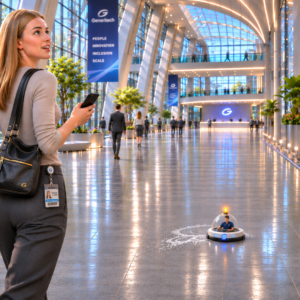
The way these Generitech communities operate and are governed seems similar to Walt Disney World in Florida, which governed itself before 2023. Was that the inspiration for them?
That was the inspiration for sure.
Thought so, but I just wanted to be sure. It is a really cool inspiration, for sure.