
Chapter Five
September 23rd, 2017 — Morning
The crisp fall wind swept across the flat farmland surrounding Ridgemont, carrying the smell of dry earth and harvested corn with it. There was little to slow it down. No mountains rose along the horizon, few natural hills broke up the landscape, and outside the occasional shelterbelt planted around old farmsteads, trees grew in scattered pockets rather than great walls of forest.
The flatness was ancient.
Millions of years earlier, much of central Minnesota had been buried beneath ice. As the glaciers retreated near the end of the last Ice Age, meltwater flooded the lowlands surrounding what would eventually become Ridgemont, creating an enormous inland lake that covered much of the region. Over thousands of years the water slowly receded, leaving behind deep layers of mineral-rich sediment and dark soil across the exposed lakebed.
That ancient lake was long gone by the time settlers arrived, but its legacy remained beneath their feet. The land around Ridgemont became some of the richest agricultural ground in the upper Midwest, mile after mile of fertile black earth capable of supporting corn, soybeans, wheat, sugar beets, and nearly anything else farmers could coax from Minnesota’s short growing season.
There was a tradeoff.
The old lakebed had left the region broad, open, and almost relentlessly flat. Once the crops came down in autumn, there could be miles of exposed ground between one obstruction and the next. Wind had nothing to fight. It simply gathered itself over the fields and kept going.
Chicago might have claimed the title of the Windy City, but people in Ridgemont tended to find that amusing. Chicago had buildings.
Ridgemont had forty miles of open farmland giving the wind a running start.
Callie felt every mile of it that morning.
The brisk September wind pushed at her back as she crossed the student parking lot toward Ridgemont High, tugging loose strands of hair across her face and sending brittle leaves scraping over the pavement around her shoes. She had surrendered to the weather before leaving home, trading the lighter clothes she had been wearing only a few weeks earlier for jeans and a thick hoodie zipped nearly to her throat. Even then, she kept her hands buried in the front pocket as she walked. Minnesota had a habit of making fall feel less like a season and more like a brief negotiation between summer and winter, and judging by the cold pressing through her sweatshirt, winter was already winning.
Ahead of her, RIDGEMONT HIGH SCHOOL stretched across the front of a sprawling brick building, the words mounted in silver letters above a bank of tall metal-and-glass doors. Beneath them, painted proudly in purple and white, was the school’s other declaration of identity.
HOME OF THE RIDGEBACKS.
Callie had never been entirely sure how that had happened.
Rhodesian Ridgebacks were not native to Minnesota. They were not especially common in Ridgemont, either, and as far as she knew there was no historic connection between the city and the breed beyond somebody, somewhere, apparently deciding that Ridgebacks sounded good with Ridgemont. Maybe there was a story behind it. There probably was. Schools loved having stories behind things.
Whatever the reason, the mascot itself had worked out spectacularly.
Gus was an actual Rhodesian Ridgeback owned and cared for by one of the school staff members, a large reddish-brown dog who had become more recognizable around Ridgemont High than some of the teachers. Someone usually brought him out wearing a purple Ridgemont vest for pep rallies, football games, homecoming events, and anything else the school could reasonably justify putting a dog in front of several hundred teenagers for. The student body adored him. Even kids who treated pep rallies like court-ordered community service would pull out their phones when Gus trotted onto the gym floor.
Callie liked Gus.
Gus, unfortunately, did nothing to make school itself more appealing.
She caught one of the heavy front doors before the wind could pull it away from her and wrestled it open. Warm air rushed over her face as she stepped inside, followed almost immediately by the familiar noise of Ridgemont High swallowing her whole.
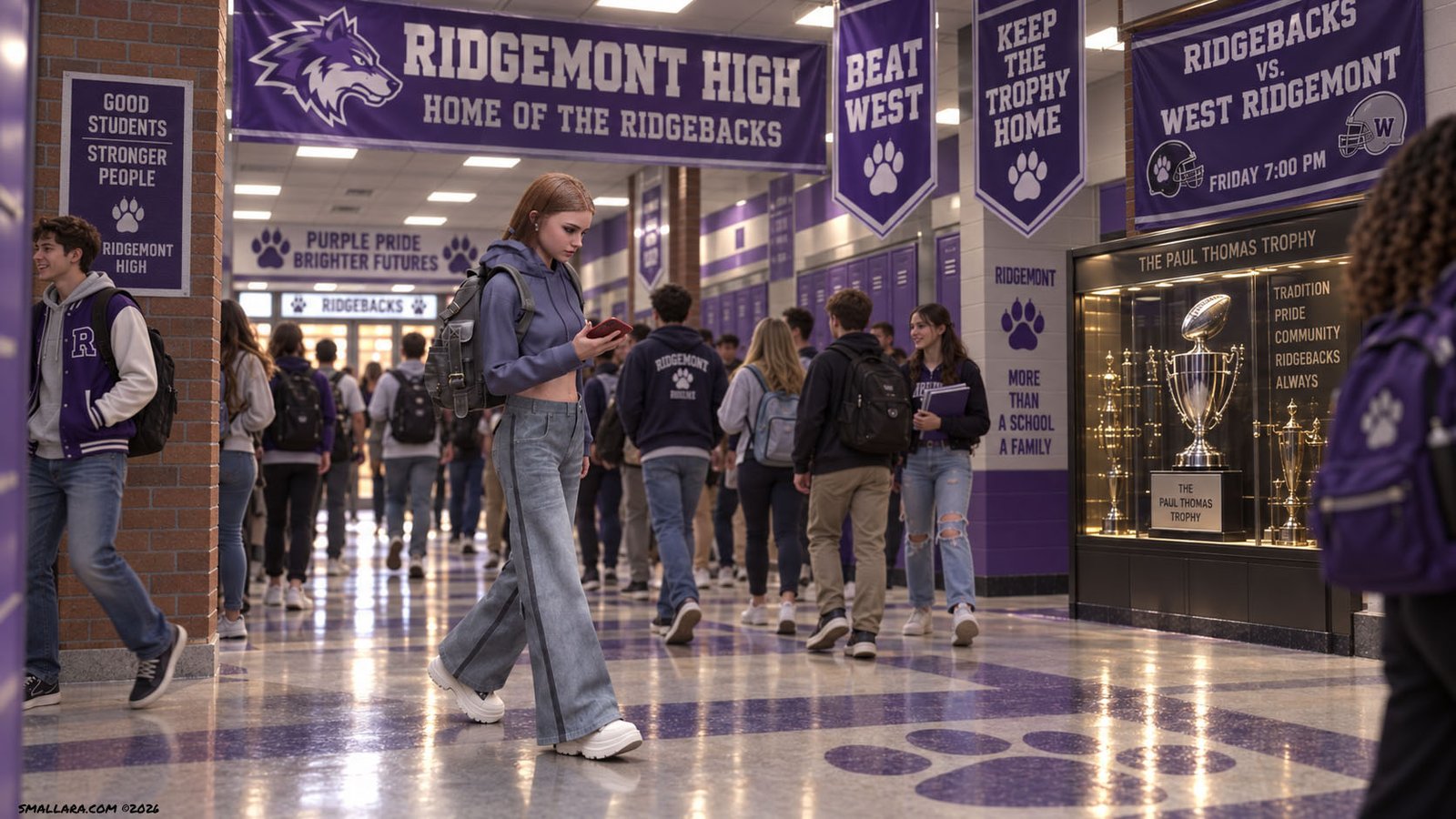
The main hallway was already packed.
Students moved in loose currents between classrooms and lockers, backpacks slung over shoulders, phones in hands, conversations overlapping until individual voices disappeared into a steady roar. Locker doors slammed. Someone shouted a name from halfway down the hall. A teacher standing outside a classroom reminded three different people to keep moving while being ignored by all of them. The smell of coffee, perfume, floor cleaner, and whatever the cafeteria had started cooking for lunch blended into the particular scent Callie associated exclusively with school.
Ridgemont High was not the only high school in the city, but it was the largest, and on mornings like this it seemed determined to fit half of Ridgemont inside one hallway.
Purple-and-silver banners hung from the ceiling above the crowd, impossible to miss even through the traffic.
BEAT WEST.
KEEP THE TROPHY HOME.
RIDGEBACKS VS. WEST RIDGEMONT
FRIDAY. 7:00 PM.
Callie glanced up at them as she moved with the crowd.
Apparently there was some concern that anyone in town might have forgotten.
They had not.
Ridgemont High and West Ridgemont High had been rivals for longer than Callie had been alive, and football was where that rivalry became something closer to civic religion. The city technically had two public high schools. On Friday nights, it had two sides.
You were Ridgemont or you were West.
Families chose. Neighborhoods chose. Businesses chose, sometimes literally hanging purple or blue banners in their windows depending on which side of town they were on. Graduates who had not stepped inside either school in twenty years still argued about games played when they were sixteen. Parents who claimed high-school sports were supposed to be about character development could become suspiciously interested in the scoreboard whenever West Ridgemont was involved.
And this Friday was not just another game.
It was the Thomas Game.
The winner took home the Paul Thomas Trophy, an oversized silver cup named for Ridgemont’s founder and mounted on a dark wooden base crowded with decades of tiny engraved placards. Somewhere in the distant past, someone had probably intended the trophy to represent community, tradition, and friendly competition between the city’s two schools.
Nobody cared about that anymore.
What mattered was custody.
Ridgemont High had possessed the trophy for four straight years. Four consecutive victories. Four new placards screwed into the base beneath the school’s name.
That made this year worse.
Winning it once was fun. Winning it twice became a streak. Four years turned it into property.
The trophy lived in the glass case outside the main gym now, polished beneath its own little spotlight as if the school were displaying a captured enemy standard. Students passed it every day. Teachers referenced it during announcements. The football team posed with it in photographs.
Losing on Friday would mean watching West Ridgemont carry it out.
No one wanted to be the class that let that happen.
Callie understood the feeling even if football itself had never occupied the sacred place in her heart that it seemed to occupy in half the city. She would go to the game. Almost everyone would. The stands would fill before kickoff, the student section would be painted purple, and somebody would inevitably show up wearing far too little clothing for an September night in Minnesota because school spirit apparently provided insulation.
For a few hours beneath the stadium lights, Ridgemont would behave as though nothing occurring anywhere else in the world mattered quite as much as which group of teenagers could move a football across one particular patch of grass.
It was ridiculous.
It was also Ridgemont.
Callie adjusted the strap of her backpack and let the morning crowd carry her deeper into the school.
“Callie!”
The shout came from somewhere off to her right, cutting through the overlapping conversations and slamming lockers. She turned toward one of the side hallways and immediately spotted Luke waving an arm over his head with enough enthusiasm to suggest he was trying to guide in an airplane.
Callie stared at him for a second.
There was absolutely no reason for the waving. Luke already stood half a head above most of the students around him, which made losing him in a crowd surprisingly difficult. He also happened to be wearing a Ridgemont football hoodie with RIDGEBACKS printed across the chest in letters roughly the size of road signs.
She lifted two fingers in acknowledgment.
Luke responded by waving harder.
Apparently he felt she might have missed him the first time.
Callie changed course and worked her way across the hallway, sidestepping around a girl crouched beside an open locker and narrowly avoiding someone backing out of the drinking fountain without looking.
“You’re late,” Luke announced when she reached him.
Callie glanced toward the clock mounted farther down the hall. “Some people would say perfectly on time.”
“Those people would be wrong.”
“The bell hasn’t rung.”
“That’s a technicality.”
“That’s literally the thing that determines whether I’m late.”
Luke considered this, then dismissed it with a shrug. “Whatever. Important stuff first.”
Only then did Callie really notice the boy standing beside him.
He was about Luke’s height but otherwise seemed built from entirely different material. Where Luke had the effortless looseness of someone who could walk into a room full of strangers and somehow leave knowing half of them, the other boy stood with his backpack hooked over one shoulder and the faintly cautious expression of someone still figuring out where he belonged. His hair was nearly black, making his pale complexion seem even lighter beneath the fluorescent hallway lights, and his features had that irritatingly symmetrical quality some people seemed to receive through genetic favoritism.
He looked suspiciously too put together for Ridgemont High at eight in the morning.
Luke slapped a hand against the boy’s chest.
“I wanted you to meet Myles. My boy.”
Myles rocked backward half a step from the impact. “Ow.”
Callie looked from him to Luke. “Hi, Myles, Luke’s boy.”
Myles smiled.
“Is that an official title,” she continued, “or are you still in the probationary period?”
“Official,” Luke said immediately.
“I don’t remember agreeing to that,” Myles said.
“You don’t have to. I appointed you.”
“That seems legally questionable.”
“Most of Luke is legally questionable,” Callie said.
“There we go.” Luke pointed between them. “Already bonding.”
Myles laughed, some of the uncertainty leaving his face as Callie stopped beside them.
“You look nice today,” he said.
Callie looked down at herself.
Jeans. Hoodie. Sneakers.
She looked back at him.
“Thanks, Grandpa.”
Luke barked out a laugh.
Myles immediately turned red. “I just meant…”
“Whoa.” Luke put up one hand. “Slow down, Romeo. We’ve known her for twelve seconds.”
“I wasn’t…”
“You opened with ‘you look nice today.’”
“I was being polite.”
Callie nodded solemnly. “Very respectful. Extremely 1940s.”
Myles looked between them. “Is this what you two are always like?”
“Yes,” Callie and Luke answered together.
That made Myles laugh despite himself.
The warning bell had not rung yet, but the hallway was beginning to thin as students peeled away toward classrooms. Luke hooked an arm around Callie’s shoulders and steered her toward the math wing.
“Come on. Walk with us.”
Callie allowed herself to be redirected for approximately three steps before looking up at him. “Luke.”
“What?”
“We’re in the same math class.”
“I know.”
“So where exactly did you think I was going?”
“I don’t know. You’re smart. You people disappear into science rooms and build robots and stuff.”
“You people?”
“Science people.”
“I am not a science person.”
Luke looked at her.
Callie looked back.
“You spent like three weeks building a robot door.”
“That was different.”
“You built a door that opens itself.”
“It wasn’t a robot.”
“It moved.”
“That does not make something a robot.”
Myles glanced between them. “What was the door for?”
Callie opened her mouth.
Luke answered first. “Hamster prison.”
“It was not a hamster prison.”
“It was literally a cage.”
“It was an enclosure.”
“That is what people call cages when they want cages to sound nicer.”
Callie shoved his arm off her shoulders. “I was testing the servo mechanism. Nothing lived in it.”
Myles nodded as though that somehow clarified everything. “Okay.”
“See? Myles gets it.”
“I absolutely do not.”
“Good answer,” Luke said.
They joined the flow of students moving toward the math classrooms. Someone brushed past Luke from behind and muttered an apology. Luke barely seemed to notice.
“So,” he said, “after school.”
Callie narrowed her eyes. “What about it?”
“My place.”
“That sounds ominous.”
“Study session.”
Callie groaned. “You really need to stop calling them that.”
“They are study sessions.”
“No, they aren’t.”
“We study.”
“We have never studied.”
“We study the complex relationship between hand-eye coordination and competitive digital environments.”
“You play Halo.”
Luke held up one finger. “First of all, we are more cultured now. We’re in high school.”
Callie waited.
“It’s Call of Duty.”
She laughed. “Oh, my mistake. Practically scholars.”
“Myles got us the hookup.”
Myles lifted his hands slightly, apparently realizing he had been drafted into the argument. “My parents own Games Galore.”
Callie looked at him again. “Wait. Seriously?”
“Yeah.”
That explained why the name had seemed faintly familiar.
Games Galore sat in one of the older shopping centers near downtown and had been Ridgemont’s default answer to almost anything involving the word game for as long as Callie could remember. Video games occupied most of the front half of the store, but the farther inside you went, the more specialized it became. Board games lined entire walls. Glass cases displayed expensive trading cards and painted miniatures. Shelves near the back held enough Dungeons & Dragons books, dice, maps, and tiny monsters to supply several imaginary kingdoms.
On weekends, folding tables appeared in the rear of the store near the snack coolers, and groups would spend entire afternoons playing campaigns Callie only vaguely understood. Sometimes the same people would still be there when her family returned from grocery shopping hours later, surrounded by empty soda bottles and piles of dice as though they had been trapped inside by some extremely nerdy weather event.
“Your parents own Games Galore?” Callie repeated.
Myles nodded.
Luke threw an arm around his shoulders now. “Which is why Myles is a valuable and cherished member of this friendship.”
Myles looked at him. “You’ve known me for three weeks.”
“Some bonds happen fast.”
“You just want free games.”
“I can love two things.”
Callie laughed.
Luke turned toward her as they approached the classroom. “So you’re coming?”
“To your extremely academic study session?”
“Exactly.”
Callie reached for the classroom door. “I’ll think about it.”
Luke caught the door before she could open it.
“That means yes.”
“That absolutely does not mean yes.”
“It does when you say it.”
Myles looked at Callie. “He does this a lot, doesn’t he?”
“You have no idea.”
The first bell rang overhead.
Luke grinned and pulled the door open with an exaggerated sweep of his arm. “After you, scholars.”
Callie rolled her eyes and stepped inside.


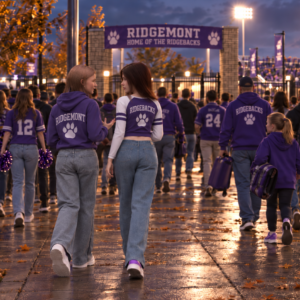
Now it’s the school’s turn for worldbuilding, and I’m loving every bit of it.
thanks, each part in these first few has some worldbuilding elements to it as we introduce the world, characters, daily life etc.
Why the picture is so shity , I can see that callie are the only hand made and the rest are all AI . Form my pov ? It was not like this before?
Because the rest of the people are lower quality. its not possible to make an image with that amount of people without lowering the quality. Most Gen 9 figures texture maps are 4k or 8k.
I render using an nvidia 5080. There is no fewer than 17 people in this scene. If I used gen 9 figures for all of them, it would be impossible to render by default. I would need to modify the texture maps of every single person to a very low res version based on distance to camera with the the furthest being the smallest, like something like 480×480 texture maps, and then larger the closer they get. Not even mentioning the amount of time that was spent in Photoshop with the custom graphics.
The banners were done in Photoshop, not AI. Not to mention the Ridgemont and the paw graphics. The school hallway and people i did generate, then used Photoshop to make over and customize the scene to fit the Ridgemont aesthetic.
It took more time than actually just using a default building in Daz Studio because of the Photoshop and layering work. Everything takes time dude and im one person. I can fully make 3d images, Photoshop them, and such, or I can write, or I can find ways to do images at acceptable levels.
I started trying out this method based on user comments. Washsnowghost actually has suggested utilizing ai in my workflow for a while. I was reluctant but wanted to try it out with this series, and while I don’t like the results when i fully use ai. I have found ways to within my workflow utilize AI which add efficiencies.
I don’t mind criticism, but you are criticizing a method without any idea of the work or process used to create it, or the amount of time it takes to do it via any method. Like oyu looked a tteh whole hting was like that just AI without taking into account or able ot even know which parts arctually ai, which parts i photoshopped, what the base image actually looks like, how many layers thing take.
You don’t know the mathematics that went into deciding between how many people I could render, how many texture maps would need to be resized, the time of making that many people. In this one i wanted custom rigemont graphics so iwould still need to Photoshop a lot of the images but when its done 3D you need to edit the actual source graphics the 3d model is based on which creates more work as you want it to render out properly with the lighting utilzied in the 3d space. Which you can partially eliminate by doing things piecemeal and combining all elements in Photoshop.
I use gronk and pictures look amazing from it. Since you already have models, I would put the models in a pic and then tell gronk what to do with them. It’s a good tool to save you time. Your writing is where your time I’m guessing is used the most. Lol
I use AI to create characters and backgrounds, and it works well for that purpose. In fact, I’m using AI to create original characters to add to the Smallara universe. CM and Lethal inspired me to do so with their stories.
It’s a great tool for pictures & video
1) “Minnesota had a habit of making fall feel less like a season and more like a brief negotiation between summer and winter, and judging by the cold pressing through her sweatshirt, winter was already winning.” I have heard that Minnesota can get quite cold
2) “Callie liked Gus. Gus, unfortunately, did nothing to make school itself more appealing.” damn it, Gus, you had one job
3) “Ridgemont High and West Ridgemont High had been rivals for longer than Callie had been alive, and football was where that rivalry became something closer to civic religion.” It’s always been weird to me how seriously Americans take high school sports
4) “She turned toward one of the side hallways and immediately spotted Luke waving an arm over his head with enough enthusiasm to suggest he was trying to guide in an airplane.” who according to the dates you gave me is not 15 and has been for a fortnight
5) “I wanted you to meet Myles. My boy.” Doesn’t Callie know Luke’s boy? He must be new to Ridgemont
6) “That is what people call cages when they want cages to sound nicer.” Yeah, but in a few years that word’s gonna change to ‘habitat’
7) “You play Halo.” – “First of all, we are more cultured now. We’re in high school. It’s Call of Duty.” I don’t think that’s at all better
8) “My parents own Games Galore.” Oh, so he is a local. (and apparently Luke’s a gold digger)
9) “Shelves near the back held enough Dungeons & Dragons books, dice, maps, and tiny monsters to supply several imaginary kingdoms.” That is what they exist for
10) “You’ve known me for three weeks.” – “Some bonds happen fast.” – “You just want free games.” – “I can love two things.” Definitely gold-digging
11) Myles’ full name and DOB?
3) Let’s not start talking about weird societal norms, or I’ll have to start listing some Aussie idiosyncrasies. 😝
3) we take all competitions seriously. Athletic, mental or business. It comes I believe from the freedom we have and we believe the best person wins no mater color , wealth, lifestyle or girl /boy. Who Evers the best wins , period. Lol
3) I mean, in some areas of the United States. High school and college sports are treated like a religion.
And a damn fine one too lol
1) Minnesota gets very cold what you would call -45 celsius before windchill at times. its been negative 70 with windchill before
2) I know right? shame on gus. He had one job to make school better.
3) americans take all sport competitions seriously. Its why while we dont care about soccer we were invested in the world cup then the us team lost and we literally didnt care anymore as it soccer not like its football, basketball or baseball, etc. even hockey is probably higher then soccer, nascar may be a bigger sport then soccer in america.
4) im confused where the 15 is coming from?I dont recall stating he was 15 in this chapter. They are all portrayed as high school freshmen
5) she doesnt know myles. He was just was a person in there school. Hes not part of the friend group until now where luke is introducing him.
6) to be fair callie is only specificalyl making a door that can open and close. shes not building a cage or habitat.
7) Halo is probably more culturally relevant in gaming for its foundational roots in xbox. Where call of duty is the bigger game as its multiplatform.
8) Lol, you dont actually know that. He could have found out later after he met him. Myles could also be using the fact his family owns games galore to get in with them at this point not much is known specifically either way.
9) dont you play d&d. I felt like you mentioned oyu did years ago deviantart.
10) Im sure myles is getting benefits as well.
11)Myles Andrew Bennett — October 2, 2002
4) I’m sure Lethal will follow up, but in episode 1 you state that it is currently 2017, so that would make Luke 15.
Freshmen are normally 14 and 15 I’m just confused with the significance of it.
It seems typical to me unless I’m misunderstanding something
My brother & many people are a grade early, some are held back for grades or their parents wanted them to stand out in sports lol
Tbh the significance is that I’m being a bit too focused on the timeline.
1) I would just fucking die if I got that cold.
3) Yeah, soccer more popular internationally than football though, just like how Cricket’s mote popular than baseball, except in America.
4) no, but you did state that “Lucas “Luke” Daniel Rasmussen Born September 7, 2002” which means his 15th Birthday was 16 days ago.
6) not yet anyway.
7) That’s probably correct.
8) lol, Myles could be Luke’s gaming sugar daddy.
9) I do, it’s good fun.
10) friends with benefits.
11) thanks.
1) The old lakebed had left the region broad, open, and almost relentlessly flat. Once the crops came down in autumn, there could be miles of exposed ground between one obstruction and the next. Wind had nothing to fight. It simply gathered itself over the fields and kept going.
I went to college in Lubbock, which had a very similar situation. Extremely flat and when the cotton was not in the ground, the wind blew big time, and the dust was always along with it! Sometimes it would lightly rain and you would get a mud storm 🤠
2) I hate to be a nitpicker again (maybe I like it, I’m not sure), but the mascot rendering is a wolf and not a ridgeback. I still appreciate that time you take to make these rendering in the first place.
3) Rhodesian Ridgebacks were not native to Minnesota.
Hence the word “Rhodesian” in the name 🤣
4) I grew up in a 2 high school town. A lot of competition about which school was best.
5) I’m a little confused about Myles’ appearance in this scene. It’s like he just got into town, but his backstory seems to indicate that he has been around for some time already.
6) “Thanks, Grandpa.”
Geez, cut the guy some slack, you just met him!
7) “It was an enclosure.”
Again I get the feeling that Callie is not going to pro-Little when the time comes.
1) yes, there are a few areas around the us that are like htis. I used the history behind lake agassiz in the minnesota area and hwo it formed and was created through the ice and melt period then fictionalized aspects as far as size, and such to work with the narrative but like most aspects of smallara i try to ground it in reality and the embelish around it.
2) Yes 100% the paw I wanted to look cool which was my primary purpose plus i went with the idea that the logo was probably student submitted along with the name ridgebacks. So they were probably not going for accuracy 100% it was just name that won then the logo that won. Atleast that was the methodology behind what i did.
While i liked the name ridgeback i didnt think using an actual ridgeback as the logo would be that cool looking atleast not with my level of artistic ability.,
3) lol, i actually had to look up the rhodesian part as i had created the name ridgebacks before i knew that.
4) same, thats where i pulled alot of hte rivalry from. I did make up the paul thomas trophy my local schools didn thave a trophy but i thought it was a cool addition.
5) Hes not new to town hes just new to the group as he is entering as lukes friend. its not stated how luke and myles met directly behidn the reason but its hinted at here.
6) Callie? Never, myles immediately gets the full Callie expierence.
7) She isnt really thinking about it in terms of littles though. She is just being literal in what she is doing as to her character seh has a project idea she trying to do. So shes looking at it purely from the aspect of im building this and this is what it is. The practical application and why isnt really important she wants the door to open adn close on its own. As that would be useful. So thats what shes doing.
Similar to how lots of inventions over time have been made. In a vaccuum guns arent dangerous, bombs arent dangerous they were from a engineering standpoing and science standpoint just can this be done.
only later is ended up being used for bad.
7) I don’t think she is not against littles but I see your point saying they can’t be human. If she stays big with her sister, I’m guessing Callie will treat littles like pets and put her parents in a cage with other littles they find. Since they are so far out & it’s early, they can as many litters they want because I would think the tax little laws haven’t passed yet.
My family have only had ridgebacks. My daughter’s main buddy and protector was a 120 pound lion hunting dog lol. It’s one of the reasons we bought a house is a pre planed neighborhood because it had a 11 acre dog park and dog friendly trails all over the neighborhood. Everyone seemed to know our dog lol
Wild that a random pull ended up being a dog you were so familar with. thats funny. very cool though. I didnt know they were lion hunting dogs
I hated at the dog park some tough guys always wanted to know if he could take a pit bull or Rottweiler and I would always say I don’t care because I don’t want my dog hurt. lol