
Chapter Six
September 29th, 2017 — Evening
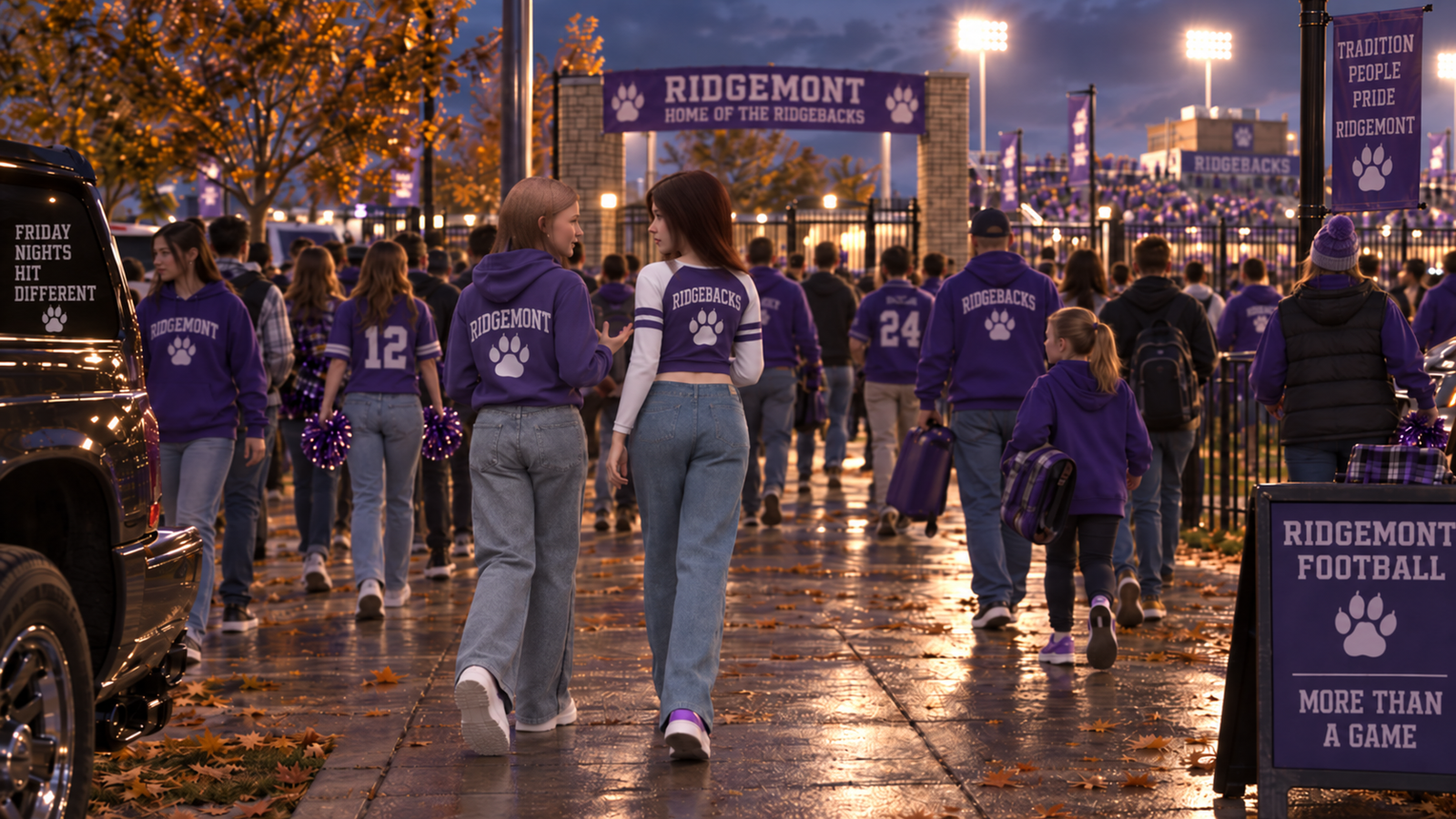
Callie and Maggie joined the river of people moving toward Ridgemont High’s football field just after sunset, when the last orange light had drained from the western sky and the stadium lamps had taken over.
Everybody in town had known it would be like this.
By late afternoon, businesses along Ridgemont Avenue had begun taping handwritten signs to their front doors announcing shortened hours. The little insurance office across from the library had closed at four. Peterson Hardware had shut down at five-thirty. Even a few places that normally stayed open late had surrendered to the inevitable, because there was no point paying three employees to stand behind empty counters while half the city sat beneath stadium lights. Restaurants, gas stations, and the grocery stores remained open, staffed by whichever unlucky souls had failed to request the night off or had drawn the shortest straw when the schedule went up.
Everyone else seemed to be here.
Cars packed the school lots until the painted lines became suggestions rather than rules. Pickup trucks had been squeezed onto grass shoulders. Minivans filled the side streets for blocks in every direction, and people streamed toward the stadium from neighborhoods that normally went quiet after dinner. Parents carried folding cushions and blankets beneath their arms. Little kids hurried beside them in oversized purple sweatshirts, some with silver paw prints painted on their cheeks. Groups of students walked five and six across, forcing everyone behind them into the street until somebody honked and sent them scattering back toward the curb.
The game did not start for another half hour, but Ridgemont already felt as though something had begun.
The air had that peculiar warmth an early Minnesota autumn sometimes offered as a final apology before winter. The wind still moved steadily across town, stirring leaves along the gutters and tugging at ponytails and sweatshirt strings, but there was no real bite in it yet. Callie had left home in a hoodie and regretted the decision almost immediately. By the time she and Maggie reached the school grounds, she had tied it around her waist and pushed the sleeves of her T-shirt farther up her arms.
Ahead of them, the stadium lights rose above the dark line of trees in four blazing columns, bright enough to bleach the night around them. Their glow reflected from car roofs and caught in the chrome of parked trucks. Every few seconds the sound from inside the stadium rolled outward over the parking lot: the brass section of the marching band warming up, drums hammering out an uneven rhythm, a burst of cheering that seemed to start for no particular reason, then collapse into laughter.
Purple was everywhere.
Purple hoodies. Purple jerseys. Purple blankets folded over arms. Purple-and-white pom-poms sticking from little girls’ fists. A man walking ahead of Callie and Maggie wore a battered Ridgemont varsity jacket that had probably been older than either of them, the leather sleeves yellowed with age and an enormous embroidered Ridgeback stretched across the back.
Two boys who looked about eight came tearing past them in matching Ridgemont shirts, both with their entire faces painted a violent shade of purple. One had managed to smear a streak of it down the side of his neck, and the other had somehow gotten some in his hair.
Maggie watched them go with a look of concern. “That is never coming off.”
Callie glanced sideways at her. “What?”
“The face paint.” Maggie nodded toward the boys as they disappeared into the crowd. “His mom’s gonna be washing purple out of his ears until Christmas.”
One of the boys shouted something about West sucking. His brother immediately repeated it louder, and their father, walking a few steps behind them with a stadium blanket tucked under one arm, made absolutely no effort to correct either of them.
Callie smiled. “Worth it.”
Maggie looked at her. “He’s gonna stain his pillow.”
“School spirit requires sacrifice.”
That earned a snort. “Easy for you to say. You wouldn’t paint your whole face.”
Callie gave her an offended look. “I have standards.”
“You drew an R on your cheek last year.”
“With eyeliner,” Callie said, as though that settled the matter. “Like a civilized person.”
Maggie laughed. “It looked terrible.”
“It looked fine.”
“It was backward.”
Callie stopped walking for half a step and turned toward her. “It was not backward.”
Maggie’s grin widened. “You did it in the mirror.”
Callie opened her mouth, then paused.
She remembered standing in front of the bathroom mirror with the eyeliner pencil.
Maggie saw the realization immediately.
“Oh my God,” she said, delighted. “You didn’t know.”
“I knew.”
“You absolutely did not.”
Callie started walking again. “Shut up.”
Maggie was still laughing when a sudden roar spilled out of the stadium ahead, louder than anything that had come before it. The sound rolled across the parking lot hard enough to make both girls look toward the lights.
“They haven’t even started yet,” Maggie said.
Callie kept her eyes on the stadium. “They’re practicing.”
Maggie looked over at her. “Practicing cheering?”
Callie shrugged. “This is the West game. You can’t go in cold.”
Maggie laughed again, but Callie was only half joking.
Ridgemont vs West Ridgemont had a way of turning perfectly normal people into lunatics for one Friday every fall. Teachers had spent the entire school day pretending anyone was paying attention. Football players had worn their jerseys through the halls. Cheerleaders had painted purple paw prints on classroom windows. Somebody had covered West Ridgemont’s name on a hallway poster with a strip of paper reading THAT OTHER SCHOOL, which lasted until lunch before an administrator removed it.
By sixth period, practically every conversation had somehow found its way back to the game.
Who was starting.
Whether Ridgemont’s offensive line could handle West’s defense.
Whether Luke had actually said they were going to win by twenty.
Whether West’s quarterback was really hurt or whether that was just something somebody had heard from somebody whose cousin knew one of their trainers.
Most of it was probably nonsense.
Nobody cared.
The rivalry had existed so long that Callie had never thought much about when it started. Ridgemont High and West Ridgemont High were simply opposites in the same way north and south were opposites. You belonged to one or the other, often before you were old enough to understand why. Families chose sides based on neighborhoods, school boundaries, old friendships, old grudges, or whichever high school somebody’s parents had attended twenty-five years earlier.
People carried it with them.
Store windows displayed purple Ridgebacks or West’s blue-and-gold colors depending on which side of town they sat. Alumni who had not set foot inside their old school since graduation still showed up for this game. Fathers who insisted high-school sports were about “building character” became deeply concerned with the scoreboard whenever West Ridgemont was involved.
And this year there was the trophy.
The Paul Thomas Trophy had spent the last four years in Ridgemont High’s glass display case outside the gym, polished beneath fluorescent lights and surrounded by old team photographs. Technically it commemorated Paul Thomas, one of Ridgemont’s founders, and supposedly represented sportsmanship, civic pride, and friendly competition between the city’s two largest schools.
Nobody under the age of sixty cared about any of that.
The important part was that Ridgemont had it.
West did not.
Four straight years had transformed possession into ownership. Another Ridgemont victory meant another little silver placard screwed onto the wooden base. A loss meant watching West’s players carry it across the field while their student section screamed themselves hoarse.
Nobody wanted to be around for that.
Callie could already imagine Monday morning if it happened.
Absolutely unbearable.
She and Maggie had nearly reached the main walkway leading toward the ticket gates when a voice rose behind them.
“Callie!”
Callie slowed and glanced toward Maggie.
Maggie was already looking at her.
“What?” Callie asked.
Maggie’s mouth twitched. “Nothing.”
“You made a face.”
“I looked at you.”
“No. You did that thing.”
“What thing?”
“That thing where you look at me and somehow manage to be annoying without saying anything.”
Maggie smiled innocently. “Sounds like a you problem.”
Callie narrowed her eyes before turning around.
Myles was weaving toward them through the crowd, slipping between a family carrying stadium cushions and three girls taking pictures together beneath one of the parking lot lights. He spotted Callie looking back and raised a hand.
Even from twenty feet away, he was easy to pick out.
His hair was nearly black beneath the white stadium lights, messy enough tonight that it looked as though he had tried to fix it and then changed his mind halfway through. He wore jeans and a purple Ridgemont T-shirt beneath an open charcoal jacket, and there was still something almost unfairly put together about him. Callie had thought the same thing the first morning Luke introduced them. Myles had the sort of face that would probably become genuinely dangerous once he figured out he had it.
At the moment, fortunately, he still seemed uncertain enough to be manageable.
Maggie leaned slightly closer to Callie as Myles approached. “So that’s Myles?”
Callie kept her eyes forward. “Yes.”
Maggie made a thoughtful little sound. “Huh.”
Callie turned immediately. “What does that mean?”
“What does what mean?”
“‘Huh.’”
“It means huh.”
“No, it means you have an opinion.”
Maggie smiled without looking at her. “I have lots of opinions.”
“About him?”
“I didn’t say that.”
“You didn’t have to.”
Maggie finally looked over. “You seem very interested in what I think.”
Callie felt the trap and refused to step into it. “I’m interested in why you’re being weird.”
“I’m not being weird.”
“You’re always weird.”
“Then technically nothing has changed.”
Myles reached them before Callie could come up with a response.
“Hey.” He smiled at Callie, slightly out of breath from catching up. “I thought that was you.”
Callie glanced past him toward the crowd he had come through. “Did you come here alone?”
“No. I came with a couple friends, but we got separated.” Myles shoved one hand into his jacket pocket and hesitated just long enough for Callie to notice it. Then his smile returned, a little less certain this time. “But then I saw your gorgeous face, so I figured I’d come over.”
For one second, Callie said nothing.
Beside her, Maggie became suspiciously quiet.
Callie looked at Myles. Then she looked back over her own shoulder toward the direction she had been walking.
“From behind?”
Myles froze.
Maggie immediately turned away, pressing her lips together.
“I…” Myles glanced behind Callie as if the parking lot might somehow provide an escape route. “Okay. Technically, I recognized you from behind.”
Callie folded her arms. “So you did not see my gorgeous face.”
“No,” Myles admitted.
“Interesting.”
“That came out wrong.”
“It came out exactly how you said it.”
Maggie made a soft choking noise beside them.
Myles looked at her. “Are you laughing?”
Maggie shook her head without turning around. “No.”
“You’re definitely laughing.”
“I’m trying very hard not to.”
“Thank you for the support.”
“You’re welcome.”
Callie’s smile was becoming harder to hide. “So what did you recognize?”
Myles looked back at her. “What?”
“If you saw me from behind. How did you know it was me?”
“Your hair.”
Callie reached up and caught a few strands between her fingers. “Half to three quarters of the girls at Ridgemont have brown or blonde hair.”
“Not exactly like yours.”
That answer came fast enough to make her pause.
Maggie noticed that too. Callie could practically feel it.
She ignored her.
“So,” Callie said, “the hair.”
“And your hoodie.”
Callie looked down at the sweatshirt tied around her waist. “My hoodie is not even on me.”
“I can still see it.”
“Very observant.”
Myles smiled, apparently deciding he had recovered some ground. “And your walk.”
Maggie’s head snapped toward him.
Callie slowly raised one eyebrow. “My walk?”
Myles’s confidence disappeared again.
“I meant I recognize the way you walk.”
“Yes,” Callie said. “That is generally what ‘your walk’ means.”
“No, I know that. I just mean there’s nothing weird about it.”
“I didn’t say there was.”
“You made it sound like there was.”
“I said two words.”
“Very judgmental words.”
Maggie folded her arms, openly enjoying herself now. “Just keep talking, Myles. You’re doing great.”
He looked at her. “You want me to fail.”
“I want to see where this goes.”
“That is not the same thing as helping.”
“I never said I was helping.”
Callie finally laughed and gave Myles a light shove on the arm. “Relax. I’m messing with you.”
He studied her face for a second, clearly checking whether she meant it. “You are?”
“Yes.”
“Okay.” He let out a breath. “Good.”
“You were actually doing pretty well until you started analyzing the way I walk.”
“I was not analyzing it.”
“That sounds like something somebody analyzing it would say.”
Myles rubbed the back of his neck. “I just recognize you.”
The answer was simple enough that Callie did not have an immediate comeback.
She hated when that happened.
For half a second, she became acutely aware of Maggie standing beside her, probably watching every microscopic change in her expression.
Callie bumped Myles’s shoulder lightly with hers and started walking again. “Fine. I’ll allow it.”
Myles fell into step beside her. “So I survived?”
Callie glanced at him. “Barely.”
“I’ll take barely.”
Maggie joined them on Callie’s other side, still wearing the grin of someone who had just been handed future ammunition. “For the record, opening with ‘gorgeous face’ was ambitious.”
Myles gave her a pained look. “I panicked.”
Callie laughed. “You panicked before you even started talking?”
“I had a better sentence in my head.”
“What was it?” Maggie asked.
Myles shook his head. “Absolutely not.”
“Oh, come on.”
“No.”
Callie looked over at him. “Was it worse?”
“It was better.”
“That means it was worse,” Maggie said.
“It was definitely worse,” Callie agreed.
Myles pointed between them. “I’m starting to understand why you two are friends.”
Maggie smiled. “Because we’re delightful?”
“Because together you’re a public hazard.”
Callie nodded approvingly. “That was better. See? You’re recovering.”
“Thank God.”
The three of them moved with the crowd toward the stadium, where volunteers in purple jackets stood beneath the entrance lights taking tickets and waving students through. Somewhere beyond the gate, the marching band launched into the first recognizable bars of the school fight song and immediately disappeared beneath another explosion of cheering.
Myles glanced toward the field as the noise rolled over them. “Where’s Luke?”
“Inside already,” Maggie said. “Supposedly saving seats.”
Myles looked at her. “Supposedly?”
Callie gave a small shrug. “Luke’s definition of saving seats has conditions.”
“What conditions?”
“Mostly whether somebody more interesting asks for them.”
Maggie nodded. “If four cute girls show up, we do not have seats anymore.”
Myles laughed. “He’d really give them away?”
“Without hesitation,” Callie said. “He’d probably act like it was our fault for being late.”
“He’d give away his own mother’s seat,” Maggie added.
Callie considered that. “He’d make her stand.”
“And tell her standing is healthier.”
Myles smiled. “That sounds exactly like him.”
They reached the gate, and Callie dug into her pocket for her student ID while Maggie searched through her bag.
Beyond the fence, the entire stadium opened in front of them.
The field burned green beneath the lights, almost unnaturally bright against the dark autumn sky. Ridgemont’s stands were already a wall of purple, students packed shoulder to shoulder in the center section while parents and families filled the rows around them. Across the field, West Ridgemont had begun filling its own bleachers in blue and gold. The marching band crowded one end zone, brass instruments flashing beneath the lights, while cheerleaders moved along the sideline shaking silver pom-poms.
The smell reached Callie almost immediately.
Cut grass. Popcorn. Hot chocolate despite the warm evening. Grilled hot dogs from the concession stand. That strange cold-metal smell of aluminum bleachers.
Then came the noise.
Not one sound, but hundreds layered together. Conversations. Shouting. The band. Sneakers ringing against metal steps. Somebody chanting RIDGE-BACKS three sections over. A whistle from somewhere on the field. The announcer’s voice breaking through the speakers and dissolving into static.
Callie stepped through the gate and felt something inside her shift.
She was not a sports person she was a football person.
She did not memorize statistics but she knew about formations. She could name most of the Vikings’ starters because they were her team and living in Minnesota made that almost unavoidable. She understood the game and could easily know what was happening, but she had never understood adults who let a loss ruin their entire Sunday. This though was different.
This was Ridgemont.
These were people she knew in the stands. Boys she passed in the hallway were warming up beneath the lights. Teachers were sitting with their families. Somewhere in the student section, Luke was probably already screaming about something that had not happened yet.
And across the field sat West.
For the next few hours, that was enough.
Maggie caught Callie lightly by the arm and pointed toward the student section. “There.”
Callie followed the direction of her finger. “Where?”
“Three rows up. Purple hoodie. Acting like an idiot.”
“That does not narrow it down.”
Maggie laughed. “Waving both arms.”
That narrowed it down.
Luke stood three rows above the walkway with both arms over his head, waving like someone trying to attract a rescue helicopter.
Callie stared at him for a second. “Why does he always do that?”
Myles followed her gaze. “Do what?”
“Wave like I’m legally blind.”
Maggie smiled. “Maybe he thinks you’ll miss him.”
“He’s six feet tall and screaming my name.”
As if summoned by the accusation, Luke cupped both hands around his mouth.
“CALLIE!”
Several people nearby turned toward him.
Callie closed her eyes.
Myles started laughing.
“He seems subtle,” he said.
“Very,” Callie muttered.
She lifted two fingers in Luke’s direction, the same minimal acknowledgment she always gave him.
Luke responded by waving even harder.
Maggie laughed. “Apparently that wasn’t enough.”
“It never is.”
Callie shook her head, but she was smiling as she started toward the bleachers.
“Come on before he starts jumping.”
Myles followed. “Would he?”
Callie glanced back at him. “You don’t know Luke very well yet.”
Ahead of them, Luke was already bouncing on the balls of his feet.
Maggie pointed. “Too late.”
Callie sighed. “Of course.”
They started up the metal stairs together, joining the crush of students packed beneath the stadium lights.
Behind them, another wave of people poured through the gates.
Ahead of them, Ridgemont High’s student section was already chanting.
And for one Friday night, beneath a clear Minnesota sky, an entire city had agreed that this mattered.

Friday Night Lights brought to you by Smallara haha.
pretty much
1) “Businesses along Ridgemont Avenue had begun taping handwritten signs to their front doors announcing shortened hours.” Damn, sport really is like a religion here.
2.1) “It was backward.” “It was not backward.” “You did it in the mirror.” OOf rookie mistake
2.2) ““Oh my God, you didn’t know.” – “I knew.” – “You absolutely did not.” That makes it worse
3) “West’s players carry it across the field while their student section screamed themselves hoarse. Nobody wanted to be around for that.” west supporters do.
4) “I have lots of opinions.” “About him?” Maggie being judgemental
5) “But then I saw your gorgeous face, so I figured I’d come over.” Is Myles flirting with Callie? NGL I thought that was for Luke
6) “Callie looked at Myles. Then she looked back over her own shoulder toward the direction she had been walking. “From behind?” all the best faces are recognisable from the back
7) “And your walk.” – “My walk?” – “I meant I recognize the way you walk.” – “Yes, that is generally what ‘your walk’ means.” That makes sense; people recognise the way I walk all the time (technically the way I limp, but same diff)
8) “I panicked.” – “You panicked before you even started talking?” – “I had a better sentence in my head.” Having a crush can do that to people
9) “If four cute girls show up, we do not have seats anymore.” Damnit Luke, stop thinking with your dick.
10) “She lifted two fingers in Luke’s direction, the same minimal acknowledgement she always gave him.” If she’d done that earlier, he probably wouldn’t have yelled
in the smaller towns in the USA, it really is. My High School would always do a big parade through town for home coming for football. Basketball….not so much lol
yup small towns and pretty much all of texas.
1)Yes, yes it is. This is not uncommon for the US when it comes to football.
2) It could have happened to anyone.
2.2) yup she unknowingly went liek that all day.
3) also known as the enemy.
4) It depends what hte opinions are. they couuld be nice.
5) Myles is flirting with Callie.
6) lol, recognized by hair is pretty good.
7) Myles grasping at straws now trying to stay above water.
8) It really can. Its why Callie is enjoying this.
9) Its luke, that cant shock you
10) probably true.
1) yep, stereotyped for a reason.
3) lol
4) could be, but I’m not getting complementary vibes from her.
5) poor Luke
6) Yeah, it’s definitely another option.
7) and they’re just watching him flail.
8) That’s mean
9) just because I’m not shocked doesn’t mean I’m not disappointed.
It looks like if the two guys become littles, they have two cute friends to take care of them & give them play dates so Callie can ask them questions what it’s like being a little other then Luke saying her boobs are big & having them do physical tests for science. LOL
Now me know the base of things, I can’t wait to see who becomes a little lol.
I have question in this week is any one will get the smallara viurs be cause is the most important chapter? Or is next week
LOL. hitting him up for spoilers directly lol. I cant wait to find out who get smallara also lol.
I dont give out those kind of spoilers. It happens when it happens.
This is varsity jacket with the ridge of a Rhoady on it lol
I can’t help myself. I love the dog lol
not bad at all. i like it.