
Chapter Sixteen
November 20, 2017
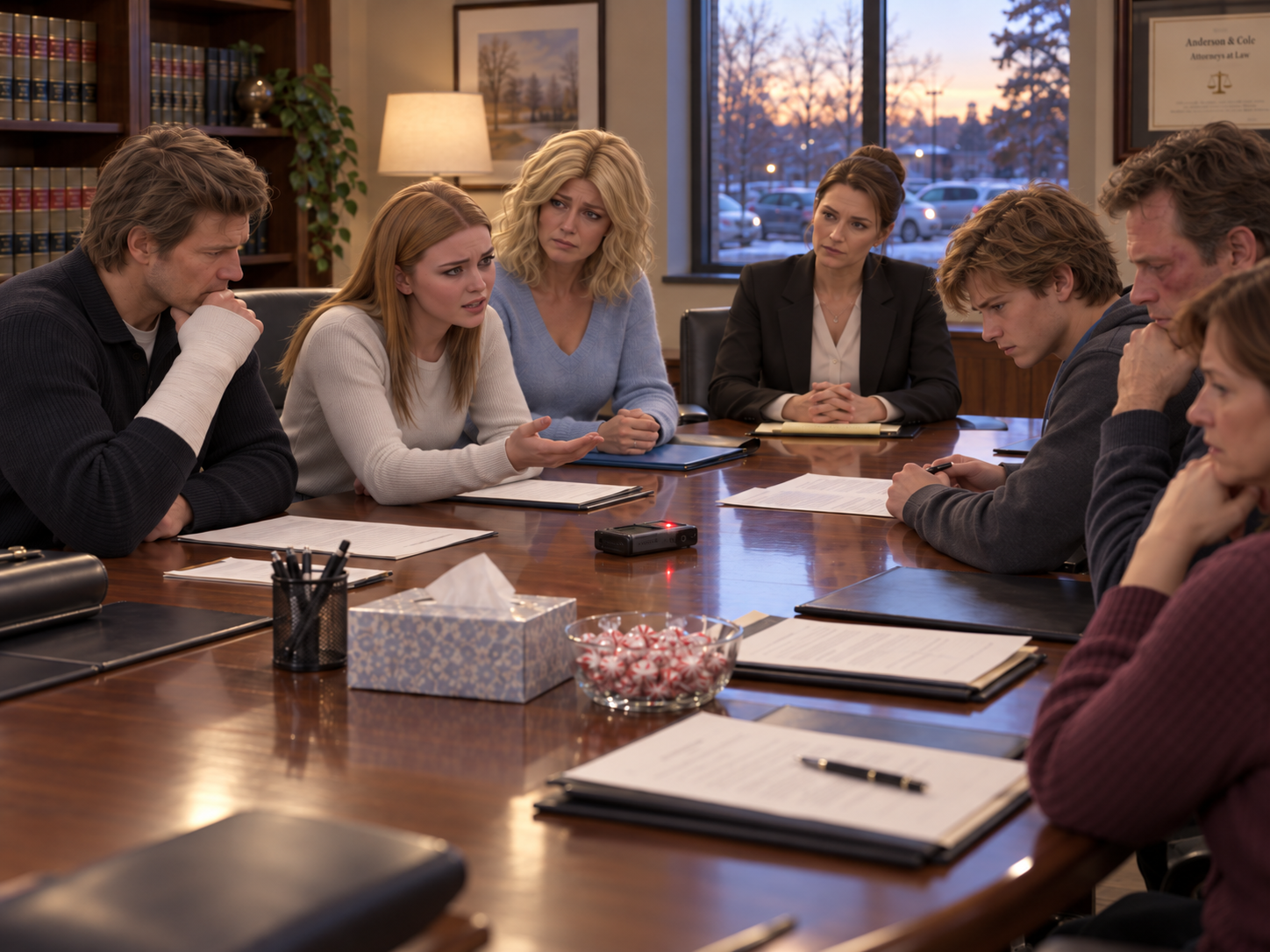
The attorney’s office was warmer than Callie expected. She had imagined a cold room with hard chairs, though she could not have said why. Instead there was a long wooden table, a bowl of wrapped peppermints, and a window overlooking the parking lot. Someone had set a box of tissues within reach of both families. Callie kept looking at it and feeling annoyed.
Stuart sat on her left with his right hand in a cast. He had insisted he was comfortable, then spent the drive over trying to fasten his coat with one hand until Sally made him stop. Now his good hand rested on the table near Callie’s, close enough that she could reach for it. Across from them, Myles sat between his parents. He had looked at Callie when she came in, but neither of them had said hello.
The attorney had been speaking for several minutes. Callie understood most of what she said. The rest seemed designed to make a simple thing sound less terrible. Myles could file his decision within thirty days of being told about the pregnancy. Callie would be notified and would have thirty days to challenge an error or a defect in the filing. Once the baby was born and parentage was confirmed, the relinquishment could be finalized. No one required Callie’s permission.
Sally had asked that last question twice. Their own attorney had given them the same answer the day before, but Callie understood why her mother wanted to hear it again with the Bennetts in the room.
“The provision about identifying Myles needs to come out,” Sally said. She pushed the blue folder a few inches toward the attorney. It was the same folder Tim had placed on the coffee table at his house, though the pages inside had been replaced.
Tim’s jaw tightened. “We discussed that.”
“You told us what you wanted,” Sally said. “That isn’t the same thing.”
The attorney turned to the marked page. “Mrs. Grey is correct. This filing concerns Myles’s legal role. It cannot require Callie to tell people someone else is the father.”
Karen glanced at Myles, then back at Sally. “We’re trying to protect him from having his private life discussed all over Ridgemont.”
“Then you should have brought a different request,” Sally said.
Callie studied the grain of the table. She was grateful that her mother had caught the clause, and she was tired of hearing the adults fight over words that would not change the main thing. People at school already knew she was pregnant. Soon enough, some of them would know whose baby it was. The Bennetts could be as unhappy about that as they liked.
The attorney drew a line through the provision and made a note beside it. When she finished, she set a small recorder in the middle of the table and switched it on. A red light appeared beside the microphone. She stated the date, identified everyone present, and turned the page toward Myles. “This is your decision,” she said. “You understand that your parents cannot file it for you?”
Myles nodded.
“I need you to answer aloud for the record.”
“Yes. I understand.”
Callie looked up. His voice sounded nearly normal. He was staring at the page, one hand folded beneath the table, the other beside the pen the attorney had left for him. She remembered him holding a game controller with both hands, leaning forward on the sofa because he was convinced that would help him beat her. For one stupid instant, the memory made her want to tell him about it. Then she saw the pen again.
The attorney went through what he would give up. Callie had heard the list at the Bennett house and from her parents afterward, but hearing it addressed to Myles was different. He would have no right to make decisions for the baby, no custody or visitation to claim later, and no parental place he could return to because he had changed his mind. If the filing was completed, he would not be required to support the child financially. When the attorney asked whether he had any questions, Myles shook his head.
“You can take more time,” she said. “The filing period has not expired.”
“I know.” Myles reached for the pen.
“Wait.” Callie’s voice came out louder than she intended. Myles stopped, and everyone turned toward her. She could feel Tim Bennett preparing to object, but she kept her eyes on Myles. “You said you understand. Tell me what you understand.”
“Cal, she just explained it.”
“That’s what she understands. I’ve heard what your parents understand too.” Callie glanced at the recorder, its little red light steady in the middle of the table. “Everyone here has had something to say about your decision except you.”
Tim leaned forward. “He doesn’t owe you a speech.”
“No,” Callie said. “He owes me an answer.”
The attorney spoke before Tim could respond. “Myles has been briefed on the filing, and he has confirmed that he understands it.”
“Then he should be able to say what he’s signing.” Callie turned toward her. “If he can’t explain it in his own words, I’m going to dispute whether he understands what he’s agreeing to. I know that won’t let me object just because I don’t like his decision. But I’m not going to sit here while everybody else tells me what Myles wants and he signs his name without saying it himself.”
The attorney considered her for a moment. “You would have the right to file that dispute. Whether it had merit would be determined separately.” She looked at Myles. “There is no reason you cannot answer her, if you’re ready to proceed.”
Callie faced him again. He was staring at the pen, and she remembered waiting for him to speak at his parents’ house. She had waited so long that day she could still feel it in her chest. “Look at me,” she said.
Myles raised his eyes.
“Tell me what you’re giving up. Tell me what you want instead. I need to hear it from the person who helped put us here.” Her voice shook, but she kept going. “And I want it recorded, so if our child ever asks what happened, there’s proof of who made this choice. Not your parents. You.”
Karen’s hand moved toward Myles’s arm. He pulled away before she touched him. For a while he looked at Callie without speaking, and she wondered if he would refuse even this. Then he glanced at the recorder and back at her.
“I don’t want to be a dad,” Myles said. “I’m giving up custody and the right to make decisions. I won’t visit or help raise the baby. I won’t pay for anything.”
“No.” Callie leaned forward. “You keep saying won’t like something is stopping you. Nothing is. You’re choosing not to.”
Myles frowned. “That’s what I said.”
“It isn’t.” She had listened to his parents describe what would happen. She had listened to the attorney describe what the law allowed. Now, with Myles finally speaking, he was still finding a way to stand one step away from what he meant. “Say you’re refusing to be this child’s father. Say you’re refusing to help take care of them or support them financially. Those are things you could do, and you’re deciding you don’t want to.”
Tim put a hand on the table. “This is ridiculous. He answered the question.”
Callie turned toward him. “Then he should have no trouble answering it again.”
“You’re trying to make him sound cruel.”
“I’m trying to make him sound like himself.” She looked back at Myles. His face had gone red, but he was still watching her. “Your parents called me every horrible thing they could think of at your house. You barely said a word. I am not leaving here with another recording of them speaking for you while you quietly sign what they put in front of you.”
The attorney glanced at the recorder. “Callie, he has acknowledged the terms. We do need to keep this from becoming an argument about his character.”
“Then keep it about his decision.” Callie gripped the edge of the table, aware that her voice was rising and unable to make herself care. “If he cannot say what he’s choosing in his own words, I can dispute whether he understands this filing. He can answer, and then nobody has to guess.”
For a moment Myles looked at the attorney instead of Callie. The attorney made no move to rescue him. “You may take more time before signing,” she told him. “If you’re ready today, answer plainly.”
Myles drew a breath. “I’m refusing custody. I’m refusing to help raise the baby. I’m refusing to pay for anything.”
“And the rest?” Callie asked.
“What rest?”
“You said you care. Are you going to know this child? Be there when they’re born? Learn who they are?” She could feel Sally looking at her, but she kept her eyes on Myles. “Are you going to give yourself any chance to love them?”
Myles’s expression tightened. “You can’t make me say I don’t care.”
“Then tell me what your caring is going to do for our child.”
He looked down at the table. Callie waited. Around them, nobody moved, and the recorder’s red light remained steady.
“Nothing,” he said.
The word hurt more than she had expected. She made herself continue. “Look at me and say all of it. I want a copy of this recording. If your family tries to bury what happened here, I’ll tell every newspaper, every reporter, and every person in Ridgemont myself. I’ll post it wherever people will read it. You can walk away from raising this child, but I won’t let you walk away and pretend someone else made the choice.”
“Callie,” Sally said softly.
“I’m not saying I’ll do it.” Callie glanced at her mother, then at the recorder. “I’m saying I need proof of what he chose.”
The attorney said both families would receive a copy. Tim began to object, but she reminded him that all the participants were present for the recorded acknowledgment. Callie barely heard the rest. Myles had lifted his head, and she waited until he met her eyes.
“I’m refusing to be a father to our child,” he said. “I’m refusing to raise them or help you raise them. I’m refusing to support them financially.” His voice caught, and he swallowed before he went on. “I’m choosing not to know them. I don’t love the baby now, and I’m choosing not to be there to find out if I could.”
Callie sat back. She had asked him to say it, and he had. Part of her had expected that forcing the words into the open would change something in him, or at least make the room feel less full of everything his parents had said. It did neither. Myles still looked miserable. The papers were still waiting.
The attorney asked whether he wanted to proceed. Myles kept his eyes on Callie for another moment, then turned to the page and signed his name while the recorder’s red light stayed on.
There was no argument afterward. The attorney checked the signature, switched off the recorder, and explained what would happen next. Callie would receive formal notice and a copy of the recording. There would be another step after the birth. Sally asked when the copy would arrive and wrote down the answer. Stuart thanked the attorney, though his voice had the strained politeness he used at Grey’s when a customer had spent twenty minutes being rude to a cashier.
Callie stood while the adults gathered their coats. She had wanted something permanent to exist outside the Bennett house, something Myles could not later claim had been said for him. Now it did. She could still hear his voice in her head, clearer than it had sounded across the table. The recorder would preserve it without the shaky parts she might forget and without the pauses she would remember too well.
Outside, the wind had picked up. Stuart held the office door with his shoulder while Sally searched her bag for the car keys, and Callie stepped into the parking lot ahead of them. A few spaces away, Karen and Tim guided Myles toward their car. He did not look back. Callie watched him go, then turned toward her own family. Stuart came over and offered her his good hand. She took it, holding on until Sally unlocked the car.
January 8, 2018
Snow had covered Ridgemont for the better part of two months, settling over the city until Callie had almost forgotten what everything looked like without it.
Beyond the neighborhoods, the surrounding farmland had gone quiet beneath broad stretches of white, the dark soil and half-empty fields buried until spring. In town, plows rumbled through the streets before sunrise, pushing dirty ridges of snow toward curbs and parking lots while kids checked their phones every morning with the desperate optimism that another three inches might somehow be enough to shut down school. It rarely was. Ridgemont knew how to deal with winter. Unless the roads disappeared entirely or the windchill threatened to freeze exposed skin in minutes, the buses still came.
Callie had developed a different morning ritual.
She checked her stomach.
Every day.
Sometimes twice.
She would stand sideways in front of her bedroom mirror before getting dressed, tug her shirt flat against herself, turn slightly, then turn back. Some mornings she was absolutely certain she could see it. There. A curve that had not been there yesterday. Proof that she was already beginning to look pregnant.
Then she would put on the same jeans she had worn two months ago and they would button normally.
That had not stopped her from checking again the following morning.
According to Sally, Callie was not showing nearly as much as Callie believed she was. According to Stuart, commenting on that subject was apparently dangerous enough that he preferred to remain neutral. Hannah had been considerably less diplomatic and informed Callie three days earlier that she looked exactly the same except she stared at her own stomach more now.
Callie had told her to go play Nintendo.
Hannah had considered that a victory.
At least one member of the Grey family had something uncomplicated to look forward to that Monday. Stuart was heading to Ridgemont Medical after work to find out whether the cast that had occupied his right hand and wrist since November could finally come off. He had spent the previous week announcing all the things he would soon be able to do with two hands again as though returning to basic human functionality was an upcoming vacation.
Sally had reminded him that he would never have lost basic human functionality if he had not punched Tim Bennett.
Stuart had replied that they had already discussed this.
Sally had replied that she planned to continue discussing it until his hand worked again.
Some things in the Grey household had returned almost completely to normal.
Others never would.
By January, Callie’s pregnancy was no longer much of a secret.
Maggie knew.
Luke knew, and had spent several days having what he called thoughts about Myles until Maggie informed him that none of those thoughts were permitted to become actions.
Jensen knew too, apparently through the mysterious social process by which Jensen discovered everything approximately three days after everyone else and then behaved as though he had known for weeks.
More importantly, Ridgemont High knew.
Not every single student, probably. Callie doubted the freshmen at the other end of the building had organized a newsletter about her. But enough people knew that the whispers had stopped feeling like whispers. For a while she had noticed heads turning in the hallway. Conversations ending when she walked too close. People she barely knew suddenly remembering her name.
There had been rude comments.
A few jokes.
One sophomore boy Callie had never spoken to had asked whether Myles deserved congratulations. Luke had heard about that one and required another conversation with Maggie concerning his thoughts.
Then, slowly, the school found other things to care about.
Someone got suspended.
A couple broke up loudly enough to provide entertainment for three lunch periods.
Basketball season got serious.
Finals happened.
Christmas happened.
The world continued.
One girl Callie knew only by sight stopped her near the cafeteria one afternoon and quietly told her that her older sister had had a son at sixteen and was doing fine. The girl had seemed embarrassed immediately afterward, as if worried she had said too much, but Callie had thought about the conversation several times since.
Mostly, though, people stopped staring.
That was what Callie appreciated most.
She could walk through the hallway and just be Callie again. At least sometimes. She could complain about homework, argue with Maggie about lunch, listen to Luke explain something ridiculous, and sit through a class without feeling like pregnant had replaced every other fact anyone knew about her.
For a little while, anyway.
Jed caught her just as she was sliding her notebook into her backpack.
“Callie. Can you hang back for a minute?”
Her hand stopped halfway to the zipper. Most of the class was already funneling toward the door, chairs scraping against tile and voices merging with the noise from the hallway. Maggie had made it almost all the way out before she noticed Callie wasn’t following. She turned around with one eyebrow raised.
“Am I in trouble?” Callie asked.
“No.” Jed gathered a few loose worksheets from the corner of his desk. “Nothing like that.”
That somehow made it worse.
Callie glanced toward Maggie and gave her a small shrug. “I’ll catch up.”
Maggie looked from Callie to Jed, clearly considering whether she ought to stay. “Text me.”
“I will.”
The last few students disappeared with her. For a moment the open doorway filled with the usual end-of-day sounds: lockers slamming, shoes squeaking against tile, somebody calling to a friend farther down the hall. Then the door eased mostly shut and the classroom settled into the quieter hum of fluorescent lights and forced heat.
Callie hooked her backpack over one shoulder but stayed beside her desk. Jed finished straightening the papers in front of him, which seemed suspiciously like something he was doing because he hadn’t decided how to begin.
That was unusual.
Jed usually knew exactly what he wanted to say.
Finally he looked at her. “I heard.”
Callie’s stomach sank.
There were several things a teacher could have heard about her lately. Only one of them required asking her to stay after class.
She adjusted the backpack strap. “Everybody has.”
“I’m not everybody.”
“No.” Callie glanced toward the door. “You’re just late.”
The corner of his mouth moved. “Fair.”
He left his desk and leaned back against its front edge, folding his arms loosely. Callie waited for whatever came next, already wishing he would get to it.
Instead he asked, “How are you doing?”
That was not what she had expected.
“I’m fine.”
Jed gave her a look.
Callie sighed. “What?”
“You’ve missed three days since November.”
“Two were appointments, and you know that.” Her defenses came up almost automatically. “All my work is turned in. I haven’t missed any tests. My grade in here is still an A.”
“I know.”
“And my other grades are fine.”
“I know that too.”
Callie frowned. “Then why are we talking about my attendance?”
“We’re not.”
She waited.
Jed pushed himself away from the desk and walked toward one of the worktables, where several half-finished electronics projects had been left for the next class. He picked up a loose jumper wire, dropped it into the plastic bin where it belonged, then looked back at her.
“I’ve had you in class long enough to know a few things about you. You’re smart.”
Callie made a face.
“I’m not giving you a participation trophy, Grey. You’re smart.”
“I didn’t say I wasn’t.”
“You made the face.”
“I have a lot of faces.”
“I’ve noticed.” Jed rested one hand against the edge of the table. “You don’t just memorize things. You want to know why they work. Then, once you understand why they work, you start looking for ways they could work better.”
Callie’s eyes drifted toward the circuit board farther down the table.
Jed followed her gaze. “You spent almost an entire lunch period fixing that servo because it moved maybe half a second slower than you wanted.”
“It was jittering.”
“It was barely jittering.”
“It was noticeable.”
“To you.”
“That still counts.”
Jed smiled faintly. “Exactly.”
Callie shifted her weight. She still had no idea where this was going, but something about the praise was making her increasingly uncomfortable.
“You have options,” Jed said. “More than I think you realize yet. Engineering programs. Scholarships if you keep doing what you’re doing. Schools outside Minnesota, if that’s what you eventually want. There are opportunities you’re probably still two or three years away from even knowing exist.”
“I know.”
“I’m not sure you do.”
Her expression hardened.
Jed caught it immediately. “That came out wrong. I don’t mean you’re too stupid to understand your own future.”
“Good.”
“I mean you’re fifteen. Nobody at fifteen completely understands how many directions their life could go.”
Callie looked toward the windows. Outside, the school parking lot was thinning quickly. Snow had been plowed into dirty mountains around the edges, and a boy in a Ridgemont hoodie was jogging toward a car without a coat because apparently frostbite stopped applying once you reached high school.
“People have been reminding me how young I am a lot lately,” she said.
“I imagine they have.”
Something in his tone made her look back.
Jed hesitated before continuing. “I also heard you’ve decided to continue the pregnancy.”
There it was.
“Yes.”
“And you’re sure?”
Callie tightened her fingers around the strap of her backpack. “Yes.”
Jed nodded slowly. “That seems like a very fast decision.”
“It wasn’t.”
“I didn’t mean—”
“I’ve had two months.” The irritation came into her voice before she could smooth it out. “I’ve talked to my parents. I’ve talked to doctors. I’ve thought about it when I was supposed to be sleeping and when I was supposed to be doing homework and pretty much every other second nobody was distracting me. So no, it wasn’t fast.”
Jed was quiet.
Then he nodded once. “Okay.”
Callie had been prepared for an argument. The simple answer threw her off.
“Okay?”
“You’re right. I don’t know how much you’ve thought about it.” He pulled one of the student chairs away from the nearest table and turned it around before sitting backward in it, his forearms resting across the back. “I know what I see from here. That’s not the same thing.”
Some of the tension left her shoulders, though not much.
Jed looked up at her. “What I do know is what you’re trying to do with the rest of your life.”
“Engineering.”
“Engineering.” He gestured vaguely toward the projects surrounding them. “And you’re good enough that I’m not talking about it as some vague thing you might maybe do someday. You can do it. But college is difficult even when college is the only difficult thing happening in your life.”
Callie knew where this was going now.
Jed continued before she could interrupt. “Engineering programs have early labs. Late labs. Group projects where three people somehow decide the fourth person should do all the work. Internships that don’t necessarily happen where you live. Exams that don’t move because something else in your life went wrong. You might eventually find the best opportunity for you is two hundred miles from Ridgemont.”
“I know college is hard.”
“I know you know.”
“Then why are you explaining it?”
“Because I don’t think you’re irresponsible.”
Callie blinked.
That was not the sentence she had expected.
Jed rested his chin briefly against his folded hands. “Actually, your problem might be that you’re responsible enough to try doing all of it.”
She frowned.
“I can picture you trying to take a full course load, raise a child, work because you don’t want your parents paying for everything, help at Grey’s because it’s the family business, and keep every assignment turned in because you’ll decide asking for an extension means you’re failing somehow.”
Callie looked away.
Jed noticed.
“That one got a little close, didn’t it?”
“No.”
“Callie.”
“Maybe.”
He nodded. “That’s what worries me. Not that you’ll quit the first time something gets hard. I think you’ll do the opposite. You’ll keep adding things until you finally can’t carry all of them.”
The classroom suddenly felt warmer than it had a minute ago. Callie shifted the backpack onto her other shoulder.
“So what are you saying?”
Jed did not answer immediately. He looked toward the window, then back at her, and when he spoke again his tone had changed.
“I think you should make absolutely sure continuing the pregnancy is the right decision for you.”
Callie stared at him.
The words landed differently from the way they had at the Bennett house. There was no accusation hiding inside them. No speech about Myles’s future. No suggestion that Callie had done something dirty and now needed to clean it up.
That did not mean she liked hearing them.
“I already have.”
“I know you believe—” Jed stopped himself. He rubbed one hand across his jaw. “No. That’s not fair.”
“No, it isn’t.”
“Sorry.”
Callie looked toward the classroom door. She could leave. Maggie was probably halfway across the building by now, wondering whether Jed had discovered Callie’s secret career as a serial arsonist.
Jed did not tell her to stay.
That helped.
When she looked back, he was still sitting in the backwards chair, waiting.
“I don’t think you’re a bad kid,” he said.
Callie gave a short laugh with no humor in it. “I’ve heard that one before.”
“I imagine you have.” He glanced toward her circuit board. “I’m saying this because I think you might be one of those students I remember ten years from now.”
Callie looked at him.
“I get kids every year telling me they’re going to invent something, start a company, become a surgeon, work for NASA, whatever. Most of them probably won’t.”
“That’s terrible.”
“It’s statistics.”
“It can be both.”
“Fair.” Jed’s expression softened briefly before becoming serious again. “But you might actually do something like that. You have the ability. You have the curiosity. More importantly, you’re stubborn enough to keep going when something doesn’t work the first twelve times.”
“The servo only took six.”
“That’s what you took from that?”
“It was six.”
Jed shook his head, but Callie caught the trace of a smile before it disappeared. “My point is that I don’t want you giving up something you’re capable of doing because you decided surviving the harder path somehow proves something.”
“I’m not trying to prove anything.”
“Okay.”
“That sounded like you don’t believe me.”
“I’m asking.”
“Then ask.”
Jed studied her for a moment. “Is this about your parents?”
“No.”
“Myles?”
“Definitely not Myles.”
The answer came quickly enough that he didn’t pursue it.
“Your church?”
Callie’s head came up.
Jed held her gaze. There was no judgment in his expression, only the question.
“No.”
“Are you worried about what people would think if you made another choice?”
“No.”
“Are you trying to show everyone you can handle this?”
“No.”
Jed waited another second. “Then why are you doing it?”
Callie opened her mouth.
Nothing came out.
She hated that.
She had answered that question for herself over and over, but somehow saying the answer in this classroom, beneath fluorescent lights with her backpack hanging from one shoulder, made it seem more exposed.
She looked down at her shoes.
“Because I want her.”
Jed became very still.
Callie rubbed her thumb along the edge of the backpack strap. “I know I don’t know if it’s a girl.”
“I figured.”
“I just think of the baby that way sometimes.”
“Okay.”
Callie swallowed. Jed didn’t fill the silence, so after a few seconds she continued.
“I thought about the other option. Seriously.” Her voice was quieter now. “I didn’t see two lines and immediately decide everything. I freaked out. I cried. I didn’t know what I wanted. My parents talked through all of it with me.”
Jed listened without interrupting.
“And every time I tried to imagine not having the baby, I couldn’t…” Callie stopped and tried again. “It wasn’t relief. That’s what I kept thinking I was supposed to feel. Like there was an exit and everything could go back to normal.”
“But it didn’t feel that way.”
She shook her head. “It made me sad.”
Jed rested his arms across the chair again.
Callie finally looked at him. “And I know that sounds like I’m making a huge decision based on feelings.”
“I didn’t say that.”
“You were thinking it.”
“I was thinking feelings are part of most huge decisions.”
That was annoyingly reasonable.
Callie looked away again. “I know this is going to be harder.”
“Much harder.”
“I know.”
Jed opened his mouth.
“No.” Callie held up one hand. “Let me finish this time.”
He closed his mouth.
“I know college will be harder. I know money will be harder. I know I’m probably going to miss things I would’ve gotten to do otherwise. I know my parents are going to have to help me, and I hate that more than you probably realize.” She blinked against the pressure building behind her eyes. “I know I might have to take fewer classes. Maybe college takes longer. Maybe I can’t go wherever I want. I don’t know yet.”
Jed nodded slightly.
“I know there are probably problems I haven’t even thought of. That’s the part everybody keeps acting like I don’t understand. I understand that I don’t know everything.”
“That matters.”
Callie looked at him.
Jed continued. “More than pretending you do.”
She absorbed that for a second before continuing. “But harder doesn’t mean I don’t get to have a future.”
“No.”
Again the answer came quickly.
Callie hadn’t expected that.
Jed leaned back slightly. “I never said you don’t.”
“You kind of did.”
His eyebrows rose.
“You spent ten minutes telling me everything I might lose.”
Jed considered that. “Okay. That’s fair.”
“And everybody does that.” Callie’s voice tightened. “They talk about college and jobs and money like the second you get pregnant, your future belongs in the past tense.”
Jed was quiet.
“And maybe some things are gone. I get that.” She wiped quickly beneath one eye. “But I don’t stop existing because I’m going to have a baby.”
“No. You don’t.”
“And the baby gets a future too.”
That stopped him.
Callie looked down again. “I’m not saying that’s what anybody else should choose. I don’t know what anybody else should do. I barely know what I’m doing.”
A faint smile touched Jed’s face. “That might be the most fifteen-year-old sentence you’ve said all afternoon.”
Callie gave him a wet-eyed glare.
“Sorry.”
“No, you’re not.”
“Not entirely.”
She wiped her cheek again. “I’m scared all the time.”
The humor left his expression.
“But I still want her.”
For a while neither of them said anything.
The room had grown quieter around them. Even the hallway noise had faded as buses pulled away and students cleared out. Outside the windows, January darkness was already beginning to settle over the parking lot.
Finally Jed stood and pushed the chair back beneath the table.
“I still think you might be making a mistake.”
Callie’s shoulders tightened.
“But,” he added, “I think you’ve thought about it a lot more seriously than I gave you credit for.”
She studied him.
“That’s supposed to make me feel better?”
“Probably not.”
“It doesn’t.”
“I figured.”
Jed rested one hip against the desk. “I’m sorry for assuming your decision came before the thinking.”
Callie looked down at the floor, then back at him. “A lot of people have done that.”
“I imagine they have.”
“And you still think I’m wrong.”
“Maybe.”
“That’s not what you said five seconds ago.”
“I said you might be making a mistake.” He folded his arms. “I’m a teacher. We reserve the right to add qualifiers after realizing we’ve overcommitted.”
Callie almost smiled.
Jed continued. “There is a difference between thinking someone is making the wrong choice and believing they’re incapable of making one.”
The Bennett living room flashed through Callie’s mind.
She understood that distinction better than she wanted to.
“So you’re done trying to talk me out of it?”
“Yes.”
“Just like that?”
“No. Not just like that. I said what I thought you needed to hear, and you listened.”
“I got mad.”
“You can be angry and still listen.”
“I considered leaving.”
“I noticed.”
“You would’ve let me?”
“Of course.”
Callie frowned. “Why?”
“Because you’re my student, not my prisoner.”
That actually made her smile.
Jed nodded toward her backpack. “Go home before Maggie starts sending a search party.”
Callie turned toward the door, then slowed.
There was one question she had been trying not to ask since the conversation began.
She turned back.
“Mr. Steverson?”
“Yeah?”
“You really think I could be an engineer?”
Jed’s answer came without hesitation.
“Yes.”
Callie watched his face, searching for the part where he softened it or added some encouraging-teacher qualification.
He didn’t.
“Even now?”
That made him pause.
Not because he was reconsidering.
It looked more like he was trying to understand why she had asked.
“Callie, being pregnant didn’t make you less intelligent.”
“I know.”
“Becoming a mother isn’t going to erase the part of your brain that spent an hour arguing with a servo motor.”
“It was jittering.”
“So you’ve mentioned.”
“It looked terrible.”
Jed pointed at her. “That. Right there. Unfortunately, I’m pretty sure that’s permanent.”
Callie smiled despite herself.
Then he grew serious.
“Yes, you can still be an engineer. The road is harder now. I’m not going to lie to you about that.”
Callie’s smile faded, but she kept looking at him.
“Harder isn’t the same as gone.”
Something in her chest loosened.
“You’ll need help,” Jed continued. “More than you’ll probably want. You’ll have to plan earlier than other students. You might have to take a different route than the one you imagined. And there will be times when you cannot do everything.”
Callie nodded.
“That doesn’t mean the road disappears.”
“No.”
“It means you adapt.” Jed gestured toward the projects around them. “You understand that better than most people.”
Callie glanced at her unfinished circuit board.
When she looked back, Jed had returned to his desk.
“Go home, Grey.”
She reached for the door.
“Thanks.”
“You’re welcome.”
Callie opened it, then looked back once. “You still made me mad.”
“I’ll try to recover.”
“Good luck.”
She stepped into the hallway before he could answer.
The school had nearly emptied. The noise that usually filled the building was gone, leaving scattered voices, a distant locker closing, and the soft buzz of the lights overhead. Callie stood there for a moment with her backpack over one shoulder, thinking about everything Jed had said.
She was still annoyed with him.
Quite a lot, actually.
But he had listened.
That mattered.
He had not changed his opinion just because Callie wanted him to. He had not pretended that having a baby at fifteen would somehow be easy. But when she explained why she had made her decision, he had treated the explanation like it belonged to a person capable of making one.
And when she asked whether she could still become an engineer, he had not hesitated.
Callie started down the hallway.
Outside the long row of windows, Ridgemont sat beneath another pale layer of winter. Snowbanks lined the parking lot, the sky had already begun fading toward the early darkness of January, and somewhere beyond the school Stuart was probably celebrating the return of his right hand as though modern medicine had personally performed a miracle for him.
Callie pulled out her phone as she walked.
Three messages from Maggie.
MAGGIE: are you alive
MAGGIE: blink twice if steverson expelled you
MAGGIE: actually dont blink text me thats more useful
Callie smiled.
CALLIE: Alive.
The typing bubble appeared almost instantly.
Callie kept walking.
Her future was harder now.
She knew that.
Maybe Jed was right about how much harder. Maybe there were pieces of it she still could not understand because there were some things nobody understood until they lived them.
But harder was not the same as gone.

Fuck Myles and his fucking family! I hope they all get Smallara and then end up with a mean guardian, or they get mauled by a dog, cat, or a squirrel. Yes, a squirrel that’ll do nicely to punish them, muhahaha, fuck em!
They are a special breed of horrible.
It’s funny how adults that don’t have kids tell people they shouldn’t have kids even though most of them are miserable & on anti depressants.
That’s a bit judgemental, IMO. Many people choose not to have kids for several reasons, all of which are valid.
I agree I am but they shouldn’t tell others about having kids if they have never raised any. In my opinion we have turned into a very selfish society around the world. That is why many cultures are withering because of depopulation. I worked with many engineering teams around the world & most seemed stressed because of social influence.
with just 3-4 chapters, Asuka has successfully create the 3 most hated characters in Smallara hahaha i was getting angry again during this. Tim needs a Randy Orton out of nowhere with a RKO
Lol it’s all to make Dayton and Sara look better. Jk
The existence of worse people doesn’t make bad ones any better.
It gives you perspective on other offenses and what bad really is in this world. As Sara’s “evils” aren’t dramaticallty lesser
Nah, Tim needs to be put through a table with a 3D, then picked up and hit with a piledriver that leaves him with a sore neck.
You aren’t wrong. Toss in a 1 and done by the USO’s
When they become littles, they will be Hannah’s so they can clean her Barbie’s lol, stuck doing massage on dolls lol
Straight out of the Dayton Harris playbook
1) “Myles could file his decision within thirty days of being told about the pregnancy. Callie would be notified and would have thirty days to challenge an error or a defect in the filing. Once the baby was born and parentage was confirmed, the relinquishment could be finalized. No one required Callie’s permission. “This, while contextually kinda sad is ultimately a good thing. Myles relinquishing the child shouldn’t need Callie’s permission, just like how Callie could legally keep or abort the child regardless of Myles’s permission.
2) ““We’re trying to protect him from having his private life discussed all over Ridgemont.” If people knew he was dating Callie, and then see Callie pregnant, it’s not gonna be rocket science to connect the dots
3) “People at school already knew she was pregnant” Damn, I was hoping to see that be revealed to at least her friends, and Hannah
4) “But I’m not going to sit here while everybody else tells me what Myles wants and he signs his name without saying it himself.” Weirdly nice to see Callie sticking up for Myles
5) “You can’t make me say I don’t care.” – “Then tell me what your caring is going to do for our child.” – “Nothing,” Callie’s trying to control the narrative now.
6) “Look at me and say all of it. I want a copy of this recording. If your family tries to bury what happened here, I’ll tell every newspaper, every reporter, and every person in Ridgemont myself. I’ll post it wherever people will read it. You can walk away from raising this child, but I won’t let you walk away and pretend someone else made the choice.” Now she’s intentionally trying to drag Myles, dude’s answered her, even if she doesn’t want to accept that it’s his answer.
7) “Part of her had expected that forcing the words into the open would change something in him” taking a page out of Tim and Karen’s books
8) “January 8, 2018” NGL this feels like the start of a new chapter, lol
9) “Hannah had been considerably less diplomatic and informed Callie three days earlier that she looked exactly the same except she stared at her own stomach more now.” Classic little sister behaviour
10) “Luke knew, and had spent several days having what he called thoughts about Myles until Maggie informed him that none of those thoughts were permitted to become actions.” Luke was gonna go Full-Stuart on him
11) “I mean you’re fifteen. Nobody at fifteen completely understands how many directions their life could go.” I was wondering if her turning 15 would get a mention.
12) “I can picture you trying to take a full course load, raise a child, work because you don’t want your parents paying for everything, help at Grey’s because it’s the family business, and keep every assignment turned in because you’ll decide asking for an extension means you’re failing somehow.” That does sound like a recipe for burnout
13) “Are you worried about what people would think if you made another choice?” “No.” “Are you trying to show everyone you can handle this?” “No.” Jed being another person trying to pressure her into an abortion was not what I was expecting.
14) “Then why are you doing it?” – “Because I want her.” Good answer
15) “I still think you might be making a mistake.” You and the Bennetts buddy.
16) “So you’re done trying to talk me out of it?” – “Yes.” Good, frankly, he never should have tried.
17) “She was still annoyed with him. Quite a lot, actually.” She should be.
1) Not sure how the laws are in your area, but just because you relinquish these aspects of parenthood, does not nullify your financial responsibility as a parent. Since only Myles is signing this and not Callie and her family, they could still require him to pay child support.
2) Yeah, the Bennetts are deluding themselves that they can keep the father’s identity from being known. Of course Myles could deny it.
6) I disagree. She wants to make sure he does not wiggle out of anything by being ambiguous. Like she said, she can let her child hear from her father in his own words how he feels and why he did what he did. (Unfortunately he will probably come to regret in when he is older).
9) I would have liked to have read when Hannah first found out.
10) I am not 100%, but I guess Luke is full on Callie’s side here and not supporting Myles in any way.
16) If he truly cared about her (which he seems to), then talking to her like he did was commendable on his part (could be seen as an actionable offense in the eyes of the school district though). Unfortunately it seems like he was not willing to offer any help other than moral support at the end.