
Chapter 35
May 2025
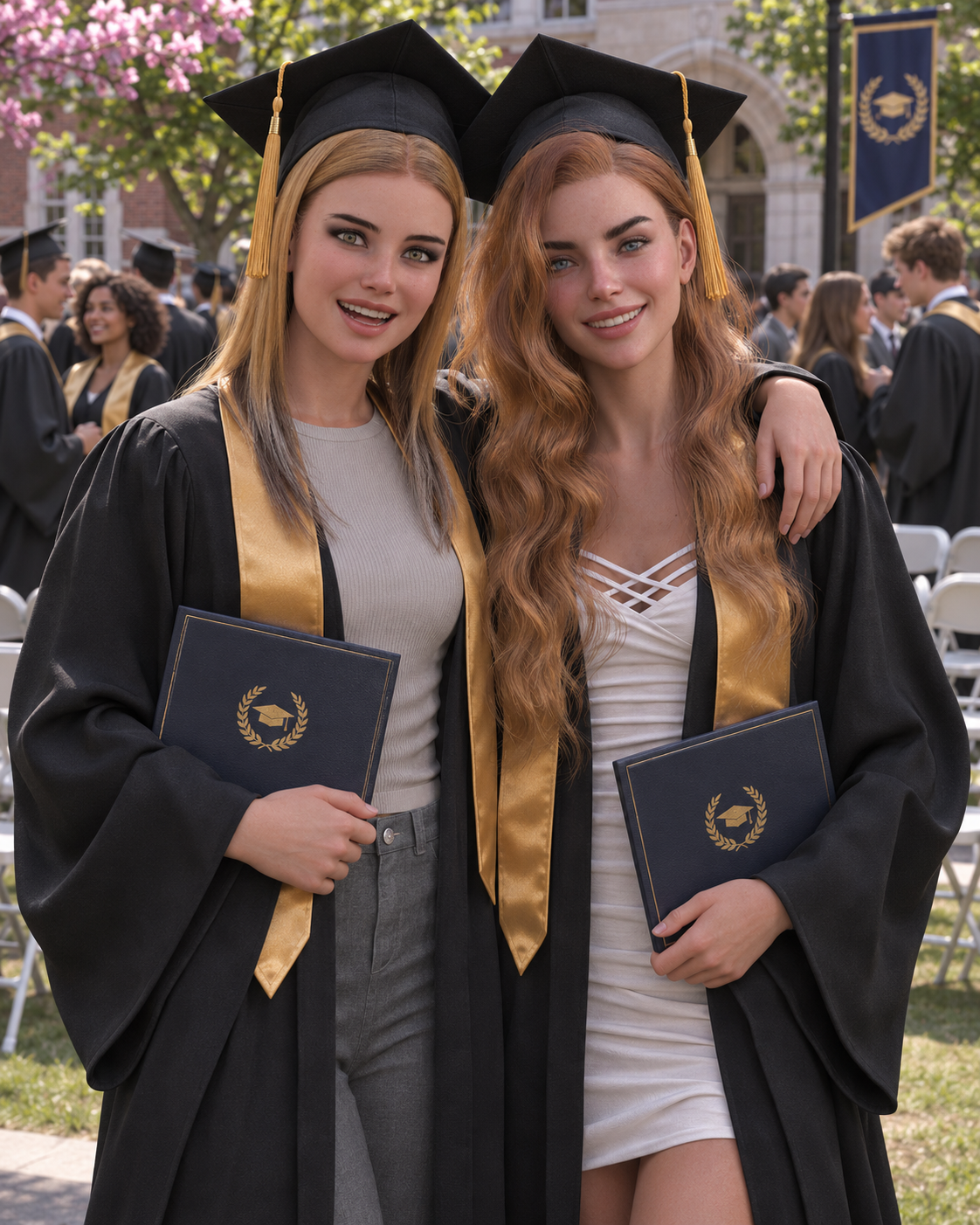
Callie had spent four years learning how to design, build, and troubleshoot electrical systems, but apparently attaching a graduation stole to a gown without stabbing herself required a completely different education. She stood in front of the bedroom mirror with one arm raised, trying to keep the silver-trimmed fabric from sliding off her shoulder while reaching for a safety pin that had somehow worked its way into the lining. The black gown rustled every time she moved. It was made of a material that seemed specifically designed to trap heat, generate static electricity, and resist all attempts at looking presentable. She had managed to get the zipper straight, which felt like an accomplishment until she noticed that the stole was hanging nearly two inches lower on one side.
“Maggie, I need you.”
“That sounds serious.”
“I’m being attacked by ceremonial clothing.”
“Have you tried negotiating?”
“I’ve already threatened it. Get in here.”
Maggie appeared in the doorway wearing an identical black gown, although hers was currently hanging open over a pale blue dress. Her mortarboard was balanced on top of her head at an angle that suggested she had put it there without consulting a mirror. She was carrying her laptop, which Callie found considerably more offensive than anything happening with the graduation clothes.
“Why do you still have that?”
“Because I was checking something.”
“Your portfolio?”
“One thing.”
“Maggie.”
“It was a spacing issue. I noticed it last night, and if I don’t fix it now, I’m going to forget.”
“You’re graduating in three hours.”
“Exactly. I have a deadline.”
Callie gave her a look through the mirror. Maggie smiled without appearing particularly ashamed and placed the laptop on the dresser, where the screen remained open to a portfolio page displaying several interface mockups. Callie recognized the project. Maggie had spent most of April refining its usability study and rewriting the case study. She had already submitted everything necessary for graduation, but the portfolio was now a professional concern, which apparently meant Maggie could worry about it indefinitely.
“Close it,” Callie said.
“Fine.” Maggie shut the laptop, then came behind her and examined the stole. “What did you do?”
“Put it on.”
“Did you try putting it on correctly?”
“I was hoping the university would have taught me that sometime before charging me for it.”
Maggie retrieved the safety pin and crouched slightly to examine the fabric. Callie held still while her friend straightened the silver trim and secured it beneath the fold of the gown. They had performed variations of this arrangement for four years, although the objects usually involved a loose button, a tangled necklace, or something Juna had managed to get caught in her hair. Maggie had become particularly good at identifying when Callie was about to solve a minor inconvenience by making it considerably worse.
“There,” Maggie said, stepping back. “You look like somebody who knows what electricity is.”
“Four years and that’s the qualification?”
“Well, they can’t promise you know how to dress yourself.”
Callie examined the result. The stole hung evenly now, and the gown concealed most of the dress she had spent an unreasonable amount of time choosing. She had wanted something nice for the photographs, although she suspected she could have worn pajamas beneath the thing without anybody noticing.
“Your cap’s crooked,” she told Maggie.
“Then it’s a very accurate representation of my degree.”
Callie laughed and reached over to straighten it. Maggie made a show of enduring the adjustment, then took two steps back to examine them together in the mirror. For a moment neither spoke. Two black gowns, two mortarboards, two women who had arrived in California with loaded cars, a frightened little girl, and considerably more confidence in their ability to handle university life than experience had justified. The apartment had changed around them in the years since. The temporary folding table they had used for studying was long gone, replaced by a proper dining table whose surface had nevertheless remained almost permanently occupied by something academic. There were fewer toys in the living room now, although Juna still had an impressive ability to distribute her belongings through every available space. Her first preschool paintings had been replaced by school assignments, reading logs, library books, and a backpack hanging beside the door with a collection of small decorative charms on its zipper.
On the dresser, Callie’s completed final project report lay inside a clear protective folder beside the graduation tickets. She had brought the report home from her last meeting with Professor Frank, intending to put it away with her other academic work. Instead, she had spent two evenings reopening it, checking the conclusions, and resisting the urge to change wording in a document that had already been accepted. The university had recorded her final marks. Her place in the biomedical engineering master’s program was confirmed. There was nothing left to submit, revise, or explain before graduation, a situation that felt suspiciously like forgetting an assignment.
“Mommy!”
Juna appeared in the doorway holding Callie’s graduation cap with both hands, which explained why it had not been on the dresser where Callie thought she had left it. Her daughter was wearing a yellow dress Sally had helped her choose during a video call, white shoes, and a determined expression. A purple ribbon held back part of her hair, although one section had already escaped.
“I fixed it,” Juna announced.
Callie looked at the cap. “What was wrong with it?”
“The string was on the wrong side.”
“The tassel?”
“Yeah. That.”
Juna turned the cap around, demonstrated where she believed the tassel belonged, and then held it above her head as though preparing to crown someone. Callie crouched to receive it, taking care not to pull the newly secured stole out of place.
“You have to wear it straight,” Juna informed her. “Otherwise your picture will look weird.”
“I appreciate the professional advice.”
“Also, we have to leave soon.”
“We have plenty of time.”
Juna narrowed her eyes. “You said that before.”
“Because it was true before.”
“And then you couldn’t find the pin.”
Maggie made an appreciative noise. “She’s got a point.”
Callie settled the mortarboard on her head while Juna inspected the result from several angles. Her daughter had developed a particular interest in graduation over the last week, largely because she now understood that names printed in a program represented actual people. She had practiced finding CALLIE MORGAN GREY until she could identify the line without assistance, then demanded to know why Maggie’s name appeared elsewhere.
The explanation that electrical engineering and human-centered design were different programs had satisfied her for approximately forty seconds. She had been more accepting of Maggie’s explanation that universities enjoyed making simple things complicated.
Now she inspected Callie’s cap one final time and stepped away. “Good. Don’t touch it.”
“I’ll do my best.”
“And don’t forget the tickets.”
Callie pointed toward the dresser. “Already checked.”
“Grandma said we should check again.”
“Grandma is a bad influence.”
The doorbell sounded before Juna could defend Sally’s reputation. She immediately abandoned her inspection and hurried down the hallway, calling that Ryan was there. Callie heard the front door open, followed by Ryan asking why somebody was running when they had agreed that running in the apartment was a terrible way to begin a Saturday.
“Because Mommy’s graduating!” Juna explained.
“That’s a pretty good reason.”
Callie followed Maggie into the living room and found Ryan carrying a paper shopping bag, a small insulated bottle, and two bouquets wrapped in pale green paper. He had dressed in dark trousers and a light button-down shirt, with the sleeves rolled neatly at his forearms. He looked up when she entered, and the smile that spread across his face was familiar enough that she recognized what was coming.
“Don’t,” she warned.
“I haven’t said anything.”
“You have that expression.”
“I was going to say you look beautiful.”
“Oh.” She stopped, feeling ridiculous. “Well. You can say that.”
Ryan approached and kissed her lightly. “You look beautiful.”
“Thank you.”
“And extremely official.”
“There it is.”
He laughed and handed her the paper bag. Inside were the extra safety pins, hair clips, and tissues she had asked him to bring the previous evening, along with a small packet of crackers Juna particularly liked. The insulated bottle contained cold water, which Ryan explained was for whoever first complained about being hot. Callie suspected that would be her.
“You remembered everything,” she said.
“I’ve been receiving instructions since Tuesday. At some point I figured I should probably follow them.”
“That’s generally how instructions work.”
“Coming from you, that’s very funny.”
Juna had already claimed one bouquet and was examining the flowers through the wrapping. Ryan had brought another for Maggie, who accepted it with an unexpectedly pleased expression before telling him that he had just raised the standard for every future graduation she might attend.
They spent another fifteen minutes finding a missing earring, checking the tickets, and convincing Juna that the flowers would survive being carried without having their wrapping removed. Callie turned off the bedroom light, returned twice to make sure she had her phone, and finally stood beside the apartment door looking at the three people waiting for her. Maggie had her gown gathered over one arm, Juna was holding her bouquet like an important delivery, and Ryan had already taken responsibility for the bag containing everything they were likely to need.
“Ready?” he asked.
Callie glanced once toward the dining table, where no assignments were waiting for her attention. Her laptop was closed. The final report was finished. She had checked her university account that morning, almost reflexively, and found nothing new requiring action.
“Yeah,” she said, reaching for her keys. “I think I actually am.”
The campus was already crowded when they arrived. Cars moved slowly through the designated parking areas, guided by students wearing bright volunteer shirts, while families crossed the sidewalks carrying flowers, balloons, gift bags, and enough photography equipment to document a minor historical event. The morning was warm and clear, with a light breeze coming off the coast. Graduation banners hung from the lampposts along the main walkway, their colors bright against the pale academic buildings. Every few yards, somebody in a black gown was stopping to embrace a relative or pose beneath a Pacifica Polytechnic University sign.
Callie had walked these paths thousands of times, often too occupied with a problem or an approaching deadline to notice much beyond where she needed to be next. Today there were people standing in front of the engineering building taking photographs, and she found herself looking at the windows above the entrance. She knew which rooms were too cold in the winter, which classroom had the unreliable projector, and where the vending machine occasionally refused to dispense anything unless someone struck the side. She had once hurried through these same doors after dropping Juna at preschool, arriving seven minutes late with juice on her sleeve and a lab preparation sheet she had finished at midnight. Today she had nowhere to go inside the building.
“There they are!” Juna called.
Stuart and Sally were standing beside a landscaped area near the commencement entrance, with Hannah leaning against the low wall behind them. Juna broke into a run before Callie could remind her to watch where she was going. Hannah moved away from the wall and caught her in a hug, lifting her briefly before setting her down and immediately examining the flowers.
“Those for me, Junebug?”
“No! They’re Mommy’s.”
“Wow. I flew all the way here, and nobody got me flowers?”
“You didn’t graduate.”
“Harsh. Accurate, but harsh.”
Callie reached them a moment later and found herself enveloped by her father before she had properly said hello. Stuart held her at arm’s length afterward, looking her over with an expression that made her suspicious he was about to say something embarrassing.
“Look at you, kiddo.”
“Please don’t start crying yet. I haven’t done anything.”
“Four years of college is something.”
“Technically I still have to walk across a stage.”
“I think we can trust you with that part.”
Sally embraced her next, then stepped back and immediately reached toward Callie’s shoulder. “Your stole is twisted.”
Callie looked down. “Mom, Maggie just fixed it.”
“Well, it moved.”
“It has moved twice already.”
“Then hold still.”
Callie submitted while Sally straightened the fabric, adjusted the collar beneath it, and brushed a loose thread from the front of the gown. She was aware of Maggie watching with considerable amusement, although Maggie wisely kept her observations to herself.
Hannah leaned closer. “For an engineer, you have a lot of trouble with clothes.”
“I’ve been informed,” Callie said.
Stuart had already taken out his phone. “Okay. Pictures before everybody disappears.”
The first photograph required three attempts because Juna was watching a passing family with a balloon arrangement shaped like a graduation cap. The second failed because Stuart had accidentally activated a short video instead of the camera. Hannah took the phone away from him for the third attempt and announced that the family had reached its technological limit for the morning.
Callie stood between her parents while Maggie arranged herself at one end of the group. When Stuart noticed her hanging slightly back, he waved her closer.
“Get in here, Maggie.”
“I’m not technically family.”
“You’ve lived with my daughter for four years. You’re past the point where we can return you.”
“That’s unfortunate,” Maggie said, stepping beside Callie. “I was hoping for store credit.”
Juna squeezed between Callie and Hannah while Ryan took several pictures. Sally insisted that Ryan appear in some too, so Hannah recruited a passing volunteer. Surely one of the photographs would have everyone looking in the same direction.
Ryan was crouched beside Juna when Callie turned toward them. Her daughter had the flowers in one hand and the folded commencement program in the other, and she was clearly dissatisfied with the arrangement.
“I can’t hold both,” Juna complained.
Ryan considered the problem seriously. “Okay. Which one do you need right now?”
“The program. I have to find Mommy.”
“Right. And what happens if you carry the flowers?”
“They’ll get squished.”
“Then how about I carry those until after the ceremony, and you take care of the program?”
Juna examined the bouquet, weighing the proposal against her obvious desire to remain in charge of it. “You can’t give them to somebody else.”
“Wouldn’t dream of it.”
“And you have to give them back.”
“Absolutely.”
She surrendered the flowers, then opened the program and searched for the page she had marked. Callie watched Ryan help her turn the booklet without folding the corners. He knew Juna liked carrying things herself, and that she would object if somebody read her a word she already recognized.
The graduate assembly announcement sounded over the nearby speakers, followed by instructions directing participants toward their assigned gathering areas. Maggie checked the time on her phone and adjusted the gown she had draped across her arm.
“We should go.”
Callie nodded, but Juna immediately looked up from the program. “Where are you going?”
“To get in line with everybody who’s graduating.” Callie crouched beside her, careful not to dislodge her cap. “You get to go sit with Grandma and Grandpa and everybody else.”
“Where?”
Callie pointed toward the seating diagram printed inside the program, then indicated the entrance across the courtyard. “You’re going to be over there, in that section. See the letter?”
Juna examined it carefully. “B.”
“That’s right. When you sit down, look toward the stage. I’ll come out with the other students.”
“But where do I look when they say your name?”
“Ryan will help you find me.” Callie touched her daughter’s shoulder. “I’ll be up on the stage when they call Callie Grey.”
“Callie Morgan Grey,” Juna corrected.
“That’s right. All three.”
Ryan held up the tickets. “We’ve got our section, and we know which side you’ll come from. We’ll find you.”
Juna seemed satisfied with that. She wrapped her arms around Callie’s neck, gave her a quick kiss, and then stepped away to resume discussing the program with Ryan. Sally reminded Callie to drink water before the ceremony, Hannah offered a final warning not to trip, and Stuart hugged her once more.
“Go get your degree, kiddo.”
Callie smiled. “I’ll do my best.”
She and Maggie headed toward the graduate entrance, moving around groups of students who were making their own hurried goodbyes. Callie looked back once and saw Juna walking between Ryan and Hannah, the program open in both hands while Ryan carried the flowers. Her daughter was explaining something to him with obvious authority. Whatever it was, he appeared to be listening.
Callie turned back toward Maggie and continued across the courtyard. Juna was happy with the people accompanying her; Callie could go where she needed to be without making another arrangement first.
The gathering area behind the auditorium was considerably quieter than the courtyard, although it was not particularly organized. Graduates stood in clusters beneath signs identifying their departments, checking phones and comparing the instructions they had received from three different university offices. Someone had brought a garment steamer and was attempting to remove wrinkles from a gown while its owner remained inside it. Another student was trying to work out whether his tassel belonged on the left or right before the ceremony. Callie found the electrical engineering assembly sign and checked her name on the roster, then noticed Professor Frank and Brenda in the adjacent faculty gathering room.
The university had arranged several accessible work surfaces along one wall, including a raised platform with a guarded edge and a small table positioned at a comfortable height for Little faculty members. Oliver Frank stood beside a tablet and a compact microphone, reviewing something on the screen while Brenda spoke with another member of the department. He looked up as Callie approached.
“Miss Grey. I wondered whether I’d see you before the procession.”
“Professor.” Callie came closer to the platform. “I wasn’t sure you’d be here yet.”
“Brenda insisted on arriving early. Apparently she doesn’t trust the university to arrange a ceremony without changing something at the last minute.”
“Because they changed something at the last minute,” Brenda said, turning toward them. “The faculty entrance. We got that sorted out, though.” She smiled at Callie. “Congratulations. You look wonderful.”
“Thank you.” Callie adjusted the program tucked beneath her arm. “I feel like I’m wearing a trash bag with sleeves.”
Oliver examined the gown. “A particularly expensive one.”
Callie laughed. She had known him since her first year. Later, when she brought a troublesome sensor assembly into his office, he’d insisted they reproduce the failure before changing anything. The problem had been a cable catching against the linkage, not the faulty circuit she had expected. He had taught her to separate what a device appeared to be doing from what the measurements actually established. Four years later, that distinction remained useful.
“I read your final report,” he said. “The submitted version.”
Callie immediately became attentive. “Was something wrong?”
“No. I was interested in the conclusion you retained about the contact measurements.”
“Oh.” She knew precisely which section he meant. “The motion artifacts.”
“Specifically, your decision not to describe the system as reliable under ordinary movement conditions.”
Callie shifted her program to her other hand. Her final project had involved designing and testing a compact wearable biosignal acquisition system. On the bench, with controlled inputs and a stable reference signal, the electronics performed remarkably well. The trouble emerged when the sensing electrodes were used against actual skin. Changes in contact pressure, movement, and electrical interference introduced variations that the signal-processing software could not consistently distinguish from useful information. She had improved the filtering and revised the contact arrangement, but the resulting system still had limitations she could not honestly eliminate.
“I kept thinking I should have fixed more of it,” she admitted. “The board works. The measurements were good under the controlled conditions. But once the contacts move, there are still cases where I can’t tell how much of the change comes from the actual signal. I didn’t want the conclusion to sound like I’d solved something I hadn’t.”
“Which is why you identified the conditions under which your results were valid,” Oliver replied. He moved his tablet aside. “That’s a perfectly respectable conclusion.”
“It doesn’t feel very satisfying.”
“Finishing the project and resolving every limitation aren’t the same thing. You documented the behavior, demonstrated what you could reproduce, and explained what remained unresolved. That’s engineering work, Callie.”
She looked down at the edge of her program. She had argued with herself about those conclusions for nearly a week, partly because she knew how much better the report would sound if she emphasized the successful measurements and treated the remaining problems as minor refinements. The testing had not justified that description. She knew it, and Oliver knew it.
“I suppose I wanted to finish with a cleaner answer.”
“Most of us do.” He gave her a small smile. “Are your graduate arrangements settled?”
“Yeah. I accepted the offer. Biomedical engineering, starting this fall. I’ve got the enrollment paperwork done, and I’m meeting with the program adviser about the research schedule.”
“Still interested in bioelectronics?”
“More than ever, actually.” Callie glanced toward the tablet beside him. “This project made it worse.”
“Worse?”
“I know how to get the circuit working. I can build something that measures a signal correctly on a bench. But that doesn’t mean it’s going to work correctly when somebody has to wear it, or move around with it, or rely on what it’s telling them. I keep running into the same problem. The electronics are only one part of the system, and I don’t understand enough about the other part yet.”
“The person?”
“The biology. The body. All of it.” She considered the distinction. “I want to understand the signals and the physical constraints well enough that the device still works outside the lab. Not just when everything’s arranged exactly the way I need it.”
Oliver nodded. “That sounds like a reasonable use of another two years.”
Callie smiled. “Hopefully.”
Brenda glanced at the time and reminded him that the faculty procession would begin assembling shortly. Callie checked her own instructions and realized that her department had also begun moving toward the designated entrance.
“Thank you,” she told him. “For everything. Seriously.”
“You’re welcome, Callie. Enjoy your graduation.” He looked at her gown again. “Even if the clothing leaves something to be desired.”
She laughed, said goodbye to Brenda, and returned to her assembly group. The discussion had not made her any more satisfied with the limitations in her project, but she no longer felt quite as compelled to open the report and argue with them again. She had done the work. The conclusions were accurate. Apparently that was allowed to be enough.
The procession began approximately ten minutes later, after a volunteer discovered that two departments had been directed toward the same entrance and hurriedly rearranged their lines. Callie followed the graduates ahead of her through a wide corridor and into the auditorium, where the noise of several thousand people reached her before she could see them. The audience filled the rising sections of seats surrounding the central floor. Bright lights illuminated the stage, and a large university emblem hung behind the lectern.
The graduates were seated by department. Callie found her assigned row, checked the printed name card on her chair, and sat down with the others. The gown gathered awkwardly beneath her legs, and the mortarboard pressed against a section of hair she had already secured twice. She adjusted it carefully, remembering Juna’s instructions, then looked toward the audience.
Finding her family among several thousand proved considerably harder than she had expected.
“Can you see your family?” asked the student beside her.
“Not yet.”
“Mine said they’d be right by the aisle. Which aisle, they neglected to mention.”
Callie smiled and tried another section. There were children sitting on laps, grandparents holding programs, and people standing to take pictures despite repeated requests from the ushers to remain seated. Somewhere among them were her parents, Hannah, Ryan, and Juna. Maggie would be seated with the human-centered design graduates on the other side of the floor, which was mildly irritating after four years of sharing nearly everything else about college.
The ceremony proceeded through the usual formalities. There was a welcome, a speech about the responsibilities of educated professionals, and an address from a graduating student who managed to make a joke about university parking that received the most enthusiastic reaction of the morning. Callie listened, applauded when appropriate, and occasionally caught herself checking the program even though she knew the order of events. The room grew warmer as the morning continued. By the time the first group of graduates began crossing the stage, she had decided the university needed to invest some of its engineering expertise in breathable ceremonial clothing. She watched several graduates miss the photographer’s mark, or turn toward the wrong exit, then get redirected with the same patient gesture. Each had worked years for these few seconds. She wondered whether they felt anything more momentous than a desperate desire not to trip.
Then the electrical engineering graduates were instructed to stand.
Her row rose together, chairs shifting against the floor. Someone ahead of her muttered that he was absolutely going to trip, and another student assured him that the university probably had insurance for that. Callie followed the line toward the stage, one hand holding the edge of her gown away from her shoes.
From this angle, she could finally see the audience section she had been searching.
Hannah was the first person she recognized, mostly because her sister was standing while everyone around her remained seated. Stuart was beside her, holding his phone. Sally had one arm around Juna, who appeared to be looking in the wrong direction until Ryan leaned down and pointed toward the stage.
Juna turned.
Even at that distance, Callie recognized the sudden excitement in her daughter’s movements. She began waving both arms, then apparently remembered she was holding the program and transferred it to Sally before resuming.
Callie raised her hand in return.
The line advanced. A volunteer checked the pronunciation card in Callie’s hand, directed her toward the stage steps, and reminded her to pause briefly for the photographer. She could hear names being announced one after another, each followed by a different collection of cheers rising from the audience. The student ahead of her made it safely across, though he nearly forgot to accept his cover. Callie watched him leave the stage, then looked toward the announcer.
“Callie Morgan Grey. Bachelor of Science in Electrical Engineering.”
Hearing all three names over the speakers caught her unexpectedly. She had written them on enough exams, forms, and reports that they usually meant little more than this belongs to me. Now they belonged to the person walking onto the stage. She stepped forward, aware of the heat under her cap and the photographer waiting near the edge. There was applause, a burst of shouting from somewhere to her right, and then one high, familiar voice cutting through the noise.
“THAT’S MY MOMMY!”
Callie turned her head toward the sound before she could stop herself. She could not distinguish the words that followed, but she knew who was responsible for them. Somewhere in that audience, Juna was making absolutely certain that nobody misunderstood whose graduation they were attending.
Callie smiled so broadly that she nearly missed the hand being extended toward her.
She shook it, accepted the dark diploma cover, and paused for the photographer as instructed. An usher directed her toward the opposite side of the stage, where the next graduate was already being announced. The exchange had taken only seconds, not nearly enough time for Callie to catch up with it.
As she followed the marked path, she remembered a night spent finishing an assignment while Juna slept nearby, and the notebook page she had later discovered covered with purple roads, a yellow house, and something her daughter insisted was a horse. One of the roads ran straight through a carefully drawn circuit. Callie had copied the assignment onto a clean page and kept the original. It was still somewhere among her old materials.
She reached the steps, descended carefully, and returned to her seat with the diploma cover resting against her knees. People around her were whispering and checking photographs on their phones. The ceremony continued, perfectly indifferent to the fact that she had just completed something that had occupied four years of her life. Callie looked at the university seal embossed on the cover and ran her thumb lightly across it. She had done it.
When the human-centered design graduates began crossing the stage, Callie straightened and looked toward the far aisle. She couldn’t pick Maggie out of the black-gowned line until the announcer read, “Margaret Elizabeth Carlson.” There she was, crossing toward the offered diploma cover with a wide smile. Callie applauded hard enough that the graduate beside her glanced over. She had watched Maggie spend late nights revising interfaces, listening to users describe problems she hadn’t expected, and defending her research when a prettier design would have been easier to sell. It was good to see her get this moment too. Callie kept watching until Maggie disappeared down the far steps.
By the time the ceremony ended, she was ready to escape the gown, find something cold to drink, and locate her family. Unfortunately, several thousand other people had apparently arrived at the same conclusion.
The outdoor gathering areas filled almost immediately. Graduates emerged through multiple exits, families moved between them, and the mobile network became unreliable enough that Callie’s first two messages to Ryan remained undelivered. She tried calling, received no connection, and finally stood beside a directional sign where she could see people approaching from both sides.
She had just begun composing another message when a familiar voice shouted her name.
“Mommy!”
Juna came around a group of graduates at a determined run, with Ryan following close enough to intervene if she failed to notice another person. Callie barely had time to lower the diploma cover before her daughter reached her.
“Mommy! I saw you!”
“I saw you too!” Callie crouched and wrapped her arms around her. “I heard you.”
“I yelled really loud.”
“You certainly did.”
Juna pulled away and immediately reached for the diploma cover. “Can I see it?”
“Sure.” Callie opened it carefully, revealing the university’s printed congratulatory message and the place where the actual diploma would eventually be inserted.
Juna stared at it. “Where’s your degree?”
“They mail the actual diploma later.”
Her daughter looked from the empty space to Callie’s face. “What?”
“This is the cover. The paper comes in the mail after they finish processing everything.”
Juna considered that explanation with the offended expression of someone discovering a serious flaw in an otherwise elaborate arrangement.
“So they made everybody sit there for all that time, and they didn’t even give you the paper?”
Ryan pressed his lips together, visibly attempting not to laugh. Callie was less successful.
“Apparently.”
“That’s dumb.”
“Your complaint has been registered.”
“Can we tell them?”
“I think they’ve heard it before, sweetheart.”
Stuart and Sally reached them a moment later, followed by Hannah carrying the flowers Ryan had temporarily surrendered to her. Sally embraced Callie first, holding her longer than she had before the ceremony. When she stepped back, her eyes were wet, although she made no attempt to explain them.
“You did it, honey.”
“Yeah.” Callie smiled. “I did.”
Stuart pulled her into a hug of his own. He said nothing at first, simply holding her while the crowd moved around them. Callie rested her cheek against his shoulder and found herself unexpectedly reluctant to let go.
“Proud of you, kiddo,” he said eventually.
“Thanks, Dad.”
“Good. Because I’m going to keep saying it.” He pulled out his phone to show her the stage photograph. At first he opened a blurry picture of the lectern, then one of somebody else’s shoulder. Hannah leaned over, found the right image, and handed it back without comment. Stuart studied the photograph of Callie holding her diploma cover for a moment before letting her see it.
She laughed, then drew back far enough to see both her parents. “Thank you. Both of you.”
Sally touched her arm. “You don’t have to thank us today.”
“I want to.” Callie glanced at Hannah, then back at them. “The car. The tuition help. All the times you took Juna during breaks so I could catch up, or came out here when I was drowning in work. Mom, you took time away from the stores to help me through that lab stretch last spring. Dad, you were still sending me money for books last semester.”
“And you kept insisting you didn’t need it,” Stuart reminded her.
“I know.” She smiled faintly. “I know what you guys did. I know it wasn’t free, and I know you had things you could’ve spent that money and time on instead.”
Sally held her gaze for a moment. “We wanted you to have the chance, honey. And you made something of it.”
“I couldn’t have done it this way without you,” Callie said.
Her mother pulled her close again. Stuart put an arm around both of them, and Callie allowed herself to remain there until Hannah announced that they were creating a traffic obstruction and somebody needed to photograph it.
Maggie appeared shortly afterward, carrying her own diploma cover and wearing the expression of a woman who had successfully navigated both an academic ceremony and several hundred people trying to use the same exit.
“I survived,” she announced.
Callie went straight to her and hugged her. “You did! I heard your name. I even found you onstage.”
“Four years of design critiques, research reports, usability testing, and arguing with people about buttons.” Maggie held up the cover. “And apparently the university thinks I’m qualified.”
“More than qualified.”
“I expect that statement in writing.”
Callie stepped back to look at her. They had celebrated each other’s individual successes for years, but this was different. Callie had watched Maggie conduct interviews, revise prototypes, and defend design decisions when a prettier interface would have been easier. Her portfolio represented more than an ability to make screens look nice.
“You should be proud of yourself,” Callie told her.
Maggie’s expression softened. “Yeah. I am.” Then she glanced toward the family. “Now somebody take pictures before my hair completely gives up.”
They posed together with their diploma covers, then let Juna squeeze between them. Ryan caught a particularly good photograph when Stuart suggested they bill the university for everything they’d fixed around their apartment.
By the time they finally headed toward the parking area, Callie’s cheeks hurt from smiling.
The restaurant Sally had reserved was a short drive from campus, with an outdoor patio overlooking a landscaped courtyard and enough shade to make eating outside pleasant. They occupied a large table near the railing, where Juna immediately took responsibility for distributing the menus. Callie had exchanged her gown for the dress underneath, although Sally had insisted on one final photograph before allowing her to remove the cap.
Lunch began with the usual argument over appetizers, followed by Stuart announcing that nobody needed to worry about the bill. Callie had expected that declaration and had decided in advance not to challenge it. She was graduating. Her father wanted to buy lunch. There were battles worth fighting, and this one did not qualify.
Juna waited until their food arrived before raising the question that had apparently been troubling her since the ceremony.
“Mommy, are you done with homework now?”
Callie looked up from her plate. “For a little while.”
“Forever?”
“Not exactly.”
Juna lowered her fork. “Why?”
“Because I’m going to keep going to school. Remember how we talked about my master’s degree?”
Her daughter considered this. “The other one?”
“That’s right. I’m finished with electrical engineering, but I’m going to study biomedical engineering for another two years.”
“Why do you need another one?”
Callie smiled. “Because there’s more I want to learn.”
“Are you going to have homework again?”
“Probably quite a bit.”
Juna looked distinctly unimpressed.
“Will we still live in our apartment?”
“Yes, sweetheart. We’re not moving anywhere right now.”
“And I still get to go to my school?”
“Absolutely.”
That answer seemed to settle the matter considerably more effectively than anything Callie could have said about graduate research. Juna returned to her lunch, apparently satisfied that the continuation of higher education would not interfere with the things she considered important.
Ryan waited until the conversation moved away from Juna before returning to something he and Callie had discussed several times during the spring.
“Have they given you a better idea of how the research schedule’s going to work?”
“Somewhat.” Callie reached for her water. “The first semester still has classes, but I’ll have regular lab time too. It won’t be as predictable as undergraduate lectures. Some of the testing will probably need longer blocks.”
“So the evenings might change?”
“Some of them. I’m hoping to keep most of the afternoons clear for pickup, but I’ll know more after I meet with the adviser.”
Ryan nodded. “We’ll work around it. I just wanted to know whether we should keep Thursday nights flexible.”
Callie smiled at him. Thursday had become their most dependable evening together, usually involving dinner, something to watch, and occasionally Juna falling asleep halfway through a movie she had insisted she was old enough to finish.
“I’d like to keep Thursdays,” she said.
“Then we’ll try.”
Maggie had been listening while examining the dessert menu. “Speaking of schedules, mine’s about to become considerably less academic.”
Sally turned toward her. “You settled on the design studio?”
Maggie nodded. “I accepted the offer. Junior UX designer. I start in June.”
“That’s wonderful,” Sally said.
Callie grinned. Maggie had received the offer two weeks earlier and spent several days reviewing it, asking questions, and trying to determine whether the company genuinely valued user research or simply wanted somebody to make its existing software prettier.
“It’s a good position,” Maggie continued. “Local team, actual research work, and they’re willing to let me work on accessibility projects. The salary’s decent too, which is a nice change from being rewarded with academic credit.”
Hannah leaned back in her chair. “So you’ll be a real adult with a real job.”
“Terrifying, isn’t it?”
“Are you moving?” Juna asked immediately.
Maggie glanced toward Callie before answering. “Not right away, Junebug. I’m staying in California. I’ll probably find my own apartment eventually, but we haven’t figured that out yet.”
“Why?”
“Because I’m going to be working instead of going to school, and it’ll probably make sense for me to live closer to my office.”
Juna considered this. “But you can still come over.”
“Obviously.” Maggie smiled. “Somebody has to make sure your mom remembers to eat when she gets busy.”
“I remember to eat,” Callie protested.
“Eventually,” Ryan said.
Callie turned toward him. “You’re supposed to be on my side.”
“I am. I’ve seen your study schedule.”
Stuart laughed, and Sally reminded Juna that Maggie had family back in Minnesota too, although her daughter seemed primarily concerned with whether the arrangement would interfere with occasional movie nights. Maggie promised that it would not.
Callie listened to the conversation and realized that she was looking forward to seeing what Maggie would do next almost as much as she was looking forward to her own graduate work. They had spent four years sharing an apartment and building routines around each other’s schedules. Those routines had made things possible that might otherwise have been far more difficult. Maggie deserved the opportunity to build something of her own now, even if Callie knew she would miss hearing her friend complain about interface design from the other side of the living room.
They did not need to decide the apartment arrangements over lunch. Maggie had a job to begin, Callie had a research schedule to establish, and Juna still needed to finish the school year. There would be time to work out the practical details.
For the afternoon, they ordered dessert.
Afterward, while Sally and Hannah helped Juna inspect the photographs on Stuart’s phone, Callie stepped away from the table with Ryan to retrieve a bag they had left in his car. The parking area was shaded by a line of trees, and the afternoon breeze had cooled enough that she was comfortable without the gown.
Ryan unlocked the car, opened the passenger door, and retrieved the bag. Instead of immediately heading back, he stopped beside her.
“I’m proud of you,” he said.
Callie smiled. “Thank you.”
“I mean it.”
“I know.” She leaned against the side of the car. “I keep thinking about the project, though. I wish I’d had another couple of weeks to work on the contact design. I think I could’ve improved the readings if I’d changed the mounting arrangement earlier.”
Ryan looked at her with familiar amusement. “Callie.”
“What?”
“You finished.”
“I know, but…”
“No, seriously. You finished. You got your degree. You don’t have to figure out how to improve something for five minutes.”
She opened her mouth, ready with another explanation, and then found herself laughing. He had listened to her talk through failed test runs and the conclusions she’d rewritten three times, and now he was refusing to let her turn graduation into another progress meeting. After more than three years together, he knew exactly when she needed somebody to point out that finishing counted, even if she could still think of things to improve.
“Okay,” she conceded. “You’re right.”
“I enjoy hearing that.”
“Don’t get used to it.”
He stepped closer and rested his hands lightly at her waist. “So?”
“So what?”
“Are you happy?”
Callie looked back toward the restaurant, where she could see Juna standing beside Hannah while Stuart attempted to take another photograph. Maggie was laughing at something Sally had said. Everyone had come here for her and Maggie, and there was nothing about the afternoon that needed fixing.
“Yeah,” she said, smiling up at him. “I’m really happy.”
“Good.”
“And I’m proud of myself.”
Ryan’s expression brightened. “There you go.”
Callie laughed and leaned up to kiss him. His arms settled around her, and for a few moments she forgot about the bag, the parking lot, and the afternoon schedule she had checked three times that morning. When they separated, he rested his forehead briefly against hers.
“Now,” he said, “can we go back before your daughter decides we’ve disappeared?”
“She’ll probably send a search party.”
“Led by Hannah.”
“With absolutely no respect for privacy.”
Ryan laughed and took her hand as they headed toward the restaurant.
By the time they returned to the apartment that evening, Juna had accumulated two balloons, a small box of leftover dessert, and enough opinions about graduation ceremonies to occupy the entire drive home. She had decided that the stage was too far from the audience, the speeches were too long, and the university needed to improve its diploma distribution system before the next ceremony.
Callie carried the flowers inside while Ryan brought the remaining bags from the car. Maggie went directly to her room to change, announcing that she had worn the graduation gown for the final time unless somebody offered her a considerable amount of money.
Juna, however, had one more graduation requirement.
“Mommy, I need your hat.”
Callie turned from the kitchen counter. “Again?”
“Please. I want one more picture.”
“Didn’t we take about a hundred?”
“This one’s different.”
Callie followed her into the living room, where Juna had already cleared a space beside the couch. The graduation cap sat on the coffee table, its tassel hanging over the edge. Juna picked it up and placed it carefully on her own head.
The mortarboard was much too large. It slid sideways immediately, nearly covering one eye.
“Mommy!”
“I’m coming.” Callie crouched beside her and adjusted the cap, tucking the edge carefully against her daughter’s hair. “You have to keep your head straight.”
“I am.”
“You’re looking at Ryan.”
“Because he’s taking the picture.”
Ryan stood a few feet away with his phone ready, trying not to laugh while Callie helped Juna manage the cap. It was still slightly oversized, but Callie managed to position it so that the tassel hung beside her daughter’s cheek rather than across her nose.
“There,” she said. “Perfect.”
Juna caught the edge before it could slip again. “Can I put this picture in my school folder?”
“Of course. Why?”
“I want to show my teacher.” She looked up at Callie, smiling beneath the enormous cap. “I told her you were getting your degree.”
Callie felt her own smile widen. “Well, we should make sure you have a good picture, then.”
She moved closer, keeping one hand lightly against the cap while Juna leaned against her shoulder. Ryan raised the phone and asked them to look at him.
“Ready?”
“Ready!” Juna announced.
Callie smiled at the camera, her daughter beside her wearing a cap that was far too big, and held it steady while Ryan took the picture Juna would carry proudly into school on Monday.

A) Ryan has lasted a long time without shrinking around a certain to be infected partner unless he is not vulnerable.
B) I am surprised after 4 years he didn’t ask her to marry him.
C) We haven’t learned if she knows if he is vulnerable which is certain she would ask proof of because of her engineering brain.
D) Does she know he is rich. 4 years is a long time for a Engineering minded girl friend not to fined out everything. I know first hand lol. And I know first hand engineering school doesn’t make you that busy lol.
E) 4 years is a long time for smallara not to have raised issues everywhere and many issues from phase 1 not to be much farther along.