
BECOMING GREY
Chapter 36
April 2026
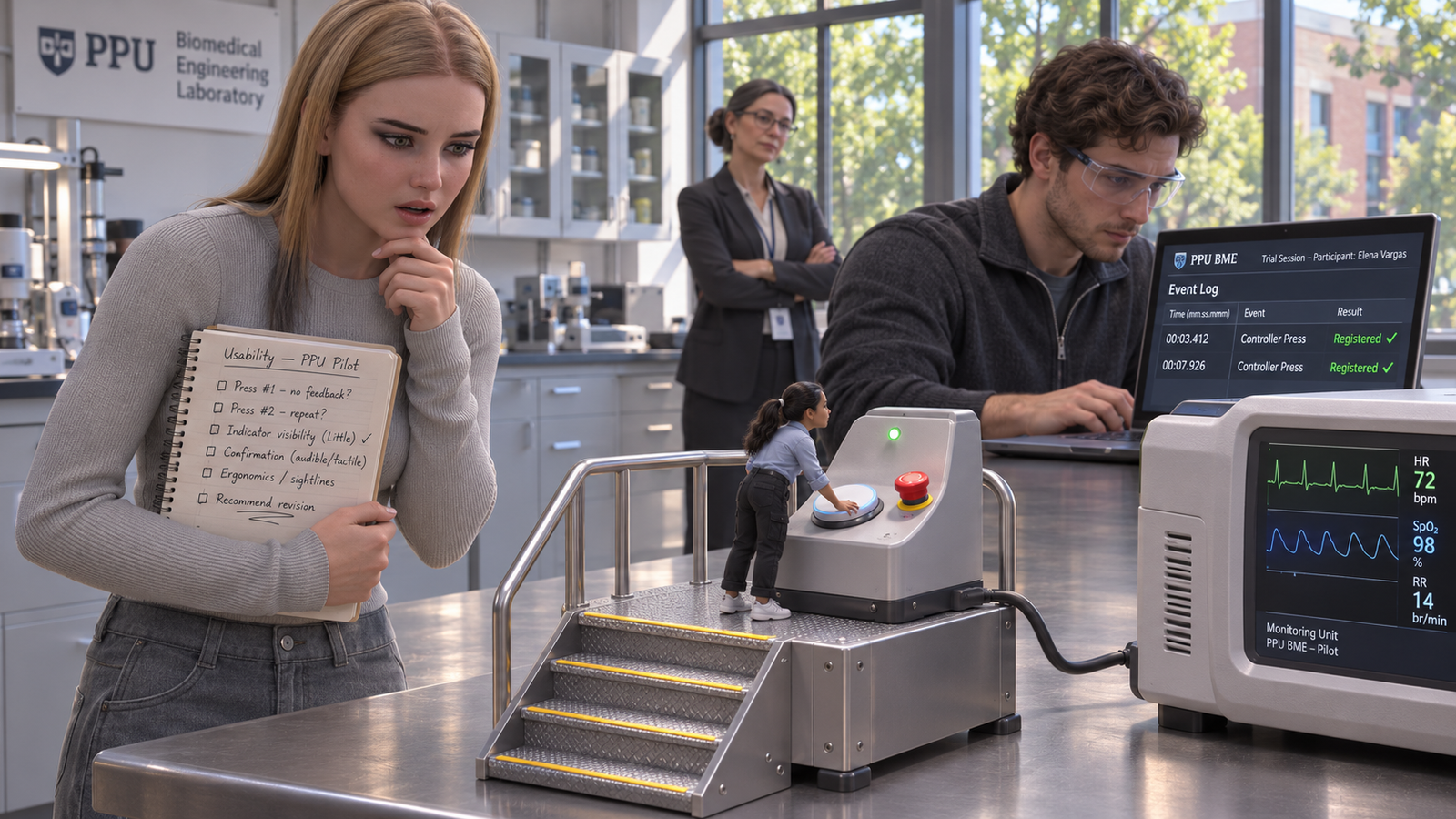
Callie had checked the emergency stop three times before she realized she was doing it again. The first two checks were recorded in her notebook, complete with the expected response and the actual result. The third had been unnecessary, performed while she was waiting for the monitoring station to finish its startup sequence. Now her thumb rested over the red switch, and she was considering a fourth simply because the equipment was sitting there, powered on, and she had another fifteen minutes before the participant arrived. She withdrew her hand and picked up the notebook instead. There were considerably more useful ways to spend fifteen minutes, including making certain the rest of the apparatus was ready for somebody encountering this particular arrangement for the first time.
The biomedical engineering laboratory at Pacifica Polytechnic University occupied a renovated section of the engineering building, where newer equipment shared space with workbenches that had apparently survived several generations of students. Someone had opened the blinds along the western windows, letting afternoon sunlight fall across the cabinets and the polished concrete floor. The ventilation system ran continuously overhead, producing a steady background noise that Callie usually stopped noticing within minutes of entering. Today she was paying attention to it because they had recently changed the prototype’s confirmation tone, and she wanted to make certain the sound remained distinguishable from everything else happening in the room.
At the center of the cleared bench stood a biomedical monitoring unit roughly the size of a desktop computer. Beside it, connected through a secured cable, sat a considerably smaller control surface designed for a Little to operate independently. The housing was approximately three inches wide, with a broad central control, a status indicator, and an emergency stop positioned along its front edge. An access platform brought the controls within comfortable reach of a Little standing upright, and a guard kept the cable from crossing the participant’s route. Callie had spent much of the previous week revising the electrical interface between the controller and the monitoring unit. The monitoring equipment itself was commercially established. Their project concerned the portion that allowed someone several inches tall to control it without requiring a full-sized person to interpret every instruction and perform every action.
“You’re looking at the stop again,” Nathan observed from the other side of the bench.
“I’m admiring the quality of our work.”
“You designed the input circuit. I wired the stop.”
“Then I’m admiring your work. Enjoy it while it lasts.” Callie turned to the laptop beside him and checked the event log. “Power’s stable. Input response is good. Display is receiving status updates. You want to run one more cycle?”
Nathan Alvarez pushed his safety glasses farther up his nose and glanced at the clock. He was another graduate student in the biomedical engineering program, with a stronger software background than Callie’s and an unfortunate habit of leaving his coffee wherever she needed to put something down. They had worked together long enough that she no longer bothered asking whose cup it was before moving it. “We already ran three.”
“Then we can make it four.”
“You’re going to keep asking until I agree, aren’t you?”
“Probably.”
He entered the test command, and Callie watched the controller’s indicator change as the monitoring station began its simulated measurement sequence. An internal signal generator supplied a known reference input, allowing them to verify the interface without connecting a participant. The laptop registered the command immediately. A short confirmation tone sounded, and the indicator remained illuminated while the station processed the measurement. Callie compared the recorded response with the expected output, waited for the completion signal, and made another mark in her notebook. The results were clean, including the timing between the control input and the station’s acknowledgment.
Nathan leaned back from the laptop. “That’s four. Can we agree it’s working?”
“The electronics are working.”
“Those are the electronics we built.”
“Which is why I’m happy about them.” Callie closed the diagnostic window, leaving the session recording program ready. “Now we find out whether anyone can actually use them.”
She opened her notebook to the previous revision. The pages contained photographs of the original housing, a diagram of the circuit, and a list of problems recorded during an earlier evaluation. The first control had required too much force. The indicator had been difficult to distinguish under bright lighting. One participant had reported uncertainty about whether a measurement had finished. They had enlarged the actuator, adjusted the signal conditioning, changed the indicator, and modified the confirmation tone. Every change had passed its individual checks. Whether those changes worked together for someone using the equipment was the question they were about to investigate.
Her phone vibrated against the bench. She glanced at the screen, expecting a reminder about the session, and found a photograph from Ryan instead.
Juna stood in their living room holding what appeared to be a cardboard wetland approximately the size of a small suitcase. Construction paper hung from one side. Several green shapes rose from its surface, and something resembling a bird protruded above a forest of wooden sticks. Juna was grinning so widely that Callie could barely see her eyes. Behind her, Ryan had apparently been caught attempting to prevent one corner of the model from collapsing.
Beneath the photograph, his message read, The instructions said shoebox. We appear to have misunderstood the concept of box.
Callie enlarged the picture, trying to identify the object supporting the back wall. It looked suspiciously like a cereal carton.
Has anyone told her wetlands aren’t supposed to have structural engineering problems? she replied.
Ryan answered almost immediately. I suggested reinforcing the wall. She informed me that reinforcement is your department.
Callie smiled and put the phone away. Ryan had arranged to pick Juna up after school so they could finish most of the project before dinner. Her daughter had already informed both of them that one particular section required her mother’s assistance and that Ryan was not authorized to touch it. Callie had accepted the assignment without knowing precisely what it involved. Based on the photograph, she was beginning to suspect she had agreed to something considerably larger than anticipated.
“Everything okay?” Nathan asked.
“Juna’s science project has expanded beyond its original specifications.”
“That’s genetic.”
“Unfortunately, yes.” Callie tucked the notebook beneath the edge of the laptop. “At least hers is made of cardboard. Ours costs money when we get creative.”
The connecting door opened before Nathan could answer. Dr. Amina Shah entered carrying the session folder, followed by Priya, the student assistant responsible for recording observations. Shah supervised the project and had spent the last week reminding the team that their participant sessions were not demonstrations arranged to prove how clever their prototype was. They were opportunities to discover whether the thing was useful, including the possibility that it was not.
“Where are we?” she asked, approaching the bench.
Callie straightened and turned the notebook toward her. “Pre-session checks are complete. Power and isolation checks passed, all controls are responding within the required timing, and the emergency stop interrupts operation correctly. Four reference cycles with no errors. The access route is clear, the cable is secured, and we’re ready for the clinical technician.”
Shah examined the record, then looked over the controller. “Any changes since yesterday’s approved configuration?”
“No hardware changes. We adjusted the confirmation tone yesterday morning, documented it, and repeated the tests afterward.”
“Good. Are you ready to begin?”
Callie looked once more at the small controller. A year ago, she would probably have turned toward Professor Frank or another experienced researcher before answering. She was accustomed to bringing an assembly to somebody else, explaining what she thought was happening, and waiting to learn which part of her reasoning needed improvement. That was still an important part of her education. It was no longer the whole of her job. She had responsibility for the electrical interface, and the team depended on her to know whether it was functioning.
“Yes,” she said. “Everything required for the session has passed. We’re ready.”
Shah accepted the answer without ceremony and set the folder beside the observer’s station. “Then let’s review the procedure before Elena comes in.”
The participant’s task was deliberately limited. With a measurement sensor fitted by a trained clinical technician, she would approach the controller, begin a measurement, determine its status, and acknowledge completion. The monitoring station would collect a short optical pulse signal using equipment configured for Little-scale measurements. The readings were not being used for diagnosis or clinical decisions. The study concerned interaction with the controls, not the participant’s health.
“We want her to understand the task,” Shah reminded Callie, “but we don’t want to demonstrate the solution before she tries it.”
“Right. I’ll explain what the station is supposed to accomplish and let her decide how to operate it.”
“And if she asks how?”
“We record that she needed clarification before giving her any instructions.”
Shah nodded. “Exactly. We aren’t testing whether you can teach somebody to use a prototype.”
Nathan took his place at the observation desk while Priya opened the session form. Nathan would monitor the software log, Priya would document the participant’s actions and questions, and Callie would introduce the task. Shah would supervise, and the clinical technician would handle anything attached to the participant. Callie appreciated the division of responsibilities. It kept her from watching four different things badly, which was usually what happened when she tried to watch four things at once.
She had just finished checking the position of the access platform and the small tabletop microphone when the door opened again.
Elena Vargas entered in a Little-scale transport chair secured to a wheeled carrier, accompanied by a research coordinator. Elena was a woman a little over six inches tall, with dark hair pulled back from her face and a practical expression Callie recognized from their previous meeting. She wore black trousers, a pale blue shirt, and a small pair of sneakers. At her scale, the surrounding laboratory furniture towered over her, and the monitoring unit looked more like industrial machinery than something intended for personal medical use.
“Please tell me you got rid of that miserable button,” Elena said as the coordinator positioned her carrier beside the access station. Her voice came clearly through the nearby microphone.
Callie laughed. “We’ve made changes.”
“That’s what people said about the last one.”
“And you were very specific about how much you disliked it.”
“I was trying to be helpful.”
“You were.” Callie crouched beside the carrier so Elena did not have to look so far upward. “Would you like to use the platform lift, or would a hand be easier?”
“Hand, please. That lift takes forever when I’m only going up one bench.”
Callie positioned herself beside the transport chair and offered her left hand, palm up, keeping it steady against the chair’s side platform. Elena rose and stepped aboard without hesitation. By now Callie had carried enough Littles during supervised work and university activities that the movement felt familiar, although she never stopped paying attention to the person in her hand. Elena’s weight settled across the center of her palm. She sat near the base of Callie’s fingers, bracing one hand lightly against her thumb while Callie brought her other hand underneath for support.
“How’s your semester?” Elena asked as Callie lifted her.
“Busy. I’m approaching the part where everybody discovers they scheduled their deadlines for the same week.”
“Ah. A university tradition.”
“Apparently they’re very committed to it.”
Callie carried her the short distance to the bench platform and lowered her hand until Elena could step onto the level surface. She waited until Elena had both feet firmly planted before withdrawing. They had spent most of the trip complaining about school, something Callie appreciated. She had learned that being careful with a Little did not require treating another adult as though ordinary conversation had become impossible.
Elena walked toward the controller, stopping just outside the designated testing area. “So what did you actually change?”
“The control requires less force, and we revised the feedback. We also made some changes to the electrical interface so inputs register more consistently.” Callie glanced toward the indicator and caught herself preparing to point out its location. “I can explain the engineering changes afterward. For this session, we’d like you to approach it as you normally would.”
Elena regarded her with obvious suspicion. “You want to see if I figure it out.”
“We want to see what makes sense without somebody explaining every control.”
“Fair enough.” Elena moved her hands to her hips. “I reserve the right to complain.”
“Please do. That’s why we invited you.”
The research coordinator confirmed that Elena had reviewed the session information and agreed to participate. Shah reminded her that she could stop at any point, whether the equipment was functioning or not. Elena acknowledged the reminder with the weary familiarity of somebody who had been through the procedure before. The clinical technician then fitted the appropriately scaled optical sensor to her wrist and verified that the monitoring equipment was receiving a usable signal. Only after those checks were complete did Shah authorize the usability task.
Callie took her place beside the observation desk. From where she stood, she could see the top of the controller and the illuminated status area quite clearly. The small microphone beside the platform picked up Elena’s voice without requiring her to shout across the room.
“Whenever you’re ready,” Callie said, “the goal is to begin a measurement, determine whether it’s progressing, and acknowledge when it finishes. You can take your time. If something doesn’t make sense, tell us what you’re thinking.”
Elena approached the small control surface. She examined the housing, leaned closer to inspect the markings, and looked toward the large monitoring unit before returning her attention to the controller. The station’s main screen was far above her natural line of sight, which was precisely why the team had developed the smaller interface. After several seconds, Elena placed her right hand over the central actuator.
“Well, this one’s definitely easier to reach.”
She pressed it.
Callie watched the event appear on Nathan’s laptop. The contact registered cleanly, passed through the conditioned input circuit, and reached the monitoring unit without a problem. The station entered its measurement state. The indicator illuminated, and the programmed confirmation tone sounded.
Everything behaved exactly as the revised specifications required.
Callie felt a quiet satisfaction that was particularly welcome after several late afternoons spent tracing a problem through the interface board. The circuit was doing what they had designed it to do. The monitoring equipment was receiving the participant’s signal, the controller had received its status update, and the event log showed no unexpected delay.
Elena kept her hand over the actuator for another moment, looking toward the housing. Then she pressed it again.
The monitoring station immediately canceled the measurement.
Callie’s eyes moved from the laptop to Elena, who was still standing beside the controller with her hand resting over the button.
“Did that start it?” Elena asked.
Callie opened her mouth. She knew exactly what had happened, and her first instinct was to explain it. The first press had initiated the sequence. The second had canceled it. She could point out the indicator, explain the cancellation behavior, and tell Elena precisely how to complete the task.
That would probably help Elena succeed on her next attempt. It would also prevent them from learning much more about why the first attempt had gone wrong.
Callie glanced toward Shah, who remained silent, then returned her attention to Elena.
“What were you expecting to happen after the first press?” she asked.
Elena considered the question. “I thought it would tell me it had started. I felt the button go down, but there wasn’t much of a click or anything when I let go. I was waiting for something to happen before I moved my hand.” She looked down at the control again. “I thought maybe it hadn’t taken.”
“What did you notice on the display?”
“Nothing, really. Was something supposed to change?”
Callie resisted the urge to point. “You can look around if you’d like.”
Elena shifted to the left, bent slightly, and examined the housing from another angle. “Oh. There’s a light up there. I can see part of it now.”
Callie wrote the response in her notebook while Priya continued documenting the sequence. From Callie’s standing position, the indicator had been unmistakable. Elena had been directly in front of the housing, with her hand covering much of the central control. The top edge was raised enough that the indicator might have been obstructed from her natural viewing position. The confirmation tone had activated as programmed, but Elena had given no indication that she recognized it over the laboratory ventilation.
The equipment had received her instruction correctly. Elena had simply been given too little reason to believe it.
Under Shah’s direction, the session continued according to the approved procedure. Callie explained that the station had returned to its ready state and provided the permitted clarification before Elena tried again. This time Elena pressed the actuator once, withdrew her hand, and leaned around the housing until she could see the illuminated status indicator. She remained in that position until the measurement completed, then acknowledged the finished sequence successfully.
“So it works,” Elena said, looking up at Callie. “I just have to know where everything is.”
“Was the completion signal easier to recognize that time?”
“A little. I heard something, but I wasn’t sure whether it came from this or the other machine.” Elena pointed toward the full-sized monitoring station. “And the light’s fine if I stand over here. But I wouldn’t have thought to stand over here until you told me where to look.”
Callie thanked her and waited while Shah formally concluded the task. The clinical technician removed the sensor, checked Elena’s wrist, and disconnected the equipment. Elena returned to the nearby seating area with the research coordinator while the team secured the station.
Once the participant portion was finished, Callie retrieved the small adjustable camera they had used during earlier evaluations. It was mounted on a narrow support that could be positioned at the height of a Little’s eyes without placing another participant in front of the device. She set it on the access platform, aligning the lens with the position Elena had occupied during the first attempt.
On the laptop, the housing looked quite different.
The controller’s upper edge rose across the camera’s view, partially concealing the indicator. Callie placed a small positioning model against the actuator to approximate the location of Elena’s hand. The illuminated area nearly disappeared behind the combination of the model and the raised housing. From slightly farther left, the indicator became visible again.
“Well,” Nathan said, leaning toward the screen. “That’s not great.”
“No.” Callie adjusted the lens a fraction lower. The obstruction became more pronounced. “And I thought that indicator was perfectly visible.”
“It is. From up there.”
“Exactly.” She captured several images and recorded the camera height and position. “We need to check this against her actual reach measurements, but at least now we have something physical to investigate.”
She did not yet know how much the restricted sightline had contributed to Elena’s second press, or whether a different confirmation sound would have prevented it. Those questions required additional testing. But the images made one thing difficult to dispute: the team had evaluated the indicator repeatedly from perspectives the participant would never naturally occupy.
Nathan returned to the event log while Callie organized the photographs. Both inputs had registered correctly. The software had performed the cancel operation it was programmed to perform. There was no electrical fault to repair, and for several seconds Callie found herself wishing there had been. A defective component would have been inconvenient, but at least they would have known precisely what needed replacing.
“Technically, the system passed,” Nathan said. “She completed the sequence after we explained it. We could make the indicator location part of the operating instructions.”
“We could.” Callie looked toward the controller. “That would be easier.”
“I’m not saying the design couldn’t be better. I’m saying the report’s due next month. If we start changing the housing again, we’re going to have to repeat validation, and the software isn’t exactly finished either.”
He was right about the deadline. The revised input circuit had already consumed more laboratory time than expected, and Nathan was juggling a separate project due shortly after theirs. Any change to the interface could affect the documentation, safety review, and follow-up testing. Callie understood why he wanted to preserve as much of the current design as possible. She wanted that too.
She opened the original requirements document and turned the laptop so they could both read it. The controller was intended to let a Little user initiate and complete routine measurements without requiring continuous guidance from a full-sized operator. Its status information had to remain understandable from the intended operating position.
“Here’s my concern,” Callie said. “We can write an instruction telling somebody where the light is, but the requirement says the interface should communicate its state from the operating position. We haven’t demonstrated that. And if the first thing somebody does when they aren’t sure it started is press the button again, we’ve made the wrong action pretty easy.”
Nathan read the requirement, then glanced at the photographs. “So what can we change without rebuilding the entire thing?”
“First, see if we can move the indicator forward or adjust the housing angle. That’s probably a small mechanical revision. Then we need to look at the feedback, especially while somebody’s hand is still over the actuator. And I’d like to reconsider how the controller handles an immediate second press.”
“That last one’s software.”
“I know. I brought you a present.”
He gave her an unimpressed look, but he opened the software specification anyway. “A lockout period?”
“Maybe. Or require a longer deliberate press to cancel. The emergency stop stays independent, obviously. I’m not trying to prevent anybody from stopping the equipment. I just don’t think pressing the same control twice because you’re unsure about the first press should automatically cancel everything.”
“We can test those behaviors without touching the monitoring station’s software.” Nathan scrolled through the input-handling routine. “The controller already reports how long the actuator stays engaged. We’d need to verify that any change doesn’t interfere with stopping the procedure safely.”
“Right. We can compare the approaches before deciding which one to propose.”
He studied the screen for a moment, then nodded. “Okay. That’s manageable. But I’m not promising another circuit board before Friday.”
Callie smiled. “Friday would be unreasonable.”
“That is not the reassurance you think it is.”
By the time Shah called the team together, Callie had separated the electrical results, the observations, and the preliminary photographs into distinct sections. She had also reviewed Priya’s notes, which carefully recorded what Elena had done without assuming why she had done it. The distinction mattered. Elena’s explanation supported a possible cause for the repeated press, but the observation itself consisted of two inputs, a canceled measurement, and a request for clarification.
Shah studied the event sequence and the camera images before looking at Callie. “What do you propose?”
“I’d investigate three things. Whether the first input gives sufficient confirmation, whether an immediate second press should cancel the sequence, and whether the status indicator remains visible from the intended operating position. We have evidence of a visibility obstruction, but I don’t think we can attribute the entire failure to that yet.”
“How would you distinguish those problems?” Shah asked. “Suppose you move the light and change the cancellation behavior, then the next participant succeeds. Which change helped?”
Callie considered the question, glancing at the prototype rather than answering immediately. She had been thinking of the modifications as a combined improvement. That would be acceptable for a finished product, but it was less useful if they wanted to establish which design decisions affected the participant’s behavior.
“We need to evaluate them separately before combining them,” she said. “We can document the sightlines with the current housing, then check the proposed indicator arrangement using the same camera positions and lighting conditions. Nathan and I can verify the alternate input behaviors independently on the bench. Once those pass, we could evaluate the revised interface with the same task, but we’d have to be careful about what the comparison actually tells us.”
“Would you use Elena again?”
“Possibly, although she’s already learned the current arrangement. We would have to account for that. I’d prefer at least one participant who hasn’t encountered the controller before, assuming recruitment and our approved procedures allow it.” Callie glanced at the observation sheet. “And we shouldn’t treat this session as proof of how every Little will use the equipment. It’s one participant. But the failure occurred under the conditions we designed the interface for, and we have enough evidence to justify investigating it.”
Shah nodded thoughtfully. “What about the cancellation behavior? Is it necessarily wrong?”
“Not necessarily. A user might genuinely want to cancel a measurement immediately. We need a way to preserve that ability without making accidental cancellation so easy. That’s why I’d compare the options rather than just disable the second input.”
“And the emergency stop?”
“Remains a separate safety control, unchanged by any of those software revisions.”
Shah looked over the notes once more. “Good. Put together a revision plan with the proposed tests, the equipment changes, and any additional participant work you’d need. I’d like you to lead the next design review.”
Callie looked up from the notebook. “Me?”
“You’ve been responsible for the electrical interface, and you’ve identified a problem that crosses the hardware, software, and physical arrangement. Nathan will review the input-handling changes, and we’ll involve the appropriate specialists for the ergonomic assessment. I’m not asking you to do everybody’s job. I’m asking you to coordinate the evidence and make sure we’re investigating the right questions.”
Callie considered the practical implications. Another review meant preparing the materials, arranging time with the team, and answering questions about decisions that did not always have clear answers. It also meant she would have more influence over what they actually built. That was the part she wanted.
“I can do that.”
“Good. There’s also a possibility this work could contribute to your master’s research. We would still need to agree on the exact scope and establish that there’s enough substantive research beyond this particular prototype. But I think it’s worth considering.”
Callie made a note before she could forget the distinction. A promising research direction was not the same thing as an approved thesis topic. Still, the possibility interested her. She had entered the biomedical engineering program because she wanted to apply her electrical engineering background to problems involving actual people. This project was beginning to show her how much work existed between making equipment function and making it useful.
They were gathering the session materials when Professor Oliver Frank appeared at the connecting doorway. Oliver had been consulting periodically on the accessibility aspects of the project, and Callie had sent him several of the earlier design diagrams. He stood on a Little-accessible work platform just inside the adjoining teaching room, his tablet resting on a stand beside him. Someone had apparently told him the session had produced an unexpected result.
“I hear your electronics behaved themselves,” he said when Callie came over.
“Unfortunately, yes. It would have been easier to blame them.”
“Would it?” Oliver regarded her with the familiar expression he used when he thought she was overlooking something. “What evidence do you have that the indicator caused the second press rather than something else?”
“The event log confirms both inputs registered, and the camera shows that the indicator can be obstructed from the participant’s position. Elena also told us she was waiting for confirmation. That supports a visibility problem, but we don’t know whether the visual indicator, the sound, or the actuator feedback made the biggest difference.”
Oliver nodded. “Then don’t write a conclusion stronger than your evidence.”
“I wasn’t planning to.”
He raised an eyebrow.
“Okay. I was probably going to write a slightly stronger one.”
“Better to catch yourself first.” Oliver smiled faintly. “Send me the revised drawings when you have them.”
Callie promised she would. As she returned to the bench, she remembered the first time Oliver had asked her to demonstrate the small automated enclosure she had built years earlier. He had made her reconstruct the conditions surrounding a malfunction instead of immediately offering a solution. Four years later, he was still asking essentially the same question, although the equipment was considerably more sophisticated and the consequences of getting something wrong were greater.
Elena was preparing to leave when Callie returned to the participant area. The research coordinator had positioned the transport carrier beside the platform, and Elena was examining the powered-down controller one final time.
“Are you going to change it again?” Elena asked.
“That’s the plan. We’re investigating a different indicator position, clearer feedback, and a change to how the controller handles another press during a measurement.”
“Will the next one still need somebody standing there telling me when it’s finished?”
Callie considered the question rather than offering reassurance she had not earned. “I hope not. But we need to test that before I can promise anything.”
Elena nodded. “Good. Because I don’t need somebody to take the measurement for me. I need the machine to tell me what it’s doing.”
“I understand.”
“I get routine checks often enough already. Having to ask somebody to press a button for me every time gets old.” Elena glanced toward the full-sized monitoring unit. “I know there are parts I need help with. I’m not asking you to change those. I just want to do the parts I can do.”
Callie explained which observations the team had recorded and how they would influence the next revision. Elena seemed more interested in those specifics than in any assurance that the next version would be wonderful. She wanted to know that the afternoon had accomplished something useful.
“Well, send me the invitation when you’ve fixed it,” she said as Callie offered her hand for the return trip. “I’d like to see whether you listened.”
“That seems fair.”
“And don’t make the button any smaller.”
“I’ll put that in the notes.”
“You’d better.”
Callie carried her back to the transport chair, lowered her hand beside the platform, and waited while Elena stepped off. The research coordinator secured the chair and accompanied her toward the door, leaving Callie with the observation records and a prototype that had performed exactly as designed without accomplishing everything it was supposed to accomplish.
She spent another twenty minutes completing the session summary. The electrical checks were straightforward. The input response, state reporting, and interruption behavior had all passed their bench requirements. The usability results were less convenient.
Callie initially entered that the participant had completed the measurement sequence after receiving clarification. It was accurate, as far as it went, and she could easily have placed the details of the first attempt farther down in the observation notes. She reread the sentence, then looked at the original task requirement beside it. Completion after instruction was not the outcome they had set out to demonstrate. Reporting it as the primary result would make the afternoon appear more successful than it had been.
She moved the cursor back to the beginning of the entry and revised it. The participant had initiated a measurement, pressed the actuator again after receiving insufficiently clear confirmation, and unintentionally canceled the sequence. She had requested clarification and subsequently completed the task with assistance. Callie added the sightline observations, the audio uncertainty, and the limitations of drawing conclusions from a single participant. She also attached the photographs without presenting them as proof of Elena’s exact viewing experience.
The revised summary looked considerably less encouraging. It would invite more questions at the next meeting, and there was a real possibility that the team would not finish every planned improvement before the semester ended. Callie disliked both prospects. She checked the wording once more, found nothing inaccurate, and saved the report anyway.

1) “Their project concerned the portion that allowed someone several inches tall to control it without requiring a full-sized person to interpret every instruction and perform every action.” Interesting that her project is specifically for Littles this time
2) “The instructions said shoebox. We appear to have misunderstood the concept of box.” Oh, Juna is going a bit bigger than instructed, I see; she gets it from her mama
3) ““Juna’s science project has expanded beyond its original specifications.” – “That’s genetic.” That’s what I thought
4) “We want her to understand the task, but we don’t want to demonstrate the solution before she tries it.” A bit of that Human-Centered (or Little-Centred) design like Maggie was studying.
5) “Callie appreciated the division of responsibilities. It kept her from watching four different things badly, which was usually what happened when she tried to watch four things at once.” that is a typical result of multi tasking
6) “You want to see if I figure it out.” – “We want to see what makes sense without somebody explaining every control.” Did no one explain to Elena why she’s here?
7) “And I thought that indicator was perfectly visible.” – “It is. From up there.” – “Exactly. We need to check this against her actual reach measurements, but at least now we have something physical to investigate.” And that would only really work for Elena; she’s taller than 6”, which puts her in like the tallest 1% of Littles. They could put it at the perfect height for Elena, and the next Little could still miss it entirely.
8) “I get routine checks often enough already. Having to ask somebody to press a button for me every time gets old. I know there are parts I need help with. I’m not asking you to change those. I just want to do the parts I can do.” A reasonable frustration and desire
5) I was a lead of a project on our team called 10x that tried to eliminate multi tasking because it was proven that workers that multi tasked were less productive. Our work % that was measured by a task program increased 40% over a 3 month period. We eliminated multiable people from our team going to the same meeting because like in any company, everyone thinks they need input and know everything lol.
1) “Their project concerned the portion that allowed someone several inches tall to control it without requiring a full-sized person to interpret every instruction and perform every action.” Interesting that her project is specifically for Littles this time
This is her masters degree level work so shes not pulling any punches. Going full on little work.
2) “The instructions said shoebox. We appear to have misunderstood the concept of box.” Oh, Juna is going a bit bigger than instructed, I see; she gets it from her mama
She does, go big or go home as they say. I can imagine juna being very particular about her project. I cant imagine where she would get such traits from.
3) ““Juna’s science project has expanded beyond its original specifications.” – “That’s genetic.” That’s what I thought
Yup most definitely. Like mother like daughter. By 12 she will be developing her own sentient life form.
4) “We want her to understand the task, but we don’t want to demonstrate the solution before she tries it.” A bit of that Human-Centered (or Little-Centred) design like Maggie was studying.
Correct, Maggie spceifically went to school for it. Callie has a broad understanding and can do it but doesn’t have same level of specific knowledge that Maggie has. As Callie’s work intersects with Maggie’s degree and Maggie would be a specialist, Callie could in theory, call in if they worked in the same company. But Maggie has a job with a very interesting employer.
5) “Callie appreciated the division of responsibilities. It kept her from watching four different things badly, which was usually what happened when she tried to watch four things at once.” that is a typical result of multi tasking
Agreed, multiasking is normally not as efficent as just specifically focusing on one area.
6) “You want to see if I figure it out.” – “We want to see what makes sense without somebody explaining every control.” Did no one explain to Elena why she’s here?
No the story said they purposefully didnt share details or explanation so that they could see her figuring it out and if the system was working naturally.
7) “And I thought that indicator was perfectly visible.” – “It is. From up there.” – “Exactly. We need to check this against her actual reach measurements, but at least now we have something physical to investigate.” And that would only really work for Elena; she’s taller than 6”, which puts her in like the tallest 1% of Littles. They could put it at the perfect height for Elena, and the next Little could still miss it entirely.
Canoncally its already been said that most things are made for women men must adapt in this case a booster or ladder. Some things are made for men specifically but if something is made universally its made for women.
8) “I get routine checks often enough already. Having to ask somebody to press a button for me every time gets old. I know there are parts I need help with. I’m not asking you to change those. I just want to do the parts I can do.” A reasonable frustration and desire
Yes, its a understanable want and desire especially as a little to be able to do the most you can do yourself
Are you saving replies for 6) & 7) to be DLC content in a future date?
lol i jus tmissed them i will edit them in
1) being a retired aerospace engineer I’m mad you can make technical stuff a good read where I failed in a big way lol.
2) Since the project was made for a Little in general, they would have to have the project tested by female and male littles because there is such a large height, weight & strength difference in littles. Much more in human male and females.
3) It is normal for engineers to lead change designs that have fields they are not trained in. I did this all the time and when a change was presented I would ask a representee for every engineering code(discipline) that was effected by the change request to approve the change or ask for changes to the change request. This is a great opportunity for Callie to learn more then she every did with book work. Learning from co workers and experience is were 90% of knowledge I believe comes from in a worker in any job. College I think can be reduced to online because many of my college degree certs were done online while working on breaks next to a plane. I only had a few labs to go to that were scheduled in advance. Everyone had to use charts and Excel programs to research and validate everything anyway lol.
4) I think Callie with Ryan’s money backing her should move back home and start a Little home life company that could create home equipment to make littles lives easier and safter and be partnered with Generitech to sell in their stores. Ryan could be a primary tester and Juna and Hanna could help Ryan as secondary guardians so Callie could focus on designs. Maggie could also work for them. The best company’s are with people you love and trust. Their company would be a good community job provider for humans and little alike no matter what state and local governments say with of course Generitech lawyers approval lol.
5) I think Callie and Ryan as a Married couple between a human and a little showing it could work physically and mentally would be a big hit on the anti little movement that Generitech would be brother n arms with them. Fighting little racism I think would be in the company charter.
6) Think their Minnesota home would be a great place for a underground little modular home community that could expand as little populations increase and could be part of the Generitech little community program. The underground aspect would reduce the need big climate equipment because after a certain depth is achieved the temp is consistent, even in cold and warm climates.
1) haha, im glad it was successful. There is always a worry of making it to much of a tech brief and not enough story
2) Canonically when things are designed universally they are designed for women as they are dominant gender. They would apply adaptions if a man was needed to do it liek a booster or stepping stool or something. Some things are made for a man, but if its dual purpose its generally scaled for a woman who is on the shorter side.
3) Callie is still going to college proper for her masters but i do agree certs and such can eb done online
4) It hasnt been stated what Ryan is doing with his money or how much he has or what callie would think about it. do hear on a little bit on some of this soon as we near the end of phase 1.
5) That would depend if they stand the test of time. They could break up or go tehre seperate ways when callie finishes school.
6) Although there area has a very small no pun intended little population so it probably wouldnt be best for business.
Looks like Callie is trying to improve the lives of Littles, which is good to see.
her group project is geared towards littles.
1) I would think that at some point these grad students would figure out that a visual computer model that would give the perspective of the user would be a good idea while they design the hardware.
2) Granted electronics design and software design are not the same thing, I know when I wrote software I would either only change one thing at a time, or I would log the heck out of all the changes in each run to make sure one things was not causing another. The nice thing about software is that you can revert to old revisions a lot quicker.
3) One of my favorite remarks when watching a user test out my software is when they do something I did not expect, I would say “Huh, I didn’t know it would do that”. My sister never understood how I could not know everything that a program would do since I wrote it. (An unfortunate consequence of the Boeing 737 Max).
4) While reading this I keep seeing 2 scenarios. One is Ryan as Callie’s live in guinea pig for her projects. The second is reversing that and seeing Callie as the guinea pig for the Littles (she being under their control through their feedback and demands).
5) Seems like no one brought it up this episode, so I’ll say it. Ryan better fill Callie in on his Smallara status. Also since it was so important to Callie to know her family’s fate (and her close friends), it just seem that by now she would have inquired about Ryan.
6) Still waiting on that shoe to drop! 👞 (metaphorically and hopefully not literally on Ryan {I was looking for a squash emoji, but couldn’t find one 😇})