
CHAPTER 37
The Opportunity
March 2027
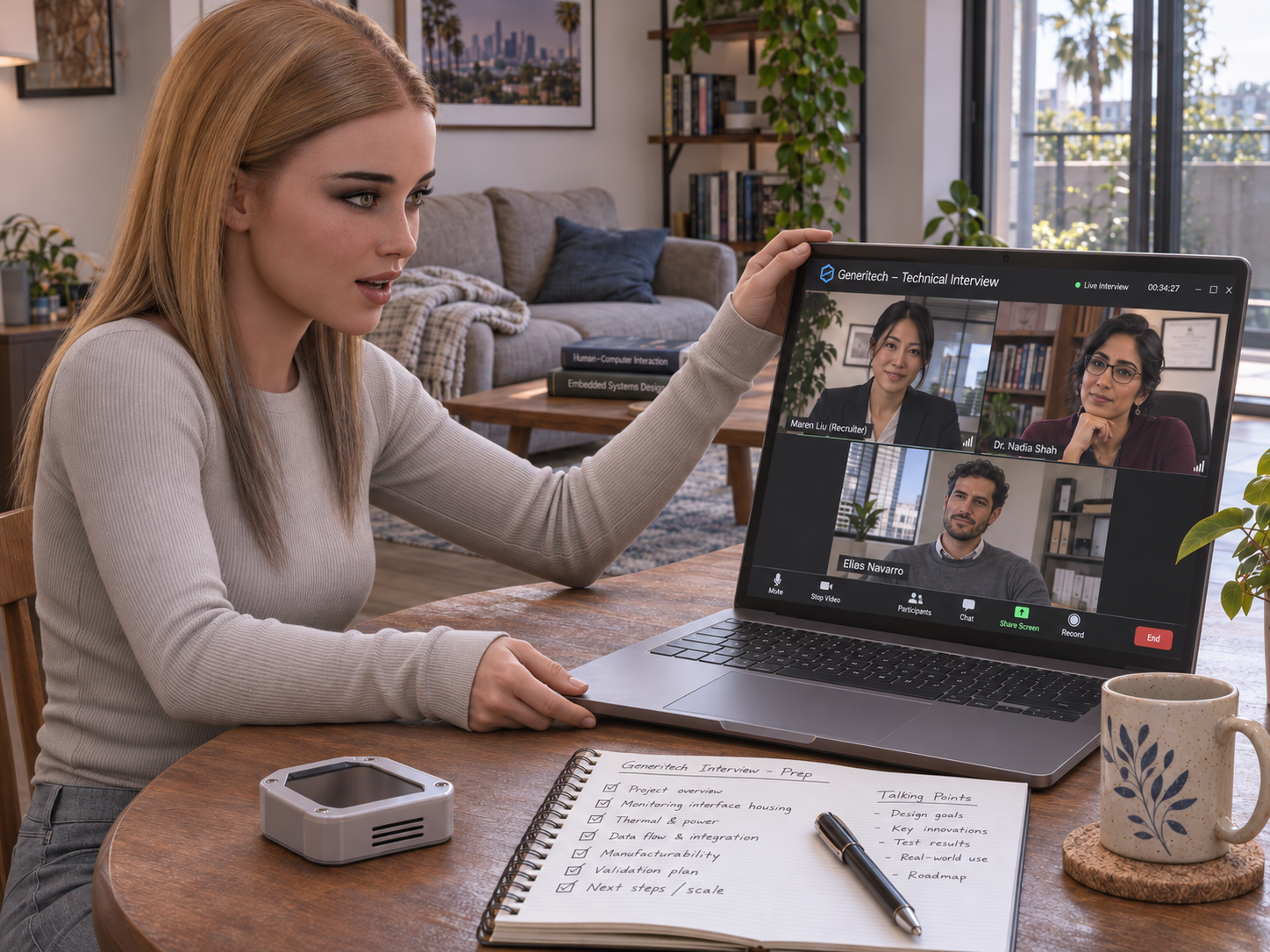
Callie moved the prototype housing off her desk, checked the laptop camera, and immediately put it back. She had spent the previous evening deciding which pieces of her research might be useful during the interview, and apparently that decision had survived until approximately eleven minutes before the meeting. The housing was a palm-sized rectangular assembly with two exposed fasteners, a recessed control, and a strip of indicator lights along one edge. It was not particularly attractive. One corner still carried a faint mark where she had filed down the original casing, and the replacement panel was a slightly different shade of gray. She turned it so the camera would not emphasize the mismatch, then decided that was ridiculous. The people interviewing her were engineers. They would probably be more interested in why the panel had been replaced than whether it matched.
She positioned the housing beside her notebook and checked the presentation one last time. Behind her, the apartment looked reasonably presentable, provided nobody asked what was happening beyond the right edge of the screen. There was a folded blanket on the couch, two library books on the coffee table, and a basket of Juna’s clean laundry that had been waiting to be put away since Tuesday. The basket was outside the camera’s view, so she left it alone. She had nineteen slides prepared, along with a separate document containing the questions she wanted to ask if the interview progressed far enough to make those questions relevant.
The meeting invitation read Generitech Research & Development, Technical Interview. Beneath it were three names, a video link, and a scheduled duration of ninety minutes. Callie had already spoken with the recruiter, submitted her résumé, provided a summary of her master’s research, and confirmed that she expected to graduate from Pacifica Polytechnic University in May. Those steps had felt familiar enough. She had applied for internships, presented research to faculty committees, and defended design decisions in rooms full of people considerably more experienced than she was. This was different primarily because of the name at the top of the invitation and the fact that the people waiting on the other end might determine where she and Juna would be living three months from now.
“Mom, is this the thing you made?”
Juna stood beside the table, holding the prototype housing Callie had just arranged. Her daughter had apparently decided that the safest way to examine it was to pick it up.
“Part of it.” Callie reached over and steadied the assembly before Juna turned it upside down. “Careful. That panel still comes loose.”
“Then why didn’t you fix it?”
“Because I needed to take it off again.”
“You always say that.”
“Because you always ask why something’s broken.” Callie accepted the housing and returned it to the desk. “It’s a prototype. Looking unfinished is practically a requirement.”
Juna considered that explanation while studying the company logo on Callie’s computer. “Are these the people who make LittleMart?”
“LittleMart is one of their stores, yeah.”
“And Generiflix?”
“Also them.”
“So they make basically everything?”
“Not everything.” Callie checked that her microphone was selecting the headset rather than the laptop’s built-in speakers. “Just enough things that it starts to feel that way.”
Ryan appeared from the hallway carrying Juna’s jacket and a small canvas bag. He had changed out of his work clothes, and Callie could tell from the way he was holding the bag that her daughter had already convinced him to carry something she could have carried herself.
“Ready?” he asked.
“Almost,” Juna said, although she had not made any visible progress toward putting on her shoes.
Callie looked at the clock. “You have eight minutes before I need the apartment quiet.”
“Plenty of time,” Ryan assured her. He set the bag near the door and helped Juna find the sleeve she had managed to turn inside out. They were going to the library, followed by something to eat if Juna’s appetite survived the possibility of choosing a book. Ryan had offered to take her out when Callie mentioned the interview, treating it as an ordinary scheduling problem rather than a favor requiring acknowledgment. They had been making arrangements like that for years now, sometimes because Callie had an evening lab session, sometimes because Ryan worked weekends, and occasionally because Juna decided she needed both adults to witness a school project that had occupied most of the dining table.
Ryan came back to the desk once Juna had located her shoes. “Do you want me to check in when you’re finished, or wait until you message?”
“Wait for my message. I don’t know whether they’ll use the whole ninety minutes.”
“Okay. Phone’s on.”
“I know.”
“Just establishing availability.”
“Very professional of you.”
He leaned down and kissed her, briefly enough that Juna could not complain about being forced to witness anything embarrassing. “You’ll do fine.”
“I would prefer to do better than fine.”
“Then do that.”
Callie gave him a look, but he was already turning toward the door. Juna called goodbye from the hallway, and Callie returned her attention to the laptop just in time to hear a rapid series of footsteps coming back.
“My card!”
Juna hurried across the room, opened the small drawer beside the couch, and retrieved her library card from beneath a packet of colored pencils. She held it up triumphantly before heading out again.
“Have fun,” Callie called.
“We will!”
Ryan waited until Juna was outside before looking back through the doorway. He raised two fingers in a little salute and followed her. A moment later, the door clicked shut, and the apartment settled into the particular quiet that only existed when Juna was somewhere else.
Callie took a drink of water, straightened the notebook beside her keyboard, and joined the meeting.
The recruiter appeared first, a woman named Maren Liu whom Callie had spoken with during the preliminary interview. She greeted Callie, confirmed that the connection was working, and introduced the two people joining from Generitech’s research division. Dr. Nadia Shah led an engineering group working on bioelectronic interfaces, while Elias Navarro specialized in human factors and accessible-system evaluation. Both appeared to be sitting in separate offices, with Shah’s background showing a glass wall and several workstations beyond it. Navarro had a whiteboard covered in diagrams that Callie could not quite read.
“Before we get into your research,” Maren said, “I wanted to give you a little more background on how we found you.”
“Mr. Steverson?” Callie asked.
“That’s right. Jed Steverson forwarded your information to our early-career recruiting team and recommended that somebody review your work. Is he still teaching in Minnesota?”
“Last I heard, yes. He was my engineering teacher in high school.”
“He mentioned that. We reviewed your academic record and the materials you submitted afterward. Professor Frank also provided an academic reference, and Dr. Shah’s team requested this conversation after going through your research summary.”
Callie glanced at the small image of herself on the screen. Jed had always been direct with her, sometimes painfully so, and there was something unexpectedly satisfying about learning that he’d remembered her work well enough to recommend it years after she had left Ridgemont. She would have to call him, although she suspected a conversation with Jed was unlikely to consist entirely of compliments.
“Well, I appreciate him putting my name forward,” she said.
“He spoke highly of your abilities,” Shah said. “But I’d like to ask you some fairly specific questions about your recent work.”
“I’d be disappointed if you didn’t.”
Shah smiled and opened the research summary. “Good. Let’s talk about the monitoring interface.”
Callie shared her screen and brought up the presentation. She began with the functional requirements rather than the device itself. The interface was part of a monitoring system intended for Little users, allowing participants to acknowledge notifications, check the current operating state, and determine whether an input had been received. Her responsibility had focused on the physical controls, their integration with the software, and the feedback provided to users. Other members of the research team had worked on the monitoring electronics and broader system integration.
She explained that the device needed to be operable without a full-sized person standing nearby. A Little user also needed to distinguish between an input being registered, a command being processed, and an action being completed. Those distinctions had been written into the requirements from the beginning. The original prototype had technically supported them, but the first participant testing had demonstrated that making information available was not necessarily the same as communicating it successfully.
Navarro interrupted when she reached the original control arrangement. “You describe an unsuccessful participant session here. What specifically failed?”
“The participant couldn’t reliably determine whether the device had accepted an input,” Callie explained. She brought up a photograph of the original assembly. “The button worked. The software registered the press, and the command went into the processing queue. But the confirmation was brief enough that the participant didn’t consistently recognize it. They pressed again because they thought the first input had been missed.”
“Was the second press a problem?”
“It could be. We weren’t getting a dangerous physical response, but the system could register another command while the first was processing. Depending on the operation, that could create an unnecessary second event or make the displayed state more confusing.”
She moved to the next slide, showing the original sequence of events alongside the revised one. “We initially treated the repeated input as the problem. After reviewing the session recording and system logs, I didn’t think that was the right conclusion. The participant was responding to information the interface wasn’t providing clearly enough.”
Shah leaned toward her camera. “What changed?”
“Three things, although two were directly related to the interface. First, we separated input recognition from completed-action confirmation. The original design relied too heavily on one brief visual response. Now there’s an immediate acknowledgment when the input is detected, followed by a persistent indication while the command is processing. The completed state has its own confirmation.”
Callie lifted the prototype housing and held it within the camera’s view. She pointed to the controls, taking care not to obscure the indicator strip with her finger. “Second, we revised the response to repeated presses. During an active command, another press doesn’t simply generate a duplicate. The interface recognizes that there’s already a pending operation and communicates that state. We didn’t want it to ignore the user without explanation, because that would recreate the original uncertainty.”
“And the third change?” Navarro asked.
“We adjusted the control’s mechanical response. That wasn’t the largest source of error, but it was worth addressing. The original button travel and activation force weren’t as consistent as we’d intended. We revised the mounting and tested that separately.”
She set the housing down and returned to her slides. There were photographs from the follow-up sessions, charts showing the event sequences, and a table comparing observations from the original prototype with the revised configuration. Callie explained that the team had completed further testing after making the changes. Participants were more successful at identifying whether an operation was pending or complete, and the repeated presses that had complicated the first session occurred less frequently. There were still limitations, particularly when lighting conditions made visual information harder to distinguish or when participants had difficulty detecting the physical response.
“We documented those separately,” she said. “The results were encouraging, but they don’t establish that the design works equally well for every participant or environment. We also had a limited sample, so I wouldn’t want to make a broader claim from it.”
Navarro looked down at something on his desk. “Why didn’t you just train users not to press the button a second time?”
Callie had anticipated the question in approximately that form. She had even written an answer in her notebook, although she found herself wanting to explain it differently now that somebody had asked.
“Training would probably reduce the number of repeated presses,” she said. “It might be appropriate for some parts of the system. But the requirement wasn’t just that somebody could learn the procedure. The device needed to communicate its operating state clearly enough that a user could understand what it was doing without continual assistance. If a person presses a button and can’t tell whether anything happened, telling them not to press it again doesn’t resolve the underlying information problem.”
“So you’d redesign the system rather than alter the training?”
“If the evidence supports that, yes. Training is still useful, but I don’t think it should be compensating for missing feedback that the device was supposed to provide. Especially when somebody might be using it independently.”
“Even if training is cheaper?”
“That depends on what you’re calling cheaper.” Callie considered the question before continuing. “If you only count development cost, sure. But if the design requires repeated assistance or causes predictable mistakes, that has a cost too. And if independent operation is one of the requirements, I can’t call the design successful just because we found a way to work around it.”
Navarro made a note, then studied the diagram for several seconds. “Let’s suppose the second press is intentional. The user changes their mind and wants to issue another command while the first is pending. You’ve prevented duplicate inputs, but how does the interface distinguish that situation from an accidental repetition?”
Callie looked at the diagram. She had considered the interaction from the standpoint of someone uncertain whether the device had registered a command, but the question exposed a different problem. The revised behavior worked well for the operations they had tested. That did not mean it would be appropriate for every possible use.
“It doesn’t make that distinction based on the press alone,” she admitted. “Our current implementation handles the repeated input according to the device’s operating state. For the functions included in this prototype, a second press during processing isn’t treated as a new command. But if we added functions where a user needed to change or cancel an operation, that behavior would need to be designed separately.”
“Would you be comfortable putting that version into a product?”
“Not without defining those additional requirements and testing the interaction.” She glanced at the prototype. “I’d also want a dedicated cancellation method if the system could initiate an action the user needed to stop immediately. I wouldn’t want an ambiguous double-press convention handling something that important.”
Shah nodded slightly. “How would you decide whether an added control was preferable to a more complicated interaction with the existing one?”
“I’d start with the tasks people actually need to perform and how often they need to perform them. Then I’d compare the physical demands and error rates of both approaches. More controls aren’t automatically better, particularly at this scale.” Callie paused. “I’d also want to review the enclosure and available mounting space before promising another button. We already had to revise the mounting once.”
Navarro smiled. “You sound like somebody who has argued with a mechanical engineer.”
“I’ve been on both sides of that argument.”
The next questions moved into the testing procedure, including how the team distinguished between a participant misunderstanding the interface and the system failing to register an input. Callie explained their use of event logs alongside observations from the sessions. A repeated press might indicate uncertainty, but it could also mean that the first press had failed electrically. They needed the logs to determine which problem had occurred.
Shah took over when Navarro finished. “What evidence would make you reconsider your conclusion that the interface was primarily responsible for the repeated inputs?”
Callie stopped with her hand resting on the mouse. It was a better question than the earlier one, and not quite the same thing. She looked at the table on her screen, then reached for her notebook.
“I’d want to compare the revised interface against the original under controlled conditions,” she said after a moment. “Including a group with standardized training and a group using the device with only the instructions intended for normal operation. If training consistently eliminated the problem without creating other difficulties, and the interface changes didn’t produce a meaningful improvement beyond that, I’d have to reconsider how much of the failure was attributable to the design.”
She glanced down at the notes she had made during the latest testing review. “I’d also want a larger participant group, with more variation in motor ability and familiarity with similar equipment. The current results suggest the feedback changes helped. They don’t isolate every variable as cleanly as I’d like.”
“What about long-term use?” Shah asked.
“We haven’t studied that yet. I can explain what I’d want to measure, but I can’t claim the system has been validated for it.”
“Go ahead.”
Callie described repeated-use testing across different environments, including situations where the user was distracted or handling another task while responding to the device. She would want to measure not just successful inputs, but whether participants correctly understood the system’s state and recovered independently when something unexpected occurred. She also wanted to examine how familiarity changed behavior over time. A design that worked during a supervised session might still create problems when the novelty wore off and a person stopped paying close attention.
Shah asked about the monitoring electronics themselves. Callie answered the portion concerning the interface and its communication with the controller, then stopped when the question moved into sensor calibration.
“That part wasn’t mine,” she admitted. “I reviewed the output requirements with the electronics team, but I didn’t perform the sensor calibration or validation. I have their documentation, but I wouldn’t be comfortable representing those results as work I conducted.”
“Fair enough,” Shah said. “Would you know who to bring into the conversation if an interface problem appeared to originate there?”
“Yes. I’d start with the person responsible for the sensor subsystem, because the first thing I’d want to know is whether we were displaying incorrect information or correctly displaying information that was already wrong.”
Navarro laughed quietly. “That’s an important distinction.”
“It was an expensive distinction in terms of our time,” Callie said. “We learned to check it earlier.”
The discussion continued for another twenty minutes. Shah asked about design reviews, Navarro returned to participant testing, and Callie found herself explaining several decisions that had seemed minor when she made them. At one point, Shah questioned why she had retained a particular control arrangement after its first revision. Callie walked through the alternatives they had considered and admitted that she had initially preferred a more complicated configuration because it offered greater flexibility. The simpler design performed better in the testing they could actually support.
“I liked my first idea more,” she acknowledged. “That wasn’t a particularly good reason to keep it.”
“Engineers do occasionally become attached to their own designs,” Shah said.
“I’ve heard rumors.”
By the time they finished discussing the project, Callie had stopped watching the small image of herself in the corner of the screen. She was too occupied following the questions and deciding what information mattered. It felt less like defending herself to strangers and more like a demanding design review. She knew some of the answers, had to think through others, and occasionally discovered that the question itself exposed something worth examining later.
Maren rejoined the conversation when Shah closed the research summary. “I’d like to spend some time discussing the position we’re considering you for, and then make sure you have an opportunity to ask us questions.”
Shah explained that the proposed position was Associate Research Engineer within the Bioelectronic Interfaces group. The team worked on several ongoing projects involving biological monitoring, accessible control systems, and interfaces intended for Little users. Some projects were still in early research, while others supported equipment being evaluated or developed by other Generitech divisions. Callie would join an established team rather than lead an independent research effort immediately. Her work would be supervised by experienced engineers, with responsibility increasing as she became familiar with their systems and procedures.
“What would the first few months look like?” Callie asked.
“Quite a lot of reading,” Shah answered. “Existing designs, technical documentation, our test procedures, and the research history behind whatever project you’re assigned to. You’ll spend time with our electronics engineers, biomedical specialists, software developers, and human-factors staff. Depending on the project, you might help prepare test protocols, build or revise interface components, assist during evaluation sessions, and document the results. We don’t expect a new graduate engineer to walk in and independently solve a problem that an established team has been studying for years.”
“That sounds reasonable.”
“We do expect you to ask questions, understand why a requirement exists, and tell us when you find something that doesn’t make sense. Some of our work involves devices that people depend on in ordinary life. A design can be technically impressive and still be wrong for the person expected to use it.”
Callie glanced at the small prototype beside her notebook. She had spent enough time with that distinction to know she wanted to keep working on it. The role sounded demanding in precisely the way she had hoped. There would be equipment she had never seen, colleagues who understood specialties she had barely encountered, and research problems that could occupy years rather than a semester. She liked that it was not being sold to her as an opportunity to change the world before she had even learned where the laboratories were.
She asked how Little participants were involved in testing. Navarro explained that research plans were reviewed with both technical and participant-support staff before sessions began. Depending on the work, Little participants might help evaluate early usability, perform defined tasks, or provide feedback on devices intended for their use. Some took part in repeated evaluations, allowing engineers to understand whether problems changed with familiarity.
“Who can stop a session?” Callie asked.
“The participant can,” Navarro said. “So can the people responsible for conducting or supervising the session. If somebody identifies a safety concern, we stop and assess it. We don’t require the participant to continue because a test was scheduled for that afternoon.”
“And if the result conflicts with the project timeline?”
“Then we have to deal with the result.” Navarro leaned back in his chair. “We had an evaluation last year where one of the participants reported a problem that hadn’t appeared in our earlier sessions. The device behaved differently under a particular combination of conditions. The development team initially thought we were looking at an isolated equipment fault, and there was some disagreement about whether we needed to delay the next design review.”
“What happened?”
“We stopped that portion of the testing and reproduced the problem. Turned out it wasn’t an isolated fault. There was an interaction between two systems that we’d tested individually but hadn’t adequately evaluated together. We documented it, revised the schedule, and went back to work.”
“Was that popular?”
“Not particularly,” Navarro admitted. “The development group had other commitments, and the review had already been arranged. But we weren’t going to present the device as ready when we had evidence that it wasn’t.”
Callie nodded, appreciating the distinction between a stated policy and an example of what happened when following it became inconvenient. She asked how an engineer could request help outside their discipline, and Shah described the review structure used for projects involving several specialties. Callie would have a direct supervisor, but technical questions were not expected to remain within departmental boundaries. If a mechanical change affected signal quality or a software revision altered usability, the relevant teams were expected to work through it together.
Maren then explained that the position was based at Generitech’s world headquarters in Gracewood, New York. The Bioelectronic Interfaces group worked from the headquarters research facilities, not from a regional office Callie could join while remaining in California. Accepting the position meant relocating to Gracewood in time for an early-June start, after she completed her master’s degree and the normal hiring requirements. Callie had understood where the job was located from the first conversation with Maren, but hearing the move stated as an actual condition of employment made her think of Juna’s schoolbag hanging by the apartment door.
Gracewood was more than the city named in the address of a large corporate headquarters. Generitech had developed its flagship civic region around that headquarters, building a community whose housing, utilities, medical facilities, schools, businesses, and transportation were woven into its operations. Callie had read about the place. She was fascinated by the thought of living inside a city whose infrastructure had been designed together, but she was also trying to imagine what it would mean to move Juna into a completely unfamiliar home.
Maren described the employee arrangements for families making that move. Generitech offered high-quality housing with monthly costs scaled to an employee’s compensation and household circumstances rather than leaving new arrivals to negotiate market rents. The arrangement included household utilities and internet, with medical coverage for eligible employees and their children. A relocation team would help Callie understand the available residences and work through the timing. For Juna, Generitech funded a private school system for employees’ children, including the required books, devices, and school meals. The precise housing charge and coverage terms would be provided in writing before Callie made her decision.
“My daughter is eight,” Callie said. “She’ll be finishing her school year here before we move. I’d want to make sure the timing works for her.”
“Of course,” Maren answered. “We can connect you directly with the school enrollment staff and the relocation team. They can explain the records they need, the school calendar, and which residential arrangements would work for you and your daughter. You should have that information before deciding how to time the move.”
Callie made a note, then asked about the situation if Ryan joined them later. She explained that he was her partner but would not necessarily relocate at the same time.
“Would he be eligible for residency through my employment, or would he need to apply separately?”
Maren considered the question rather than answering immediately. “There are different arrangements depending on the relationship and the circumstances. I don’t want to give you an answer that might not apply to your situation. I’ll have our relocation team provide the relevant written policy, including what would be required if he joined you after your start date.”
“That would help. I don’t want to make plans based on an assumption.”
“Absolutely. We’ll include that in the follow-up.”
They finished shortly afterward. Maren explained the remaining hiring steps and said the team would be in touch after its internal review. Callie thanked everyone, disconnected, and found herself staring at her desktop for several seconds before reaching for her phone.
She typed Ryan a message.
Finished. Went well, I think.
His answer arrived while she was putting the prototype back in its box.
Good. Juna found three books and has declared the library’s selection inadequate. Want us home?
Callie smiled.
Yes. I need someone to tell me whether I sounded like an idiot.
I can do that. No charge.
She set down her phone, walked into the kitchen, and realized she had not eaten anything since breakfast.
* * *
Four days later, the written offer arrived while Callie was reviewing the latest revisions to her master’s research report.
She had been correcting a figure whose labels had somehow become misaligned when she recognized the sender in the notification. For a moment, she simply looked at the email, aware that the document she had spent the morning trying to finish no longer interested her nearly as much. Then she opened the message and read the first paragraph.
Generitech was pleased to offer her the position of Associate Research Engineer, Bioelectronic Interfaces, within Research & Development.
Callie read the sentence again, then opened the attachment.
The document specified an early June start at Generitech’s world headquarters in Gracewood, contingent on successful completion of her master’s degree and the standard employment requirements. Relocation to Gracewood was part of the appointment, not an optional arrangement or a choice between corporate offices. The offer included her compensation, employee benefits, reporting arrangements, and a summary of the position’s responsibilities. Its base salary was considerably above what she had expected to earn in her first professional engineering position. That alone would have made her look twice. Together with the family provisions, it represented a very different kind of start to her career than the one she had spent years budgeting for.
She studied the compensation figures long enough to confirm that she had read them correctly. The amount represented more than financial comfort. She thought about the years of comparing grocery prices, timing purchases around what was left after rent and childcare, and deciding whether a perfectly functional piece of equipment could survive another semester before she replaced it. She would still have a budget, of course. Moving across the country with a child wasn’t going to become inexpensive simply because Generitech had offered her a good salary. But there was a difference between planning carefully because it was sensible and planning carefully because a mistake could mean not having enough money.
She opened the housing and family-benefits information next.
The materials described Gracewood as the community surrounding Generitech’s world headquarters, with employee housing, services, and schools integrated into the city the company had built there. The housing program was scaled to salary and family circumstances, with utilities and internet included in the monthly arrangement and medical coverage available for Callie and Juna under the employee package. Juna would have access to Generitech’s funded private school system, where the necessary learning materials, devices, and meals were provided. Callie worked through the documents with the same care she gave a technical specification, checking which provisions were established and which still required a written determination for her household. She did not yet have a specific address, a finalized monthly housing figure, or every medical billing detail. Those questions belonged on the list for Maren. Other things were perfectly clear. Her laboratory would be at headquarters. The job required her to move to Gracewood. Juna would be moving with her.
She opened the location map once more and followed the routes from the residential neighborhoods toward the headquarters district. GraceLink connected the parts of the city she would have to learn: home, school, laboratories, the places where ordinary errands would happen. It was an engineer’s kind of map, all systems and connections, and for a moment she found herself curious about how the pieces worked together. Then she looked at the school information again. The connections she cared about most would be the ones that made a new home feel like somewhere Juna belonged.
The offer remained open for ten business days.
Callie picked up her phone and found Ryan’s contact. She was halfway through pressing the call button when she stopped.
He would be happy for her. She knew that. He had listened to her talk about Generitech since the first contact from the recruiter, and he had been the one insisting that she take the interview seriously even when she tried to convince herself it was only an exploratory conversation.
But before calling him, she wanted a moment to consider the offer without immediately converting it into a discussion about moving, schooling, schedules, and whether a relationship could survive three thousand miles.
She returned to the description of her responsibilities.
During the interview, Shah had mentioned several ongoing projects without sharing details that would have required a more formal review. Callie had found herself thinking about those projects afterward, wondering how the team approached its design problems, what equipment its laboratories contained, and how many things she would need to learn before she could contribute meaningfully. She could picture herself sitting in a design review with people like Shah and Navarro, arguing over results, discovering a flaw in something she had built, and staying late to understand why a system wasn’t behaving as expected.
She wanted that.
Not merely the Generitech name on her résumé or the compensation attached to the position. She wanted the work itself. She wanted to be surrounded by people who understood engineering problems well enough to challenge her, with the resources to investigate questions that could take months or years to answer properly.
For so long, she had treated becoming an engineer as something she was working toward while also being Juna’s mother. One degree, then another. Classes, laboratories, childcare arrangements, work, and whatever else needed to be done that week. Sometimes the destination had felt so distant that she had concentrated almost entirely on reaching the next semester.
Now somebody had put the destination in writing.
She looked at the offer again. She had earned her place in this conversation, and Generitech wanted her to join its research team. She was not going to pretend she didn’t care how much that meant simply because accepting would make the next few months complicated.
Callie called Ryan.
He answered after several rings, sounding as though he had stepped away from the bookstore floor.
“Everything okay?”
“Generitech sent me an offer.”
There was a brief pause, followed by a noise that sounded like he had nearly dropped something. “Seriously?”
“Seriously.”
“Callie, that’s amazing.”
She laughed, unable to help herself. “Yeah. It kind of is.”
“Tell me everything.”
“I’m going to. But you’re at work, and I’ve got about six different documents open right now.”
“Then tell me tonight. I’ll come over after my shift.”
“You’re already coming over.”
“Good. Saves me a trip.”
Callie smiled and returned to the offer. “I’ll see you tonight.”
She ended the call and looked again at the letter on her screen, where her name appeared beneath Generitech’s familiar logo. Ryan had sounded every bit as excited as she had hoped, and later they would have plenty to discuss. There were questions she still needed answered and arrangements she could not make until she knew more. Juna would have to be told, and her parents, and eventually Jed, who had started the entire process by sending her name to someone at Generitech.
For the moment, though, Callie left the letter open and returned to the list of responsibilities she had already read several times. The job was real. The people she’d met wanted her to join them, and she knew she wanted to go.
She allowed herself a few more minutes to enjoy that before reaching for her notebook.


Whoa, good for Callie.
Hell yeah! Finally going to see inside Generitech from an employee’s pov. also, I loved Callie using the words people and person the whole time, never distinguishing between human and little.
I am curious about Ryan possibly moving with them and how that’ll effect him looking for charity, revealing his vulnerability, and revealing that his family was super rich (idk if that last part is something callie knows already but assume not)
still Callie is probably the best person for this to happen to.
1) yeah, she will be working with genritech with a non transformed little as a hopeful husband lol
2)Ryan will be able to tell Calli and Juna they will be able to live in his child hood big house and schools and she will be able to know hopefully his background and they will get married
3) I was thinking during reading that Ryan would have pre shrinking happening so he could keep Juna home from school to make sure she could help him if he shrank or Callie could bring him to work for testing.
4) I love, love lol that’s why I hope Callie & Ryan give genritech a example of a Human and little mixed couple that is doing great. lol
5) I think the Gray family, because Ryan will be a little will make a great addition to the smallara universe even if its in the east coast lol.
6) Since I cant write, I was hoping to make a fan page for little support item ideas from everyone lol.
0) ‘The Opportunity” ooh, first chapter to actually have a title.
1) “Mom, is this the thing you made?” Juna stood beside the table, holding the prototype housing Callie had just arranged. Her daughter had apparently decided that the safest way to examine it was to pick it up.” Hands-on examination often helps, especially with 8yo’s.
2) “The meeting invitation read Generitech Research & Development”. Same thing as the ID badge you showed me
3) ““You sound like somebody who has argued with a mechanical engineer.” – “I’ve been on both sides of that argument.” I could see Callie arguing with herself on these types of things
4) “A design that worked during a supervised session might still create problems when the novelty wore off and a person stopped paying close attention.” Very true, of most things
5) “Who can stop a session?” – “The participant can. So can the people responsible for conducting or supervising the session. If somebody identifies a safety concern, we stop and assess it. We don’t require the participant to continue because a test was scheduled for that afternoon.” Sound like bare minimum common sense safety practice, though in this world that’s actually quite the achievement.
6) “Maren then explained that the position was based at Generitech’s world headquarters in Gracewood, New York”. There’s a place in New York named after the Gracewoods? Is it a suburb or just a Generitech base?
7) “Generitech offered high-quality housing with monthly costs scaled to an employee’s compensation and household circumstances rather than leaving new arrivals to negotiate market rents.” Sounds like a great idea for minimum wage workers but a screwie deal for high earners. Also sounds like a means for Generitech to have a hand in controlling it’s employees off hours lives as well as on the clock.
8) “For Juna, Generitech funded a private school system for employees’ children, including the required books, devices, and school meals.” If this school’s so great, why didn’t Chloe go there?
9) “Generitech was pleased to offer her the position of Associate Research Engineer, Bioelectronic Interfaces, within Research & Development.” She did it! I knew she could
10) “But there was a difference between planning carefully because it was sensible and planning carefully because a mistake could mean not having enough money.” That is a fairly substantial difference
11) “GraceLink connected the parts of the city she would have to learn: home, school, laboratories, the places where ordinary errands would happen.” Another genribusiness, this time named after the family, not the business.
12) “ Jed, who had started the entire process by sending her name to someone at Generitech.” And who the fuck is Jed that he had those kinds of contacts?
12) Jed is a former generitech employee who left the company to because of a career opportunity for his wife. He teaches high school because he loves teaching but he’s still knows people at generitech and can get wehre he needs to when he wants too.
11) Its not exactly a business:
GraceLink
The transit network of Gracewood in Becoming Grey
GraceLink, usually called the Link, is the underground passenger transit network that Generitech built for Gracewood, its flagship Civic Region in New York. It originated there and became the transit model for Generitech’s other Civic Regions. Gracewood was designed around it from the start. A neighborhood station is within walking distance, and many of the places residents travel to most often have stations built directly into them.
What a trip looks like
A rider walks to a neighborhood hub and takes a Local train to a distribution hub. From there, they can connect to service for a school, downtown, Generitech headquarters, or another major destination. Schools, hospitals, the airport, and major employment sites have integrated stations, so the train can take riders straight to the institution they came to visit.
A Local ride can take only a few minutes. On some trips, walking between platforms and making the connection takes longer than the ride itself. The vehicles are recognizable automated trains and shuttles, and the trip has a familiar rhythm. You walk to the station, board, change trains if you need to, and get on with your day. For a family in Gracewood, the Link can be the school commute in the morning and the way to a medical appointment that afternoon.
The technology under the city
GraceLink runs on Generitech’s Vector Transit System (VTS). Its high-speed service combines magnetic levitation and linear-motor propulsion with low-pressure express guideways. Lower air pressure reduces drag, while automated routing coordinates movements across the network. Smooth acceleration is part of the design.
Express trains can cruise at roughly 620–650 mph on suitable stretches. The system’s theoretical maximum is about 750 mph, while passenger service stays within the cruising range. Those speeds belong to express runs. A short neighborhood trip is quick because the station is close and the ride is short.
Where the Link takes you
Generitech headquarters has its own GraceLink station. Inside headquarters is Lilliton, the functioning city built at the scale of Littles. A rider can take GraceLink as far as headquarters. Entry to Lilliton requires a separate miniaturized version of Gracelink for commuting within Lilliton.
Its called GraceLink as it was designed for Gracewood specifically as there transit system before being deployed at scale in other civic regions.
GraceLink’s 620–650 mph express cruising speed is about 998–1,046 km/h. Its theoretical maximum of 750 mph is about 1,207 km/h.
10) Agreed but still important distinction to make
9) It was nip and tuck for a few years but she did it. I feel like me showing you the badge helped in your faith in her but you are a fairly optimistic person when it comes to good people.
8) Chloe didnt go for two reasons. One, she wanted to see and expierence life with kids her age outside of generitech and have expierences and opportunities that were beyond the control of her family. Second reason is because she had made friends and wanted to go to school with them and have expierences with them.
Her parents didn’t want her to expierence life only within there structured world. They felt it was important for someone who was going to be the future CEO of generiech and groomed for hte role from a young age. To see the everyday struggles, see the problems people deal with, and more importantly grow and develop beyond their walls which while a risk they felt its important that she be able to stand on her own to feet and know what its like be hurt, hated, have mean things said but also teh beauty of man how this negativities make the good times so much more. Grow in ehr judgmement of people and ability to read people who aren’t just telling you what you want ot hear.
7) Well, Generitech provides housing as part of the job package. If you take a job at headquarters, you know up front that it means moving to Gracewood, what the lease terms are, and that your eligibility to live there generally comes with the job. People take those jobs because they want to work for Generitech, and for a lot of them, living in Gracewood is part of the appeal.
You still get to choose what type of home you live in, if its a big house, a condo, or whatever.
6) you would have heard about this in smallara prime. Its the county aka civic region that Chloe’s family governs. They have a city called gracewood that surrounds the generitech headquarters.
5) thats not even a expectation in the real world. its an ideal sure but not a expectation or gaurantee
4) agreed
3) Herself and others as Callie is the type of person who would do multiple jobs.
2) yup gotta stay on brand
1) also a good durability test.
0) ironically most do i just remove them. I forgot to remove it.