
Chapter 43
June 2027
The commercial area Denise had mentioned was located several corridors away from the conference room, beyond a broad interior walkway that connected different sections of Generitech Headquarters. Callie followed her through the building, trying to remember the turns they took while occasionally becoming distracted by something that caught her attention. The headquarters was busy without feeling crowded. Employees moved between departments, some walking alone while others traveled in small groups, talking or examining information displayed on their devices. Through one set of windows, Callie could see another courtyard with benches arranged beneath several trees. Beyond it, a different section of the headquarters rose above the surrounding buildings, its glass exterior reflecting the morning sunlight.
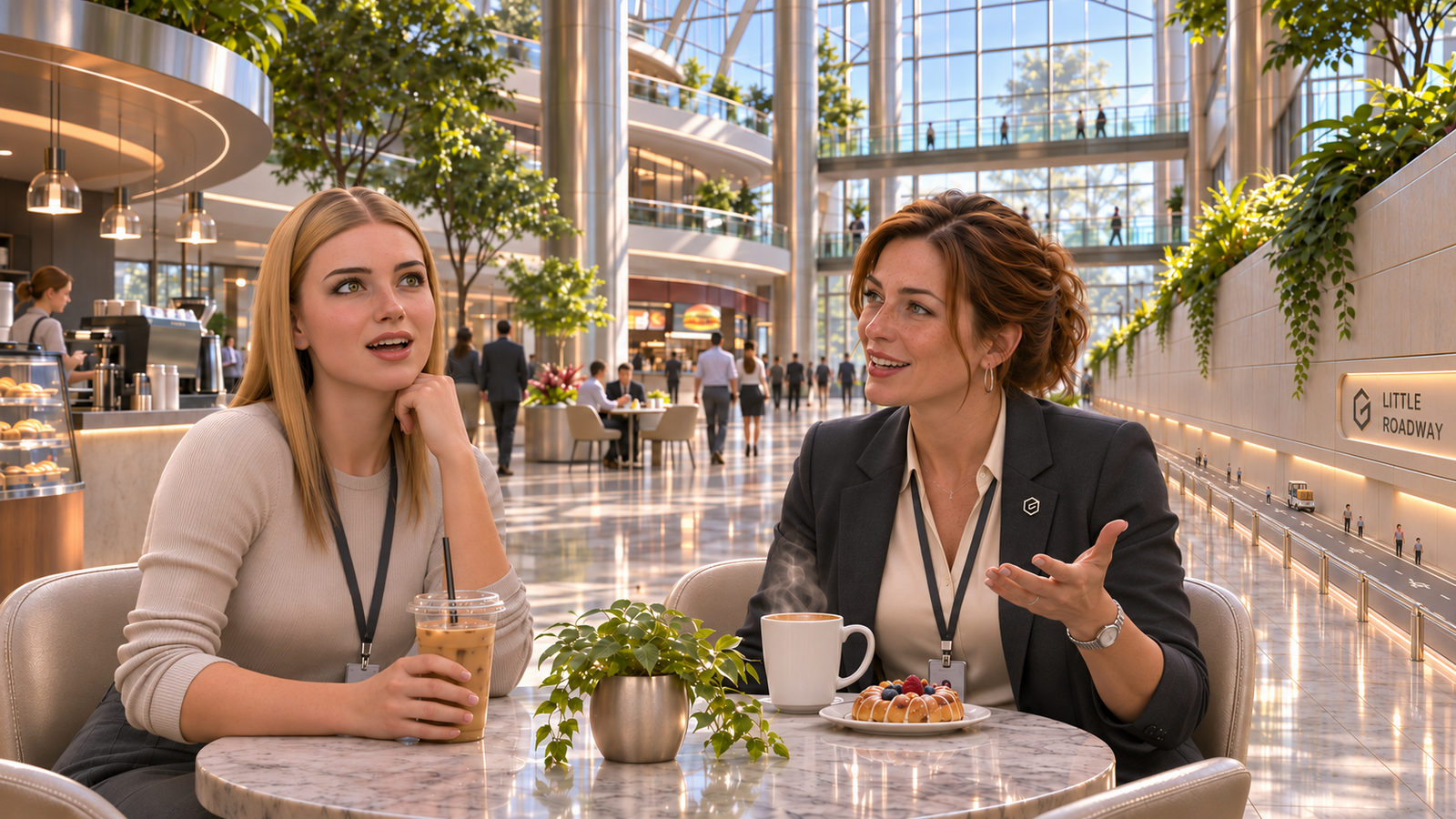
The Little Roadway continued along the walls, separated from the main pedestrian area by the same markings she’d noticed when she first entered the building. A small service vehicle passed them carrying several containers secured behind its driver. Farther along, two Littles walked together in the designated pedestrian section, apparently discussing something on a device one of them was carrying. Callie glanced down as they went by, noticing the way the smaller roadway followed the same intersections and corridors used by full-sized employees.
“Have you had many opportunities to work with Littles before?” Denise asked, noticing where she was looking.
“Not directly. Most of my research has been focused on developing equipment for them, but my university didn’t have anything like this.” Callie watched the two Littles disappear around a corner. “It’s one thing designing something for somebody who’s four inches tall. It’s another thing actually seeing an entire transportation system built around them.”
“You’ll see quite a bit more of that once you reach your department.”
“I’m looking forward to it.”
They continued through another set of doors, emerging into a spacious interior concourse filled with natural light. A high ceiling rose several stories above them, supported by broad structural columns arranged around an open central area. Plants and small trees occupied landscaped sections between the walkways, and several seating areas were positioned where people could gather without obstructing traffic. Along one side of the concourse, a collection of restaurants and smaller shops occupied the lower level. Callie recognized several of the brands immediately, including a familiar coffee chain and a McDonald’s farther down the walkway. Employees stood in short lines at some of the counters, while others sat at tables eating or talking.
“Okay,” Callie said, looking around. “I definitely didn’t expect to find an actual shopping area inside headquarters.”
Denise smiled. “It’s convenient when you have this many people working in one complex. There are several commercial areas throughout the headquarters, along with dining facilities and other employee services.”
“How many people work in this building?”
“Quite a few, although the number varies depending on which departments and facilities you’re including. The headquarters complex is much larger than the sections most visitors see.”
Callie glanced toward the upper levels, where glass-fronted walkways connected different parts of the structure. She’d thought the building looked enormous from outside, but moving through it was making her realize how little its exterior revealed about the arrangement inside.
“That sounds like a diplomatic way of saying I’m going to get lost.”
“Oh, almost certainly. Most new employees do.”
“Good. I’d hate to disappoint everybody.”
Denise laughed and led her toward the coffee shop. “Come on. Let’s get something to drink.”
The shop looked much like the locations Callie had visited in California, with a familiar menu displayed above the counter and employees preparing drinks behind the service area. There were a few differences in the equipment and layout, but the branding, menu, and overall appearance were recognizable. Callie ordered an iced coffee, while Denise selected a hot drink and a small pastry. Their orders were processed almost immediately, with the payment confirmation appearing through Flow before Callie had finished putting her phone away.
They moved to a table near the edge of the seating area, where they could watch people passing through the concourse. Callie set her drink down and glanced back toward the shop.
“So this is one of the businesses you were talking about earlier?”
“Exactly.”
“Generitech owns this location?”
“Yes. The shop operates under a licensing arrangement with the brand, but the business itself is operated by Generitech.”
Callie looked toward the employees preparing drinks behind the counter. “So those people are Generitech employees?”
“They are.”
“And that’s true for the McDonald’s over there?”
“Yes.”
Callie followed her gesture toward the restaurant she’d noticed when they entered. She could see the familiar golden arches above the service area and a few customers waiting for their orders.
“Okay, that’s still going to take some getting used to. I understand that Generitech owns a lot of businesses. I’ve known that for years. It’s just strange realizing the McDonald’s down the street is technically operated by the same company that hired me to design biomedical equipment.”
Denise smiled over her coffee. “That’s one of the things new residents tend to find surprising. Generitech doesn’t simply regulate the businesses operating inside its Civic Regions. We own and operate them.”
“Even when the brands belong to somebody else.”
“Correct. McDonald’s still owns its brand and intellectual property, of course. But the individual restaurant operates through a franchise agreement. Generitech holds that franchise, provides the facilities, employs the staff, and manages the business according to the terms of the agreement.”
“So Generitech is the franchisee.”
“Exactly. We negotiate similar arrangements with other businesses whose brands we want represented inside our regions. Some are franchise agreements, others are licensing or operating arrangements, depending on the industry.”
Callie took a drink of her coffee while considering the explanation. The shop was busy enough that she could hear the espresso machines operating behind the counter, along with the ordinary conversation of customers waiting for their orders. Nothing about it suggested a business that was fundamentally different from the locations she’d visited in California. The employees wore familiar uniforms, the products carried the same branding, and customers ordered what they wanted without appearing to think about who owned the store.
“So if I stop at McDonald’s for lunch, I’m technically spending money with my employer?”
“You are.”
“And if I go grocery shopping afterward?”
“Also Generitech.”
“Buy something at the mall?”
“Most likely Generitech.”
Callie laughed. “That’s actually kind of ridiculous when you think about it.”
“It can sound that way when you first hear it.”
“I mean, I’ve been shopping at Generitech-owned businesses for years. I understand how subsidiaries work. It’s just strange realizing practically every place I might spend money around here is operated by the same company that signs my paycheck.”
“That’s one of the differences between shopping in an ordinary city and living in a Civic Region. Outside our regions, Generitech competes alongside other businesses in the general economy. Inside, we operate the commercial environment directly.”
Callie looked around the concourse again. Several employees were carrying shopping bags, and a woman walking past their table was holding a takeout container from one of the restaurants. She wondered how many of them had gone through this same conversation during their first week in Gracewood.
“My parents own a grocery chain back in Minnesota,” she said. “Nothing remotely this big, obviously, but enough that I know how complicated running stores can get. How do you keep all the different businesses from stepping all over each other?”
“There’s quite a bit of coordination between our operating divisions. Retail, food service, distribution, facilities, and other departments have their own management structures, but they’re working within the same organization. That gives us opportunities to coordinate services that would ordinarily belong to separate companies.”
“Like distribution and inventory?”
“Exactly. Imagine how many separate arrangements a traditional shopping district needs for deliveries, maintenance, security, waste collection, payment processing, utilities, and communications. Each business might be negotiating with different providers, using different systems, and solving many of the same problems independently. Here, those services can be managed as parts of a coordinated operation.”
Callie nodded. She’d seen a smaller version of that problem at Grey’s whenever suppliers changed delivery schedules or a refrigeration contractor needed access to a particular store. Her parents were good at managing those situations, but she’d heard her father complain often enough about the number of companies involved in keeping refrigerated food cold and shelves stocked. A shared infrastructure could eliminate some of those complications, although she imagined it required an extraordinary amount of coordination to keep everything functioning.
“That has to be a nightmare to manage,” she said.
“It certainly keeps people employed.” Denise smiled and took another drink. “But the advantage is that we can design those systems together rather than treating each business as an isolated operation.”
Callie thought about the facilities she’d passed while driving through Gracewood. The streets were wide and orderly, without the collection of delivery vehicles, service trucks, and construction equipment she was accustomed to seeing around busy commercial areas. She wondered how much of that was the result of the transportation network and how much came from coordinating deliveries through the same organization.
“And because you control the infrastructure, you can design it around how your businesses actually operate,” she said. “Instead of building a shopping center and then trying to figure out where all the delivery trucks are supposed to go.”
“Precisely.”
“That makes sense.” Callie looked toward the coffee shop again. “Does that mean all these employees have the same benefits I do?”
“They’re part of the same broader organization, but individual positions and operating divisions have different compensation structures and job-specific benefits. A restaurant employee doesn’t receive the same salary as a senior research engineer, obviously. But they’re still Generitech employees.”
Callie nodded. That distinction seemed reasonable enough. Her parents certainly couldn’t pay a new cashier the same salary as the manager responsible for overseeing an entire store, although they tried to keep wages competitive enough that they weren’t constantly replacing employees. Generitech simply operated on a scale that made those differences considerably more extensive.
“That’s a lot of people under one company,” she said.
“It is. And that’s part of why the internal organization is structured the way it is. Someone working in food service is managed through the appropriate operating division rather than having the same people responsible for restaurants and biomedical research.”
“Probably a good idea. I can build you a circuit, but I wouldn’t trust me to run a McDonald’s during the lunch rush.”
Denise laughed. “Well, hopefully we won’t have to find out.”
They spent a few more minutes talking about the relationship between Generitech’s different businesses. Callie learned that the company could coordinate purchasing, distribution, facilities management, and other services across multiple operating divisions while still honoring the separate contractual obligations associated with outside brands. She was particularly interested in the way familiar products and services could be integrated into the larger system without requiring every business to carry Generitech branding.
Eventually Denise finished her pastry and checked the time. “All right. Let me show you one other thing before we head back.”
They left their table and continued through the concourse, passing several more shops before reaching a broad wall display showing information about Gracewood’s neighborhoods and civic services. The interface was arranged around a map of the region, with different categories available for housing, transportation, schools, shopping, healthcare, and other facilities. A few people were examining the display when they arrived, so Denise waited until they moved away before selecting the residential category.
“Now, we’ve talked about how Generitech owns and operates the commercial businesses inside the region,” she said. “The same basic ownership structure extends to residential and commercial property.”
“Right. We went through some of that when I picked the condo.”
“Exactly. Generitech owns the land and the residential buildings, while residents lease their homes under the applicable housing agreements.”
Callie looked at the map, recognizing the general neighborhood where she and Juna had moved. It was situated near her daughter’s new school, with several other residential buildings clustered around landscaped spaces and pedestrian routes.
“So nobody actually buys a house here?”
“Not in the conventional sense of purchasing the property outright. Residents generally lease their homes from Generitech. The company retains ownership of the land and buildings, along with responsibility for maintaining the surrounding infrastructure.”
“Okay. That’s what I thought.”
“The important distinction is that this doesn’t mean Generitech owns everything a resident possesses. Your personal property remains yours. Anything you purchase with your own money belongs to you, just as it would anywhere else.”
Callie smiled. “So my RAV4 is still mine.”
“Absolutely.”
“Good. My parents gave me that car, and I’d hate to have to tell my dad I accidentally donated it to my employer.”
Denise laughed. “No, we won’t be taking your car.”
“Just checking.”
“The furnishings provided through your housing agreement are covered under that arrangement, but anything you personally own remains your property. Your clothing, electronics, vehicle, and other possessions don’t become Generitech property simply because you’re living in one of our residences.”
Callie nodded. She hadn’t seriously worried about that, but it was a useful distinction given the unusual ownership structure of the Civic Regions. Generitech controlled virtually every aspect of the surrounding infrastructure, yet residents still maintained their own personal possessions and finances.
Denise selected the neighborhood where Callie’s condo was located, bringing up general information about the residential facilities.
“How are you finding your new place?”
“I love it. Juna does too.” Callie smiled, remembering her daughter’s expression when she’d first walked into her bedroom. “I was a little worried about choosing the furnishings before actually seeing everything in person, but it turned out really well. I don’t think I could’ve arranged a place that nicely if I’d spent three months shopping.”
“That’s one of the advantages of having the housing prepared before you arrive. You’re not spending your first several weeks trying to make an empty apartment livable.”
“Believe me, I appreciate it. I’ve moved enough times to know how much fun that isn’t.”
Callie studied the map again. She’d chosen a three-bedroom, two-bathroom condo, with the furnishings selected before she and Juna left California. The additional bedroom had given them more space than they’d been accustomed to, and the neighborhood was close enough to Juna’s school that Callie wouldn’t have to plan her entire morning around getting her daughter across town. The fact that the housing arrangement included services she’d previously paid for separately made the financial side of the move considerably easier to manage.
“One thing I’m still curious about,” she said. “Since Generitech owns the buildings and operates the region, how does that work with residential privacy?”
Denise turned toward her. “What do you mean?”
“Well, I understand the security systems are pretty extensive. We went through the checkpoint when we drove into Gracewood, and I know the perimeter is monitored. But does that extend into people’s homes?”
“Not in the way you’re probably imagining,” Denise replied. “The systems used to secure our regional boundaries and public infrastructure aren’t the same thing as monitoring what residents do inside their homes. Your condo is your private residence.”
“Okay. That’s what I figured, but it seemed worth asking.”
“We do offer HomeGuard, which is an optional residential security service. Residents can choose to use it and customize the protections they want. It isn’t a requirement simply because you live on Generitech property.”
“That’s good to know.”
“Obviously, there are situations involving immediate threats to life or properly authorized investigations where ordinary privacy protections have exceptions, just as they would elsewhere. But owning a building doesn’t mean the company gets to watch what someone is doing in their living room.”
Callie nodded. The distinction was important to her, particularly with Juna living in the region. She appreciated the security she’d seen throughout Gracewood, but there was a difference between knowing the roads and neighborhoods were protected and having someone monitoring what happened inside her home. She’d already spent time reviewing the housing agreement before signing it, and Denise’s explanation was consistent with what she’d understood.
“So basically, the security is there to protect the region, not to keep tabs on whether I remembered to do the dishes.”
Denise smiled. “Exactly.”
“That’s good, because I have an eight-year-old. There are days when the kitchen probably qualifies as a disaster area.”
“I think most parents can relate.”
They continued reviewing the residential information, with Denise explaining that the company’s ownership of the infrastructure allowed it to coordinate services that would normally be handled by separate providers. Housing, utilities, transportation, maintenance, and neighborhood facilities were designed to work together from the beginning. Residents still made their own decisions about their personal lives and finances, but the systems supporting those decisions were intended to operate as smoothly as possible.
Callie could already see the advantages. In California, she’d spent years dealing with different companies for her apartment, electricity, internet, insurance, banking, and practically everything else. When something went wrong, half the problem was figuring out which company she needed to contact. More than once, she’d been told that an issue belonged to somebody else’s department or service provider, leaving her to spend another hour trying to reach the right person.
Having those systems coordinated through the same organization wouldn’t eliminate every problem, but she could understand why Generitech preferred the arrangement.
“That explains a lot about the way the city is designed,” she said. “You’re not just building the infrastructure. You’re building everything around the infrastructure.”
“That’s a good way of putting it.”
“Expensive way of doing things, though.”
“Very,” Denise agreed. “But the company looks at these regions as long-term investments. We’re building places intended to remain functional and desirable for generations. That changes how you approach the initial expense.”
Callie thought of Grey’s again. Her parents had spent years investing in refrigeration equipment, store renovations, delivery vehicles, and the ordinary improvements required to keep their business competitive. They couldn’t always afford to do everything they wanted, and her father had occasionally put off replacing equipment he knew would eventually need attention because another expense was more urgent. Generitech operated on a financial scale that allowed it to make decisions most businesses couldn’t even consider. Instead of replacing aging infrastructure, it could design entire communities around systems that didn’t yet exist anywhere else.
“That’s a pretty different way of approaching development,” she said.
“It is. And of course, it also means the company has a responsibility to maintain what it builds. Our residents and employees depend on these systems every day.”
Callie looked at the residential district displayed in front of her. Somewhere within that neighborhood was the condo where Juna had already started arranging her belongings, deciding where her books belonged, and discovering which cupboards were tall enough that she’d need help reaching them. A few days earlier, the building had been nothing more than an address and a collection of photographs on a screen. Now it was where her daughter expected to wake up in the morning, eat breakfast, and spend the summer getting to know a new city.
She’d never given much thought to who owned the streets around her old apartment in California or how many different companies were responsible for keeping the lights on. Living in Gracewood made those questions more visible, partly because the answers kept leading back to Generitech.
“I think I’m starting to understand why people like living here,” she said.
Denise smiled. “That’s good. There’s a lot to take in when you first arrive, but most residents find that the different systems become pretty ordinary once they’re accustomed to using them.”
“I can believe that. Juna’s already acting like the condo is the only place we’ve ever lived. She asked me yesterday whether we could get a different couch.”
“Already?”
“Yep. Apparently, she has opinions about the furniture I selected.”
Denise laughed. “Well, at least she feels comfortable enough to make suggestions.”
“That’s one way of looking at it.”
They left the display and started back through the commercial area. The concourse had grown busier while they’d been talking, with more employees moving between the shops and seating areas. Callie noticed a Little-scale entrance beside one of the restaurants, complete with a separate service counter positioned at an appropriate height. A few Littles were waiting nearby, talking among themselves while another employee prepared their orders. She slowed briefly to watch, interested in the way the restaurant accommodated customers of radically different sizes without requiring the smaller patrons to depend on someone full-sized to order for them.
Denise followed her gaze. “You’ll find accommodations like that throughout the headquarters.”
“I noticed.” Callie smiled. “Sorry. I keep getting distracted.”
“You’re allowed to be curious. You’re an engineer.”
“That’s what I keep telling people.”
They continued through the concourse and returned to the main hallway, passing the Little Roadway as another service vehicle traveled toward the commercial area. Callie glanced back once before following Denise around the next corner. She’d spent years studying the technical problems associated with designing equipment for Littles, but seeing their ordinary activities integrated into a full-sized workplace made those problems feel considerably more immediate.
It also gave her a better understanding of what Generitech was trying to accomplish with its Civic Regions. The company wasn’t simply producing advanced products and selling them to the highest bidder. It was building environments where its technology could be used as part of everyday life, from the transportation people relied on to the restaurants where they bought lunch.
By the time they reached the conference room, Callie had finished her coffee and accumulated considerably more questions than she’d started with.
Denise opened the door and stepped aside to let her enter. “All right. I think we’ve given you enough of a tour for now. We still have a few things to finish before I can send you to your department.”
“Sounds good.”
“The next part should go pretty quickly, especially since you already have some of your financial accounts established.”
Callie returned to her chair and set her empty coffee cup beside her purse. Denise resumed her place across the table, and the large wall display came to life again.
Callie settled in, feeling considerably more comfortable than she had when she’d first entered the room. She still had plenty to learn about Generitech, but the company was beginning to make sense to her in a way that its recruitment materials and impressive buildings hadn’t quite managed.
And she hadn’t even reached Research and Development yet.

I am thinking with the tech that Genritech has, I would think they would figure out a way to create littles from immune humans so they could create more eco friendly areas like in downsizing. As far as I can tell, Little body’s are better then normal human body’s other then size and thermal regulation.
Given how poorly the rest of this world treats Littles, I couldn’t imagine Genritech trying to turn immune people into Littles. Though I could imagine that there are conspiracy theorists in this world who think they are.
Generitech has no interest in making immune people smaller. Some boxes are not meant to be opened.
1) “Have you had many opportunities to work with Littles before?” – “Not directly. Most of my research has been focused on developing equipment for them, but my university didn’t have anything like this.” True, but her teacher was a Little. That kinda counts
2) “Callie recognised several of the brands immediately, including a familiar coffee chain and a McDonald’s farther down the walkway.” So if there’s a McDonalds in Gracewood, does that mean Genritech owns Maccas, or is this an exception to “everything in the county is a Genritech company?”
3) “So those people are Generitech employees?” – “They are.” – “And that’s true for the McDonald’s over there?” Well, that answers that
4) “So if I stop at McDonald’s for lunch, I’m technically spending money with my employer?” – “You are.” – “And if I go grocery shopping afterward?” – “Also Generitech.” – “Buy something at the mall?” – “Most likely Generitech.” Damn, Generitech really likes having its fingers in every pie
5) “And because you control the infrastructure, you can design it around how your businesses actually operate, instead of building a shopping centre and then trying to figure out where all the delivery trucks are supposed to go.” According to the drivers at my work, not considering delivery trucks when designing a shopping centre is a common oversight.
6) “A restaurant employee doesn’t receive the same salary as a senior research engineer, obviously. But they’re still Generitech employees.” Good, jobs of different value should have different pay rates,
7) “The important distinction is that this doesn’t mean Generitech owns everything a resident possesses. Your personal property remains yours. Anything you purchase with your own money belongs to you, just as it would anywhere else.” That really should go without saying.
8) “More than once, she’d been told that an issue belonged to somebody else’s department or service provider, leaving her to spend another hour trying to reach the right person. Having those systems coordinated through the same organization wouldn’t eliminate every problem, but she could understand why Generitech preferred the arrangement. I’ve delt with shit like that, I can see why it’s an upgrade
9) “in California or how many different companies were responsible for keeping the lights on. Living in Gracewood made those questions more visible, partly because the answers kept leading back to Generitech.” all roads lead to Genritech
10) “She slowed briefly to watch, interested in the way the restaurant accommodated customers of radically different sizes without requiring the smaller patrons to depend on someone full-sized to order for them” That seems so bare minimal yet is miles ahead of most other places