
Chapter 44
June 2027
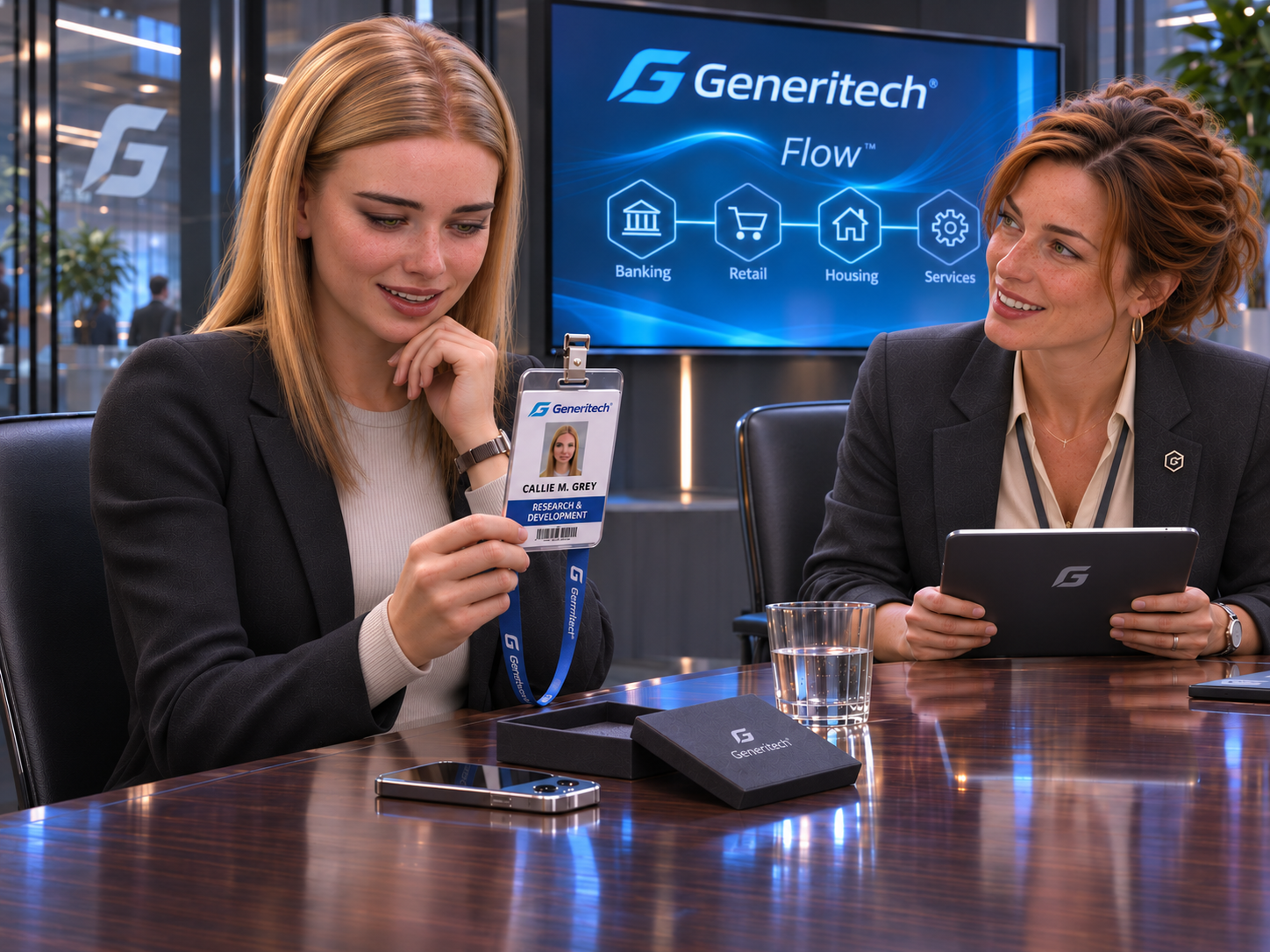
The Generitech logo appeared on the wall display, followed by a familiar blue-and-white emblem Callie recognized immediately. Beneath it was the word Flow, accompanied by a series of connected symbols representing banking, retail, housing, and other financial services. She’d used the platform for years, although after everything Denise had explained about the Civic Regions, she suspected there were features she’d never had a reason to explore.
“Now, all of those businesses and services we discussed need a way to conduct financial transactions,” Denise said. “That’s where Flow comes in.”
“Oh, I know Flow.”
“Excellent. That should make this part easier. How familiar are you with it?”
“I’ve been using it for years. I have a GeneriBank and Trust account, and I’ve had Flow connected to it for quite a while.”
“Perfect.” Denise made a small notation on her tablet. “Then you already understand the basics.”
“Yeah. I use it for shopping, transfers, bills, that kind of thing. I actually started using GeneriBank while I was in college.”
“Then you’re ahead of where many new employees begin.” Denise touched the display, bringing up a simplified illustration of the financial platform. “There are a few differences in how it’s used inside a Civic Region, so I’ll go over those briefly.”
Callie nodded and took another drink of water. The presentation looked familiar enough, although the number of services connected to the central Flow platform was considerably greater than what she’d normally seen displayed in the application on her phone.
“As you’re probably aware, Flow isn’t simply an application for sending money. It’s Generitech’s financial transaction platform. It handles payment processing, digital wallets, identity verification, merchant services, and other financial interactions through a unified system.”
“Right.”
“Outside our Civic Regions, people can use Flow alongside whatever other financial services they prefer. Within a Civic Region, the businesses and services we operate conduct their transactions through Flow. It’s the standard financial infrastructure for the entire region.”
“So every store, restaurant, and service is using it?”
“Yes. When you make a purchase at one of our stores, pay for a service, or complete another financial transaction, it’s processed through Flow.”
Callie nodded. She’d already noticed that many of the businesses she’d visited didn’t have the assortment of payment terminals she’d become accustomed to elsewhere. Her purchases had been completed almost immediately, with confirmations appearing on her phone before she’d even finished gathering her things. The coffee she’d purchased earlier had been no different, although she’d been too busy talking to Denise to give the transaction much thought.
“That explains why checking out is so fast,” she said.
“Exactly. Flow processes transactions through its own network, so it isn’t dependent on the same collection of outside payment processors and settlement systems that traditional transactions often use. Authorization and transfer happen in real time.”
“And because the businesses are integrated into the same system, they don’t have to maintain separate arrangements with different payment providers.”
“Correct.”
Callie looked at the illustration. That was another layer of the system she’d been trying to understand since arriving. Generitech wasn’t merely operating stores and housing inside the Civic Region. It also controlled the infrastructure through which payments were processed, reducing the number of external systems needed to keep the economy functioning.
“And your identity is already connected to your account,” Denise continued. “Flow can verify transactions through compatible devices and whatever authentication methods are appropriate for the situation. In many cases, you don’t even need to open the application because the service you’re using already supports it.”
“That’s how I usually use it.”
“Most people do once they’re accustomed to it. Your account remains yours, and you’ll continue to manage your spending, transfers, and other financial activity through it.”
Callie glanced at the different services shown on the screen. “What about payroll? Is that handled through Flow too?”
“Yes. Generitech pays employees directly through Flow, and the funds are available through their associated accounts. Your payroll information will be connected to your verified financial profile.”
“So my paycheck would go into Flow, and I can still use my GeneriBank account the way I normally do?”
“Exactly. Flow handles the transaction and account integration, while GeneriBank and Trust provides your banking services. They’re closely connected, but they’re not quite the same thing.”
“Okay, that’s what I thought.”
Denise returned to her tablet. “Since you already have an account, we shouldn’t need to establish a new one. Let me just confirm that your existing profile is linked to your employee information.”
She entered Callie’s name and selected a record. Callie watched the wall display change to a neutral confirmation screen while Denise reviewed information on her tablet. A moment later, a request appeared on Callie’s phone asking her to authorize the connection between her existing Flow profile and her new Generitech employment record.
“Oh, there it is,” Callie said, picking up the phone.
“Go ahead and confirm that it’s you.”
Callie reviewed the request and authorized it. The confirmation disappeared, replaced by a brief notice that her identity had been verified. Denise checked the result on her tablet.
“Perfect. Your account is linked. That takes care of the payroll setup.”
“That’s it?”
“That’s it.”
“I was expecting at least three forms asking me to enter the same routing number.”
Denise laughed. “We try to avoid that.”
“Well, I approve.”
“I’ll be sure to include that in your employee satisfaction report.”
Callie smiled and set her phone back on the table. She’d spent enough years managing university accounts, financial aid deposits, childcare payments, and ordinary banking paperwork to appreciate how much easier it was when different systems actually communicated with one another. There had been times during college when she’d needed to wait several business days for a transfer to clear, even though the money was already sitting in one account and needed to be in another. The ability to move funds immediately had been one of the reasons she’d adopted Flow in the first place.
Denise brought up the next part of the presentation. “Your existing Flow account will also work for the services associated with your housing and other regional expenses. You’ll be able to review those transactions through the same system rather than maintaining separate payment arrangements for every service.”
“That’ll be nice. I’ve been keeping track of everything manually for so long that I still have spreadsheets for half my bills.”
“You can certainly keep using them if you prefer.”
“Oh, I will.” Callie smiled. “I don’t think I’m physically capable of managing money without a spreadsheet somewhere.”
“Well, the transaction history should make keeping it updated easier.”
“That’s all I ask.”
Denise spent another few minutes reviewing the general payment and account-management procedures. Most were already familiar to Callie, although she learned a few things about how Flow interacted with regional services. The system could handle automatic payments and subscriptions, keep track of financial activity across supported services, and complete transactions without requiring residents to repeatedly enter their personal information. Callie appreciated that she could still review and control her own transactions rather than having the system make every decision for her.
She also found herself thinking about the implications of having virtually every economic transaction inside Gracewood processed through the same platform. From an engineering perspective, it was an impressive example of integrated system design. From a financial perspective, it meant the company could eliminate a remarkable amount of the administrative overhead associated with maintaining numerous independent payment systems.
“So even the smaller businesses use Flow?” Callie asked. “Like individual shops or food stands?”
“Yes. Businesses operating within the region use the same financial infrastructure. The customer experience can differ depending on the service, but the underlying processing is consistent.”
Callie nodded. “Makes sense. No reason to make everyone reinvent the payment system.”
“Exactly.”
“Do you handle the Little Cities through Flow too?”
Denise smiled. “We do, although their economic systems have some important differences. Little-scale environments use Generitech Credits, which are managed through Flow. Their accounts, wages, purchases, and other transactions operate within that system.”
“So the platform works across both environments, but they’re not necessarily using the same currency.”
“Correct. The Little-scale economy has its own requirements. Your ordinary salary and purchases here in Gracewood will remain in dollars.”
“Good. I wasn’t looking forward to explaining to my accountant why my paycheck suddenly came in Little Credits or Generibucks or whatever you call them.”
Denise laughed. “No, you don’t need to worry about that.”
Callie looked back toward the display. She’d studied the technical challenges of developing equipment for Littles throughout her graduate research, but she’d spent considerably less time thinking about how entire Little communities managed their daily finances. It was another reminder that the company she was joining approached Smallara on a scale far beyond the individual medical devices and assistive systems that had occupied most of her work at Pacifica Polytechnic.
Her research had always required her to consider the person who would eventually use the technology. A device could function perfectly during laboratory testing and still be frustrating, uncomfortable, or impractical in everyday life. She’d encountered that problem repeatedly while developing her master’s project, particularly when trying to design interfaces that provided useful information without requiring constant attention from the person using them. Generitech had taken that same general philosophy and applied it to entire communities.
The more she learned about the company’s approach, the more interested she became in seeing how those ideas were applied inside her new department.
Denise closed the Flow presentation and returned to Callie’s employee file. “All right. Your financial information is complete, your confidentiality agreements are signed, and your housing and benefits are active. That takes care of most of the required administrative work.”
“That was surprisingly painless.”
“We like to think so.” Denise set the tablet down and leaned back slightly in her chair. “There is one other thing I like to discuss with new employees, particularly people joining us directly out of university.”
“Sure.”
“Have you given much thought to where you’d like your career to go after your first few years?”
Callie considered the question. She’d spent so much of the last several months concentrating on finishing her master’s degree, securing the position at Generitech, and moving herself and Juna across the country that she’d barely allowed herself to think beyond getting established in her new job.
“Honestly, not much past the immediate future,” she admitted. “I want to get settled into Research and Development, learn how everything works, and hopefully start contributing to something useful. I’ve got some ideas about the kinds of projects I’d like to work on eventually, but I know I have a lot to learn first.”
“That’s a good place to start.”
“I mean, I’ve done research before, obviously. But I also know that working in a university laboratory isn’t the same thing as working here.”
“No, it isn’t. You’ll find quite a few differences.” Denise glanced at her employee record. “One thing I want you to understand is that Generitech approaches employment a little differently from many other organizations. We invest heavily in our people, and we generally expect them to build long-term careers with us.”
Callie nodded. She’d certainly gotten that impression during recruitment. The salary and benefits alone were considerably more generous than most of the opportunities she’d considered, and the relocation package had made an otherwise intimidating move surprisingly manageable.
“We hire people because we believe they can contribute to the organization,” Denise continued. “But that doesn’t mean we expect someone to remain in the same position for their entire career. One of the advantages of being part of Generitech is the number of opportunities available within the organization itself.”
“Like transferring between departments?”
“Exactly. Or between subsidiaries. Someone might begin in one division, develop new skills, and eventually move into an entirely different area of the company. Those moves don’t mean they’re starting over as a new employee. Their accumulated service and contributions remain recognized within the organization.”
Callie looked interested. “So if I spent ten years in biomedical research and eventually decided I wanted to move into another engineering field, I wouldn’t necessarily have to leave Generitech to do it.”
“That’s right. Obviously, you’d need the appropriate qualifications for whatever position you wanted, but internal mobility is something we encourage. We want employees to continue developing rather than feel they’ve reached the end of their opportunities.”
“That’s actually pretty appealing.”
“It tends to be.” Denise smiled. “Many of our employees spend their entire careers within the Generitech organization. They may have several different positions, work in different regions, or move between subsidiaries, but they remain with the company.”
Callie thought about that. Most of her professors had talked about career development in terms of moving between employers, building experience, pursuing better opportunities, and negotiating higher salaries. She’d expected that to be part of her own professional life eventually. The idea of spending decades within one company would have sounded limiting if she hadn’t just spent the morning learning how extensive Generitech’s operations were.
“That’s a pretty different approach from what I’m used to hearing,” she said.
“It is. People can leave, of course. We’re not suggesting that accepting a position means you’re obligated to remain here forever. But our goal is to make Generitech a place where people want to stay.”
“And you’ve got enough different industries that somebody could change careers without really leaving the company.”
“Precisely. There’s an enormous amount of opportunity here, especially for someone with your background.”
Callie looked down at the Generitech logo displayed beside her name on the tabletop. She’d worked toward becoming an engineer for as long as she could remember. The first time she’d taken apart an electronic device to see how it worked, she’d been more interested in the arrangement of components than the fact that she’d probably voided whatever warranty it still possessed. In high school, she’d spent evenings experimenting with sensors and small mechanical projects when she should have been studying for other classes. Later, she’d learned to approach those interests with the discipline required to turn an idea into something that could actually be used.
It had taken years to reach the point where somebody was willing to pay her to do that work professionally. She wasn’t particularly interested in becoming an administrator or moving away from engineering simply because she gained enough experience to qualify for a management position. But having the option to pursue different technical fields without abandoning the organization she’d joined was appealing.
“I think I’d like to stay pretty close to the technical side of things,” she said. “At least for now. I enjoy the actual engineering. Designing something, testing it, figuring out why it doesn’t work, and then spending an unreasonable amount of time trying to make it work.”
Denise smiled. “I think you’ll fit in very well with your department.”
“I hope so.”
“Dr. Shah spoke very highly of your interview, from what I understand.”
Callie felt herself smile. “Really?”
“Really. Your recruitment record includes some very positive comments about your research and the way you approached the technical questions. I don’t have all the details, of course, but it sounds like your team is looking forward to having you.”
“That’s good to hear.” Callie remembered the interview, particularly the questions that had forced her to reconsider parts of her own design. She’d left the meeting worried she’d spent too much time explaining what she didn’t know, only to receive an offer that exceeded nearly everything she’d hoped for. “I really enjoyed talking with them. They asked some pretty difficult questions, but I liked that they actually understood what I was trying to do.”
“That’s generally a good sign.”
“Yeah. I’m just hoping I can keep up once I actually start.”
“I’m sure there’ll be plenty of things you don’t know yet,” Denise said. “That’s normal. You’re joining a team with people who have considerably more experience in Generitech’s systems and research procedures. You’re not expected to arrive knowing everything.”
“Good, because I definitely don’t.”
“What we do expect is that you’ll work hard, ask questions, and take your responsibilities seriously. We put considerable resources into our employees, but that comes with expectations. Especially in Research and Development, where the work can involve technology that isn’t available anywhere outside our facilities.”
Callie nodded. After the confidentiality agreements she’d signed earlier, she had a better understanding of why the company placed so much emphasis on trust. Some of the equipment she’d be working with might be far beyond anything she’d encountered during her education. Generitech would be giving her access to research and technology developed through investments she could barely begin to imagine.
“I can understand that,” she said. “I’ve always taken my research seriously. I wouldn’t have made it this far if I didn’t.”
“I’m glad to hear it.” Denise checked the time on her tablet. “And the other side of that arrangement is that Generitech takes its responsibilities to employees seriously. We want people focused on doing their jobs and enjoying their lives, not constantly worrying about whether they can afford groceries or how they’re going to pay a medical bill.”
Callie smiled slightly. “That’s certainly a change from graduate school.”
“I imagine it is.”
“There were a few years where I felt like half my education involved figuring out how to stretch money until the next paycheck.” Callie thought about the various expenses she’d managed while raising Juna through college. Her parents had helped, and she’d never been without people willing to lend a hand, but she’d spent enough nights calculating expenses to appreciate the difference between having support and having genuine financial security. “I’m looking forward to not having to do that every month.”
“And that’s exactly the kind of difference we want our employees to experience. It doesn’t mean everyone can buy anything they want, of course. People still need to manage their finances and make sensible decisions. But ordinary living expenses shouldn’t be a constant source of anxiety for someone who’s working hard and contributing to the organization.”
Callie nodded. She’d already spent time reviewing her new salary against the cost of her housing, transportation, and Juna’s expenses. The numbers still seemed slightly unreal whenever she looked at them. Even after accounting for the expenses she expected to have, she’d be able to save money without wondering whether she’d need it for something else before the end of the month.
“I can definitely appreciate that.”
Denise smiled and reached for her tablet again. “Well, I think that covers everything I wanted to discuss. Do you have any other questions before we finish?”
Callie looked toward the world map still displayed in a smaller window on the wall. She had plenty of questions, but most of them were about the engineering rather than the administrative arrangements of her employment. She wanted to know how the GraceLink network handled routing, what Generitech used for water reclamation, and how the city’s various systems maintained service without the kinds of interruptions she was accustomed to seeing elsewhere. She suspected Denise could answer some of those questions, but she also recognized that the woman had probably scheduled a reasonable amount of time for employee orientation and hadn’t planned on spending the entire morning discussing infrastructure with an overly curious engineer.
“Probably about a hundred,” Callie admitted. “But I think most of them are going to be questions for somebody in engineering.”
“That doesn’t surprise me.”
“Actually, there is one thing. If I want to learn more about how the Civic Regions operate, is there somewhere I can look? Beyond the general information that’s available publicly?”
“Absolutely. You’ll have access to employee resources covering the regional services, organizational structure, and the information relevant to your position. There are also public resources that go into more detail about the history and development of the Civic Regions.”
“Perfect. I’ll probably end up reading through those.”
“I had a feeling you might.” Denise selected another option on her tablet. “I’ll include the appropriate information with your orientation materials.”
“Thanks. I appreciate it.”
“You’re welcome.” Denise looked over Callie’s completed file one final time before setting the tablet aside. “All right. Everything is in order. That means we can get your employee credentials finalized and send you on to Research and Development.”
Callie straightened slightly in her chair. After the lengthy discussion of regional governance and financial systems, hearing that she was about to begin the actual work portion of her day brought back some of the nervous excitement she’d felt walking into headquarters.
Denise reached into a small drawer built into the table and retrieved a white identification badge attached to a simple holder. She checked the information printed on its surface before sliding it across to Callie.
“There you go. Your official Generitech employee badge.”
Callie picked it up. The company’s blue G logo occupied the upper portion, with her photograph positioned beside the identifying information. Beneath it, her name appeared in clear lettering.
CALLIE M. GREY
RESEARCH & DEVELOPMENT
A barcode occupied the lower portion of the badge. The entire thing looked straightforward enough, although the quality of the printing and material was noticeably better than the university identification cards she’d carried for years.
She turned it over, examining the reverse side.
“Feels weird seeing that,” she admitted.
“Your name?”
“My name with Research and Development underneath it.” Callie smiled as she looked at the front again. “I’ve spent so long working toward this that it almost doesn’t seem real.”
Denise returned her smile. “Well, it’s real now. You’ve earned it.”
Callie ran her thumb lightly along the edge of the badge. She remembered being fourteen and sitting at her desk in Ridgemont, surrounded by wires and electronic components, trying to make a homemade mechanism do something that sounded much simpler than it turned out to be. She remembered Mr. Steverson pushing her to think seriously about engineering, insisting she was capable of more than she sometimes allowed herself to believe. There had been university applications, difficult classes, late-night assignments, research deadlines, and years of balancing her education with the responsibilities of raising Juna.
She’d never known exactly where all of it would lead. There had been too many practical problems to solve along the way for her to spend much time imagining a particular office or employer. But she’d kept moving toward the same goal, adjusting her plans whenever something changed without allowing herself to forget why she’d started.
Now she was sitting inside the headquarters of the largest corporation in the world, holding an identification badge that said she belonged to its Research and Development division.
“Yeah,” she said quietly, smiling. “I guess I did.”
Denise gave her a moment before continuing. “Your badge will identify you as an employee and provide the access appropriate to your position. Your department will go over any additional authorizations you need for particular laboratories or research facilities. Some areas require specific permissions regardless of your employment status.”
“Right. That makes sense.”
“And don’t be surprised if you spend a little time getting familiar with the systems before they put you to work on anything complicated.”
“Honestly, I’d be more worried if they handed me a project on day one and told me to figure everything out myself.”
“That would make for an interesting first day.”
“Not necessarily a good one.”
Denise laughed and stood, collecting her tablet from the table. Callie rose as well, slipping the badge into its holder and fastening it where it would be visible. She picked up her purse and checked that she hadn’t left her phone beside the water glass.
“Ready?” Denise asked.
“As I’ll ever be.”
They left the conference room together, returning to the broad hallway Callie had followed earlier. The building was busier now, with employees moving between corridors and groups of people talking as they walked. Callie noticed the Little Roadway running along the wall, its smaller pedestrian section separated from the lane used by service vehicles. A Little driving a compact utility cart passed in the opposite direction, carrying several containers secured behind the driver’s seat. Farther along, two Little employees walked together near the wall, talking as they made their way toward another part of the building.
Denise noticed where Callie was looking. “You’re going to find plenty of opportunities to see how our Little-scale systems work once you get into Research and Development.”
“I’m sure.” Callie smiled. “It’s going to take some getting used to.”
“It does. Although I imagine somebody with your background will adjust pretty quickly.”
“I hope so.”
They approached an intersection where several hallways met. Denise slowed slightly, giving Callie time to look around before indicating the corridor to their left.
“This way. Your department is farther into the headquarters complex.”
Callie followed her, glancing down at the badge resting against her shirt. She was still trying to remember the route they’d taken through the building, although she’d already accepted that she was probably going to get lost at least once before the end of the week. The headquarters was enormous, and she’d seen only a small portion of it since arriving.
“One last question,” she said.
Denise looked over with an amused expression. “Of course.”
“How long did it take you to stop getting lost in here?”
“Oh, I still get turned around occasionally. I’ve worked for Generitech for fourteen years, and there are parts of this complex I’ve never had a reason to visit.”
“Fourteen years?”
“Yes. I started in employee services and moved into my current position several years ago.”
Callie smiled. “So you weren’t kidding about people staying with the company.”
“Not at all. I’ve had several different positions, and I still enjoy coming to work. I don’t have much reason to look elsewhere.”
“That’s good to hear.”
“It is. And you’ll find that most people here are quite happy to help if you’re trying to find somewhere. Just don’t be afraid to ask.”
“I’ll remember that.”
They continued down the hallway, passing another set of doors before reaching a larger junction where the architecture opened into a spacious interior area. Callie could see additional corridors extending toward other sections of the building, along with employees moving between them. Somewhere ahead lay the laboratories, engineers, and research teams she’d spent the last several months imagining whenever she looked at her Generitech offer letter.
The badge shifted slightly against her shirt as she walked, and she adjusted it before looking toward the corridor Denise had indicated. She’d arrived that morning expecting to complete paperwork, receive her credentials, and find out where she was supposed to go. Instead, she’d learned more about the organization she’d joined than she had during months of recruitment and relocation arrangements. There was still an enormous amount she didn’t understand, and she doubted a single week would be enough to answer even half her questions.
But for the first time since accepting the offer, the job was no longer something waiting for her on the other side of graduation and a cross-country move. She had completed the paperwork, received her badge, and was finally on her way to meet the people she’d be working with.
Callie followed Denise through the next set of doors, eager to see what Research and Development had waiting for her.


I’m loving learning about Genritech, their different divisions in the company, and how they work besides the obvious.
Not to spoil things but tomorrow starts a interesting look at another area that people I think are interested
1) “I was expecting at least three forms asking me to enter the same routing number.” – “We try to avoid that.” Oh, thank goodness; that is so annoying
2) ““Do you handle the Little Cities through Flow too?” – “We do, although their economic systems have some important differences. Little-scale environments use Generitech Credits, which are managed through Flow. Their accounts, wages, purchases, and other transactions operate within that system.” Still a bit shitty how they don’t pay Littles in actual money.
3) “Little Credits or Generibucks or whatever you call them.” Genribucks, lol
4) “And that’s exactly the kind of difference we want our employees to experience. It doesn’t mean everyone can buy anything they want, of course. People still need to manage their finances and make sensible decisions. But ordinary living expenses shouldn’t be a constant source of anxiety for someone who’s working hard and contributing to the organization.” That’s the point of a living wage right there.
5) “Feels weird seeing that,” – “Your name?” – “My name with Research and Development underneath it.” Literally the first thing I saw about you, it feels weird that it took 44 chapters to get here.
6) ““And don’t be surprised if you spend a little time getting familiar with the systems before they put you to work on anything complicated.” – “Honestly, I’d be more worried if they handed me a project on day one and told me to figure everything out myself.” Nah, throw her into the deep end, she can handle it.
7) “So you weren’t kidding about people staying with the company.” – “Not at all. I’ve had several different positions, and I still enjoy coming to work. I don’t have much reason to look elsewhere.” Just another way Genritech wants to control loyalty.