
Chapter 45
June 2027
Callie was beginning to understand why Denise had admitted she still occasionally got lost inside Generitech headquarters. They had been walking for several minutes since leaving employee services, and every time Callie thought she had a reasonable idea of how the building was arranged, the corridor opened into another enormous space or turned toward an intersection she hadn’t known was there. Broad passageways connected glass-fronted offices, lounges, landscaped seating areas, and entrances to departments she recognized only from their signs. Employees moved in both directions without much apparent interest in the architecture around them. Some carried coffee, others talked with colleagues, and one man was trying to finish a conversation through an earpiece while balancing a laptop against his side. Callie found that oddly reassuring. She had walked into headquarters expecting something extraordinary, and it was extraordinary, but people still came to work with their coffee and their half-finished conversations.
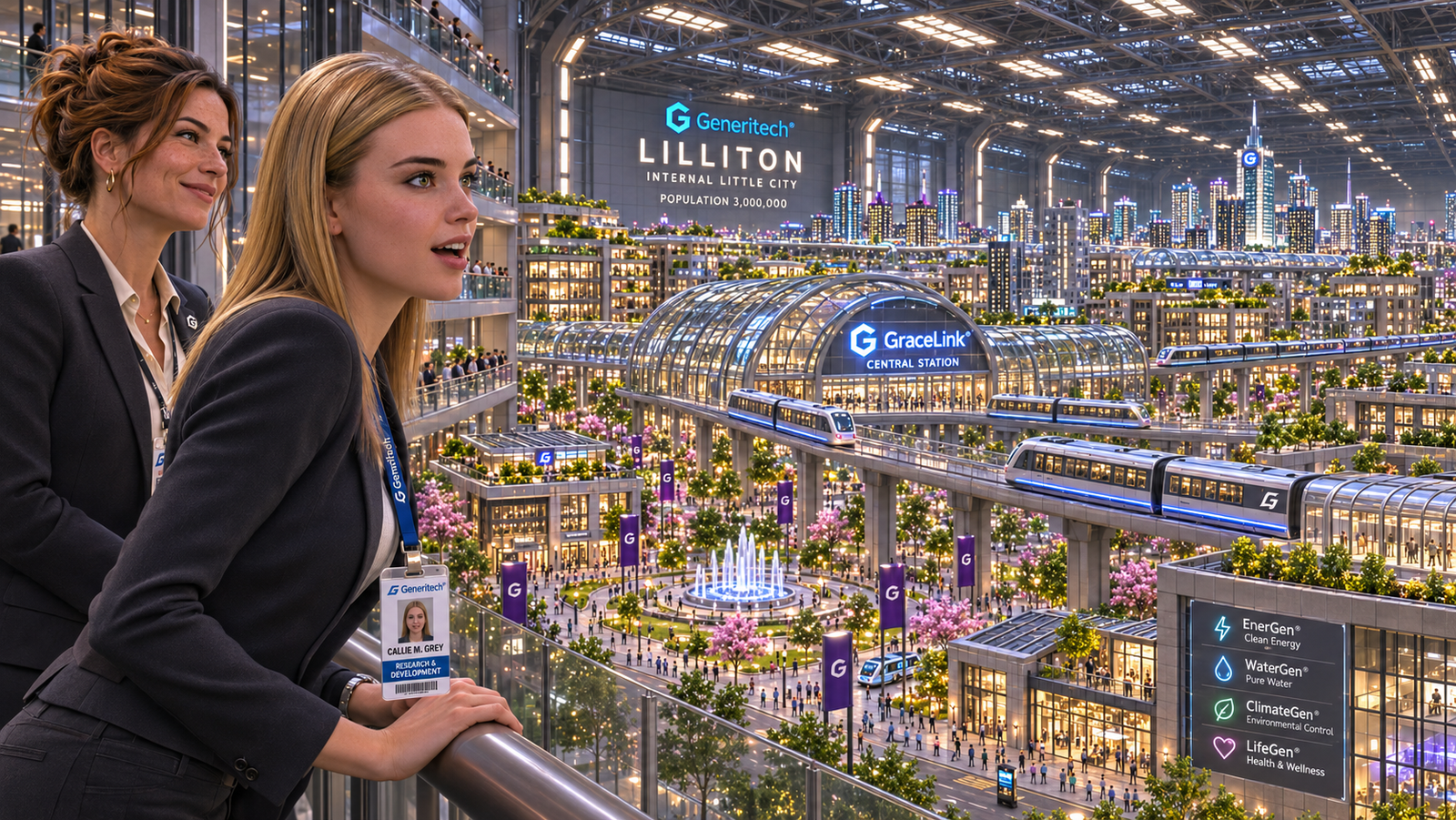
She glanced down at the white badge hanging against her shirt. CALLIE M. GREY appeared beneath the blue Generitech logo, followed by RESEARCH & DEVELOPMENT in smaller letters. She had already checked the spelling twice, although there was no reason to think employee services had somehow gotten her name wrong. The badge had been issued less than an hour ago, and she was discovering that she liked having an excuse to look at it. It made the offer letter, the move from California, and the exhausting business of getting herself and Juna settled in Gracewood feel a little more real. At some point today, she would reach the department that had hired her and begin learning what she was supposed to do there. For now, Denise was explaining the route as though Callie might be expected to retrace it without assistance tomorrow morning.
“So Research and Development occupies this entire section?” Callie asked as they passed another directory.
“Several sections,” Denise said. “Different groups have different requirements. Some need offices, some need big testing spaces, some need laboratories with their own environmental controls. We’ve also got research facilities elsewhere in Gracewood. You aren’t going to work in every one of them.”
“That’s a relief. I think I’ve forgotten half the turns we’ve made already.”
“Most people do on their first day. You’ll learn the routes you use, and the directories will do the rest.” Denise glanced back with a smile. “I’ve been here fourteen years. There are still places I’d have to look up.”
Along the wall to their right, the Little Roadway ran parallel to the pedestrian corridor. Callie had noticed the marked lanes almost as soon as she’d entered headquarters that morning. A strip of floor about a foot out from the wall separated the Little route from the area used by full-sized employees, and within that protected strip, pedestrian and vehicle lanes operated independently. The roads had their own signs, intersections, and signals. They weren’t decorative lines on the floor, either. Callie had passed Littles walking to work, small utility vehicles carrying equipment, and a floor scrubber with a Little operator who had cheerfully given her directions to the service desk earlier. The first few encounters had stopped her in her tracks. Now she was getting used to the movement below her peripheral vision, checking her position when people passed rather than staring every time she saw one.
At the next junction, the Little Roadway began to change. The vehicle lanes widened into multiple approaches, and new roads emerged from protected openings in the wall. A pedestrian route rose gently onto a separated walkway above one intersection, while a commercial lane diverted toward a cluster of receiving doors. There were more vehicles here than anywhere else she’d seen in the building. Two cars paused at a light as a boxy little delivery truck turned across the intersection. A bus approached a covered stop, and a line of pedestrians moved along the walkway behind it. Beyond the stop, several secured portals led into the wall, each serving a different stream of traffic.
Callie slowed, then came to a stop beside the barrier. What had looked from a distance like a complicated loading area resolved into an actual transportation interchange. The signs were larger than the ones along the ordinary Little Roadway, and a broad overhead display identified the destination in letters she could read without leaning forward.
LILLITON
She looked from the sign to the streams of vehicles entering and leaving the portals. One of the cars accelerated through an open lane and disappeared beneath the wall, while another emerged in the opposite direction. A Little pedestrian waited at a signal and crossed only after the roadway lights changed. Callie had read about Lilliton during graduate school, and it had appeared in Generitech’s material when she began preparing for her interview. She knew the company maintained entire Little Cities, and she knew its headquarters contained one of the most significant. Somehow that information had remained abstract enough that she hadn’t considered the possibility of walking past its entrance on the way to her new job.
“Wait. Is that Lilliton?”
Denise, who had continued a few steps, turned around. “Sure is. One of the main entrances.”
“The Little City?”
“That’s the one.”
Callie watched a small commercial vehicle pass into a separate receiving route. The roadway disappeared from sight after only a few feet, but it plainly continued somewhere substantial beyond the wall. She tried to picture the buildings and streets on the other side, then looked toward the signs directing vehicles to residential and commercial districts. The names told her considerably less than she’d hoped. “Can we see it?”
Denise glanced at the direction they’d been heading. “I thought we were going to Research and Development.”
“We are.” Callie gave her a hopeful look. “But we’re right here.”
“You sound exactly like somebody who doesn’t have to keep an onboarding schedule.” Denise pulled out her phone, though she was already smiling. “There is an observation gallery around the corner. Let me check what kind of time we’ve got.”
Callie stayed near the barrier while Denise opened the schedule. A bus pulled away from the stop below them, its passengers visible through the windows as tiny shapes seated behind the glass. She caught herself wanting to crouch for a better view and decided against it. There was probably a reasonable limit to how much of her first day she ought to spend kneeling beside a road. Denise tapped out a message and waited for a reply, then read the notification that appeared a moment later.
“All right,” she said. “Your department contact knows we’re making a stop. We have some flexibility before the handoff, as long as I don’t lose you in there.”
“You won’t.”
“That’s what they all say.”
Denise led her away from the main corridor and into a quieter passage that curved along the outside of the interchange. Windows in the wall revealed a protected service area where Little vehicles continued through a series of checkpoints. From here, Callie could see the different traffic routes more clearly. Commercial deliveries had their own access, and the pedestrian approach remained separated from the bus and vehicle lanes all the way to its entrance. Nothing about the layout suggested that the city had been added as an afterthought. Its transportation routes were integrated into the structure of headquarters, with the same deliberate organization she had noticed in Gracewood’s streets and stations.
“Do most Littles who work in headquarters come from Lilliton?” she asked.
“A lot of them do. Not all. Some departments have separate accommodations, and some people are coming from other facilities.” Denise gestured toward the traffic beyond the glass. “You’ll see people traveling in both directions all day. This is one of the busier connections.”
“I can tell.” Callie looked at the little bus disappearing through a portal. “I didn’t realize the road network was this extensive.”
“Most people don’t until they start paying attention to it.”
The passage ended at a small reception area with glass doors and a desk positioned beside a wall of informational displays. Beyond the doors, a broad gallery curved out of sight. A sign identified it as an authorized observation area, and Callie noticed several reminders about remaining behind the protective barriers and respecting the privacy of residential spaces. Denise presented her badge at a reader. The screen acknowledged her credentials but prompted her to confirm an escorted guest, which she did by selecting Callie’s name from the pending access record.
Callie raised her badge slightly. “So mine doesn’t get me in here by itself?”
“Not yet, and not necessarily ever without the right authorization. Different departments have different access. Just because we both work in headquarters doesn’t mean we can stroll through whatever secured area looks interesting.”
“Fair enough.” Callie slipped the badge back against her shirt. “I’d be a little worried if it worked that way.”
The doors opened, and Denise stepped through. The gallery ahead was quieter than the corridor they’d left. Callie heard the soft movement of conditioned air and the muted footsteps of a few other visitors somewhere ahead, but the noise of the interchange had fallen away. A thick wall of glass ran along the far side of the space. Beyond it, light filled an enormous opening that Callie couldn’t immediately make sense of from the entrance. Denise continued toward the windows, then stopped when she realized Callie hadn’t followed.
Callie had reached the edge of the overlook and was staring through the glass.
Below her was a city.
The nearest buildings lay well beneath the level of the gallery, arranged in blocks around broad streets and landscaped plazas. Office towers rose beyond them, their facades reflecting a bright, natural-looking light from the enormous space overhead. Roads crossed at busy intersections, divided by medians and pedestrian crossings. Rows of apartment buildings gave way to taller commercial structures, and an elevated rail line curved between two clusters of towers before vanishing behind the downtown skyline. More buildings extended beyond those, then still more, until distance and intervening architecture concealed the streets altogether.
Callie had expected miniature houses and roads. She’d seen photographs of Little communities, including some of the residential developments Generitech had constructed in its other facilities. What stood before her was something altogether larger. The city had districts with visibly different purposes and densities. A broad boulevard connected a commercial area to a cluster of towers, while smaller streets led toward a greener neighborhood beyond it. Some rooftops carried gardens. Others contained equipment installations or screened service areas. The entire place was illuminated by a daylight system mounted so high above the city that it didn’t immediately register as a ceiling. From where she stood, the most distant buildings seemed to recede into their own urban horizon.
“Oh, wow,” she said.
Denise came up beside her. “I had a feeling you’d like this.”
Callie hardly heard her. Her attention kept catching on new details. A main avenue passed beneath the gallery, with little cars moving through an intersection near a public square. Farther away, a bus stopped beside a covered platform. A delivery vehicle turned away from traffic toward the rear of a commercial building. She spotted people on the sidewalks only after she’d begun following the vehicles, their small moving figures collecting at corners and crossing when the signals allowed. At this distance she couldn’t distinguish their faces, and most of their clothing was little more than tiny patches of color. She could, however, see that they were moving with purpose. Some walked together. Others hurried alone. A few stood in clusters outside what looked like restaurants or shops.
“That’s all Lilliton?” she asked.
“What you’re seeing is part of it. Most of this view is downtown.”
Callie turned toward her. “Part of downtown?”
“Uh-huh. There are residential districts beyond those buildings, and several other developed sections connected to this one. Some are on different structural levels. You can’t see the whole city from any single gallery.”
Callie looked back. She had already been trying to find the edges of the development, following a road until it disappeared behind a tower, then searching for where it might continue on the other side. She realized now that the distant concentration of buildings wasn’t the end of Lilliton at all. It was merely the farthest area she could see from this particular angle.
A glass fronted tower rising near the center of the downtown district caught her attention. From the elevated overlook she could see several floors below her and many more above. The building was physically tall enough to stand as a respectable structure even in the full-sized world, but every window and floor division had been proportioned for residents who measured their height in inches. She tilted her head back to follow the tower toward its roof.
“How tall is that one?”
Denise followed her pointing hand. “I don’t know the exact height of that particular building. Some of the downtown towers are over thirty feet.”
“Thirty feet.” Callie looked at the tower again. The number meant something different once she could compare it with the gallery itself. “I knew they built high rises, but that’s still a thirty foot building. Inside another building.”
“And you’re not even looking at the tallest part of headquarters,” Denise said.
“I think I need a minute to get used to that.”
She moved farther along the glass, where a change in angle opened a view down another avenue. The streets were wide and orderly, with median landscaping and distinct lanes for traffic, and the blocks were interrupted by plazas that looked generous even at the scale of the surrounding buildings. Lilliton had the same modern design sensibility she’d seen throughout Gracewood, but the geography wasn’t a copy. Its own streets and districts had been arranged around the needs of the people living here. A city could share its engineering philosophy with Gracewood without resembling it block for block.
Callie stopped near an informational map that marked the visible downtown district and showed connections to areas beyond the gallery’s view. The map used broad district labels and transit routes rather than displaying private residences. She traced one line with her eyes from a station near the center toward a tunnel at the edge of the district. Another line led in a different direction before crossing into a structural connection she couldn’t see from here. She had no trouble believing that the city extended much farther than the windows suggested. What she had trouble believing was that it all existed within the headquarters complex she’d entered that morning.
“How many people live here?” she asked.
“Around three million. That’s the approximate figure, anyway. People move in and out of the population count over time.”
Callie turned away from the map. “Three million?”
“Yes.”
She looked back through the glass. Ridgemont, where she’d grown up, had roughly a hundred thousand people. She had spent most of her childhood thinking of it as a reasonably large city, at least compared with the small farming communities surrounding it. She’d gone to school there, worked at Grey’s, driven its streets, and known whole neighborhoods by the stores and people in them. Lilliton held about thirty times that population, and she was standing in a hallway inside the building that contained it.
The mathematics of scale had never been difficult for Callie. A house proportioned for a six inch person required a fraction of the space occupied by an ordinary home, and the same principle applied to roads, shops, and public buildings. If anything, the numbers should have made the city easier to imagine. Yet looking out at actual streets, traffic, and towers, she found it much harder to think of Lilliton as a simple problem in proportions. Three million people meant millions of separate daily schedules, meals, jobs, errands, families, and places to be. A city that size had to keep functioning even when someone missed a bus, a pipe needed repair, or a grocery delivery arrived at an inconvenient time. Its small dimensions hadn’t made the logistical complexity disappear.
“That’s incredible,” she said.
“It is.” Denise rested a hand lightly against the gallery railing. “I’ve been through here plenty of times and I still notice things I hadn’t seen before.”
Callie lingered at the glass. She had imagined herself arriving at Generitech, meeting her team, and eventually learning the systems that supported its Little research facilities. She had expected to be impressed by the laboratories. It hadn’t occurred to her that she’d encounter a metropolis on the way there, or that it would leave her with so many questions before she’d even reached her department.
A small shape moved between the downtown office towers. Callie followed it until it emerged into clear view along an elevated track. It was a train, sleek and unmistakably familiar in its design, approaching a station above one of the busiest avenues. Another line crossed below it and disappeared toward the residential district. She leaned a little closer to the window as the first train slowed.
“They have their own GraceLink?” she asked.
“They certainly do.” Denise glanced at the track, then toward the continuation of the gallery. “There’s a closer view of the station farther along, if you want to see it.”
Callie turned to her. “You have to ask?”
Denise laughed and gestured toward the next section of glass. Callie followed, still watching the train as it slipped between the towers, and found herself looking forward to the rest of the visit almost as much as she’d been looking forward to her first morning in Research and Development.


Man, Lillton sounds and looks incredible. A true marvel of Generitech.
I wonder if generitech gets info on engineers and scientists that test vulnerable so they can give them an opportunity to work for them as a little and choose when they transform like in Mexico. I hope Ryan gets to enjoy Callie’s love for littles lol.